
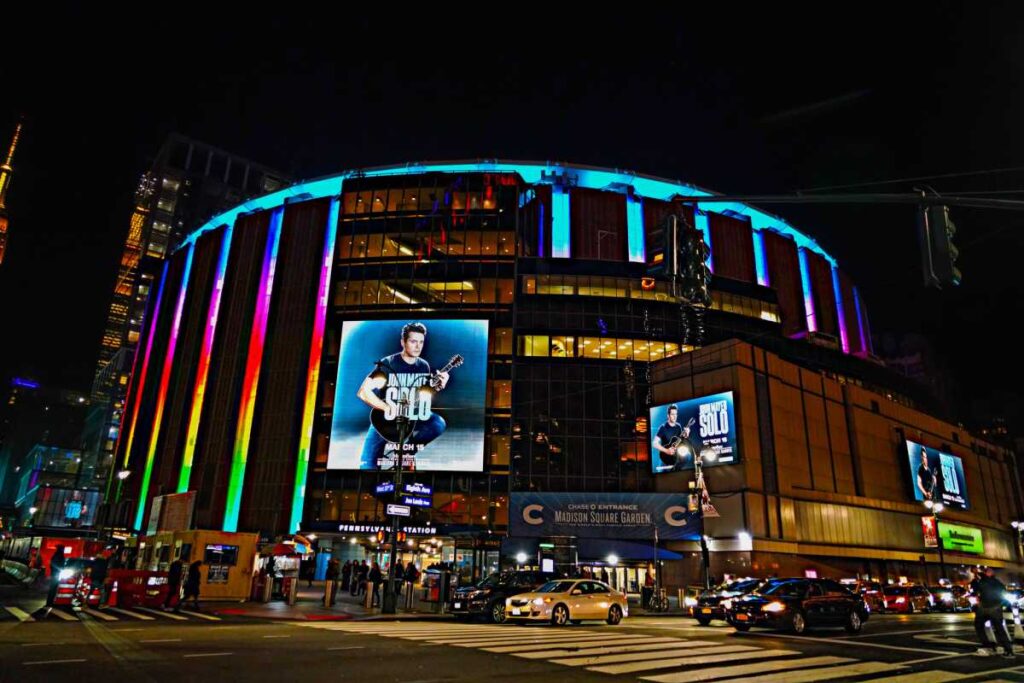
Madison Square Garden is suing the technology magazine WIRED over a report published last week that detailed how the venue tracked and categorized celebrity Knicks fans.
The story is headlined “Madison Square Garden Kept a List of Gay Celebrities,” highlighting a section that outlined how the venue categorizes some celebrities and high-profile fans in its “talent database” as LGBTQIA.
In response, MSG Entertainment filed a defamation lawsuit against WIRED on Thursday, claiming that the story was aimed at misleading readers to think that the LGBTQIA category was designed to be exclusive when its purpose was to flag these fans for LGBTQIA-related events.
“WIRED combed the dark web, obtained data stolen from MSG by an extortionist hacking group, and cherry-picked fragments of that data to manufacture a false narrative portraying MSG as targeting the LGBTQIA community for discriminatory purposes. Nothing could be further from the truth,” wrote MSG’s lawyers in the complaint.
WIRED’s story centers on how Garden assesses celebrity fans based on a “risk score.” Under this system, the venue marks celebrities with a risk if they’ve done something publicly to draw negative attention from MSG’s leadership.
The rapper Fat Joe has a medium risk score. Knicks superfan Ben Stiller is low risk, while hip-hop stars Freddie Gibbs, Lil Jon, and A Boogie Wit da Hoodie have high-risk scores, according to WIRED’s reporting.
The database emerged as part of a cache of internal MSG information that a criminal hacker group named ShinyHunters published last month. According to WIRED, the talent database also tracks some celebrities’ identity information, including sexual orientation, with 93 entries marked as “LGBTQIA.” The authors of the WIRED piece wrote that they did not know the purpose of the LGBTQIA list.
“Why MSG felt the need to label Ricky Martin or Phoebe Bridgers or Geese’s Emily Green in this way is unclear,” WIRED reported.
In its lawsuit, MSG accused the article’s authors, Noah Schachtman and Maddy Varner, of implying that the database kept sexual orientation information for “exclusionary, discriminatory, security, or risk-based purposes.”
“Defendants knew there was no nefarious ‘list’ of gay celebrities, and defendants knew that the stolen data contained dozens of fields per customer—including mundane fields such as address, phone number, and dietary restrictions—used for relationship management purposes, not discrimination,” MSG’s lawyers wrote in the court papers.
WIRED did not respond to a request for comment, but its leadership posted a statement to social media that it stands by its reporting and plans to fight “this baseless and ridiculous lawsuit.”
“We look forward to continuing our coverage of MSG, and on billionaire James Dolan’s use of technology across his entertainment empire.”
The story is part of a series of stories that WIRED has published on MSG owner James Dolan’s reliance on biometric surveillance technology in the stadium.
 Photo by Dean Moses
Besides the details on the venue’s LGBTQIA categorization, the authors cited previous reporting from WIRED that alleged MSG’s security chief John Eversole had closely used facial recognition software to track a trans woman Knicks fan who was reportedly friends with a number of Knicks players over the course of months.
The allegations came from a wrongful termination lawsuit filed by a former security staff member named Donald Ingrasselino, who claimed that Eversole had decided to monitor the transgender fan based on the belief that her presence could cause damage to MSG’s reputation.
MSG declined to comment on the allegations in the Ingrasselino lawsuit.