
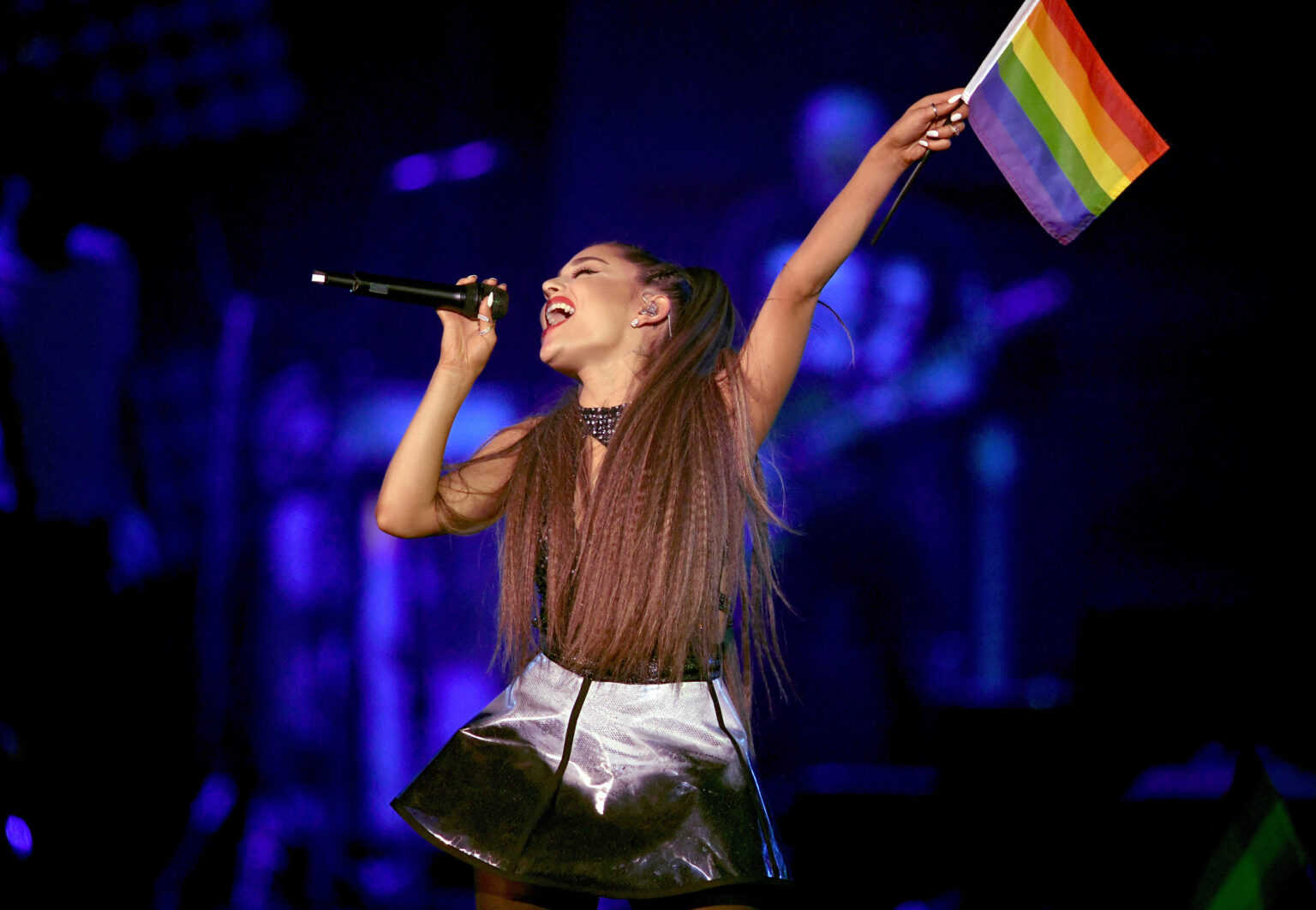
For years, pop star Ariana Grande gave away money, mostly quietly and without much structure. There were annual gifts to England’s Royal Manchester Children’s Hospital. Sometimes a night’s performance proceeds were handed to nonprofit groups. She anonymously funded a holiday gift drive for transgender young people in addition to launching a $3 million fundraising event for transgender youths in 2022.
Now those scattered acts of giving have a name and a public face: the Brighter Days Ahead Foundation. Launched in June, it will focus on causes Grande has advocated for in the past, including LGBTQ+ rights, reproductive health, immigrant rights, and mental health. Grande is doing this at a moment when philanthropic support for these causes is eroding, said Shauna Nep, Grande’s philanthropic adviser.
“We’re seeing the support for the kinds of issues she cares about going down drastically and the attacks going up aggressively,” Nep said.
Grande wants to use her platform to draw attention to these areas and give other funders the confidence to step in once they see her lead the way, Nep said. This summer, Grande is using her Eternal Sunshine Tour to fund and promote the foundation, highlighting national and local nonprofits at each tour stop. Names of her grantee organizations are shown on screens in the center of the arena during the pre-show countdown. And fans who donate to the nonprofit can enter a sweepstake for a chance to win a trip to see her final tour date in London.
“The fan experience is still completely intact,” Nep said. “We’re meeting them where they are instead of taking them away from anything.”
Tour funds will be split among the featured local organizations, though none has been distributed yet. The grants announced so far have come entirely from Grande’s personal giving, a foundation spokesperson said.
In many ways, Grande, who also starred in the Wicked movies, is following in the footsteps of earlier generations of entertainers who lent their names to politically controversial causes like HIV/AIDS and created their own foundations to help move large sums of money.
But today celebrities’ platforms are larger than ever, giving them even more sway, noted Genevieve Shaker, who teaches courses on celebrity philanthropy and fundraising leadership at Indiana University’s Lilly School of Philanthropy.
“In the past, prior to social media, celebrities might be more dependent on traditional media to share stories about what they’re doing,” she said. “Now they have their own kind of media empire where they can leverage lots of channels to communicate, including about philanthropy and causes and nonprofits.”
Beyond Vanity Projects
Trans Lifeline, which runs a crisis hotline for transgender people, is one of the groups Grande has supported. Grande first connected with the organization after the U.S. Supreme Court’s June 2025 ruling upheld Tennessee’s ban on gender-affirming care for transgender minors. Alarmed by that decision, and the resulting clinic closures, and the removal of LGBTQ-specific options from the national suicide hotline, Grande chose to support three organizations doing crisis work for people who had lost access to care including Trans Lifeline.
The group has received $125,000 total — $75,000 in emergency funding last June and $50,000 when the foundation formally launched in May. The money helped Trans Lifeline relaunch a microgrants program that distributed $100,000 directly to trans people across the country in partnership with five grassroots organizations, said Dante Alviar Horton, its executive director. Some of the funding also went toward improving benefits for the organization’s direct service crisis workers.
Trans Lifeline relies almost entirely on individual donors. Visibility gained from celebrity supporters has helped sustain the group, Alviar Horton said. He pointed to Trans Lifeline’s recent collaboration with designer Conner Ives on the “Protect the Dolls” T-shirt campaign, which raised more than $500,000 after celebrities like Pedro Pascal began wearing the shirts publicly.
“I was grateful that there were people in the celebrity sphere that cared enough to be like, ‘This matters,’” Alviar Horton said.
Still, he’d like to see more celebrities making statements of support to help shift public opinion on trans rights, given the reach of social media.
Celebrity philanthropy has often been dismissed as image management, allowing entertainers to have red carpet moments without putting much money or thought behind their advocacy efforts. Grande resisted creating a formal foundation for years for exactly that reason, Nep said.
“She does not want anyone to think that she thinks of herself as a philanthropist,” Nep said. “She knows she’s an artist.”
However, Nep, who has worked with the singer since 2018, encouraged Grande to formalize her giving so she could strategically move money to nonprofit groups and more easily collaborate with funding partners. In May, Nep helped the Wicked star launch Brighter Days Ahead.
Grande’s organization is a fiscally sponsored project of the Entertainment Industry Foundation, a public charity established in 1942 to support Hollywood’s philanthropic efforts. It allows celebrities, including Charlize Theron and Olivia Rodrigo, to easily create nonprofits to raise and distribute funds.
The largest of her foundation’s four funds is “Protect and Defend,” which supports organizations doing legal and legislative work for transgender youths, immigrants, and reproductive rights. The foundation is the largest funder for several of the grassroots organizations it supports and typically provides unrestricted grants. These groups typically get little support from institutional and government funders. Transgender-focused organizations, specifically, have seen funding dwindle as needs increase, Nep noted.
Meeting the Moment
Grande has been a longtime advocate for causes at the center of her philanthropy. In 2019, she donated roughly $250,000 in concert proceeds to Planned Parenthood after several states passed abortion restrictions. She has publicly discussed her struggles with post-traumatic stress disorder, anxiety, and depression, expressed appreciation for her gay and transgender fans, and has spoken out against the Trump administration’s immigration policies.
Grande’s activism and personal connection to these issues echo an earlier era when celebrities led the charge on funding for AIDS and HIV, Shaker said. Elizabeth Taylor co-founded the American Foundation for AIDS Research, or amfAR, in 1985 after watching friends suffer from HIV/AIDS and its stigma. For similar reasons, singer Elton John founded the Elton John AIDS Foundation in 1992, the same year he first publicly identified himself as gay.
The political climate facing transgender people today rivals what HIV/AIDS advocates confronted decades ago, said Anne Aslett, CEO of the Elton John AIDS Foundation.
Back in the 1980s and ‘90s, John was watching close friends like singer Freddie Mercury succumb to AIDS-related illnesses, she said.
It was “really, really tough” to raise money for HIV/AIDS work among the broader public, including within the entertainment industry, she said. Because of his global stardom, John was able to humanize the cause for people, even those who didn’t share his views on politics or sexuality, Aslett said.
John created the foundation to help provide dignified palliative care. From the outset, the foundation was shaped by his authentic interest in supporting AIDS research and his insistence on listening to people with lived experience of the epidemic, Aslett said. That is what has helped sustain the organization for more than three decades, she said. But that personal interest and connection aren’t enough to really drive philanthropic success.
“Artists are hard-wired to pay attention to human emotion,” Aslett said. “They’re very empathetic. But that alone isn’t enough. They have to have a good structure underneath to make it work.”
Risks for Nonprofits
Nonprofits affiliated with celebrities, especially those focused on underfunded causes like transgender rights, must consider the risk of becoming dependent on a single celebrity funder, Shaker said. Having a famous supporter doesn’t eliminate the need for a diversified funding base, Shaker said.
And unpredictable waves of interest can be hard to manage, Alviar Horton said. The viral “Protect the Dolls” T-shirt campaign was welcome but difficult to plan around once public attention moved on, he said. Multiyear pledges matter more to organizations trying to plan strategically, he said.
Brighter Days Ahead has hosted events in Los Angeles and New York meant to give back to grantees rather than raise money. Trans Lifeline took part in a Los Angeles event in which volunteers packed hygiene kits for homeless LGBTQ+ youth with the L.A. LGBT Center. In New York, at the Stonewall National Monument visitor center, volunteers packed 200 backpacks of school supplies for trans youths, which were distributed by three nonprofits. More activities are planned, the foundation said.
Added Alviar Horton: “I would really encourage that type of engagement rather than that once-in-a-blue-moon energy.”