
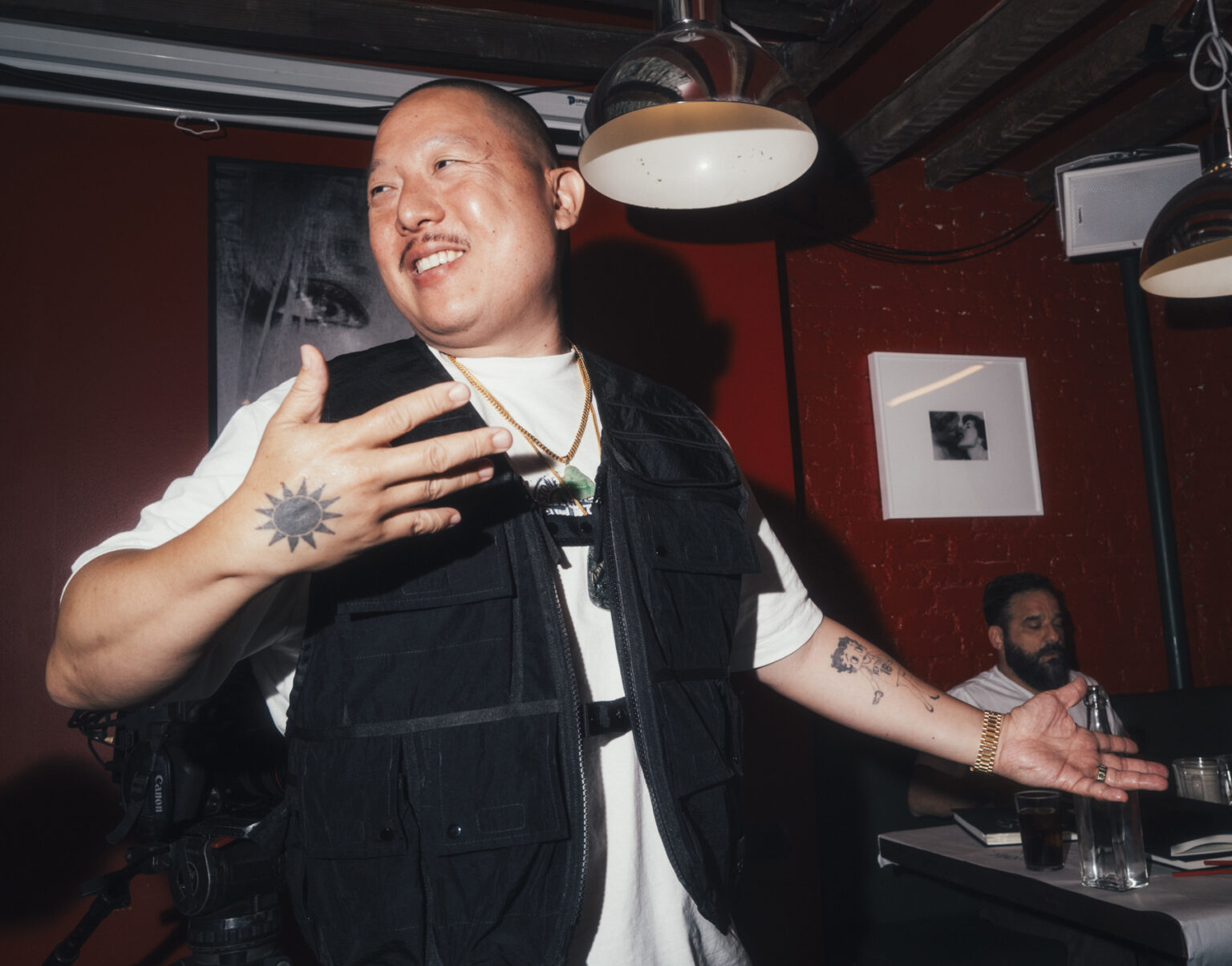
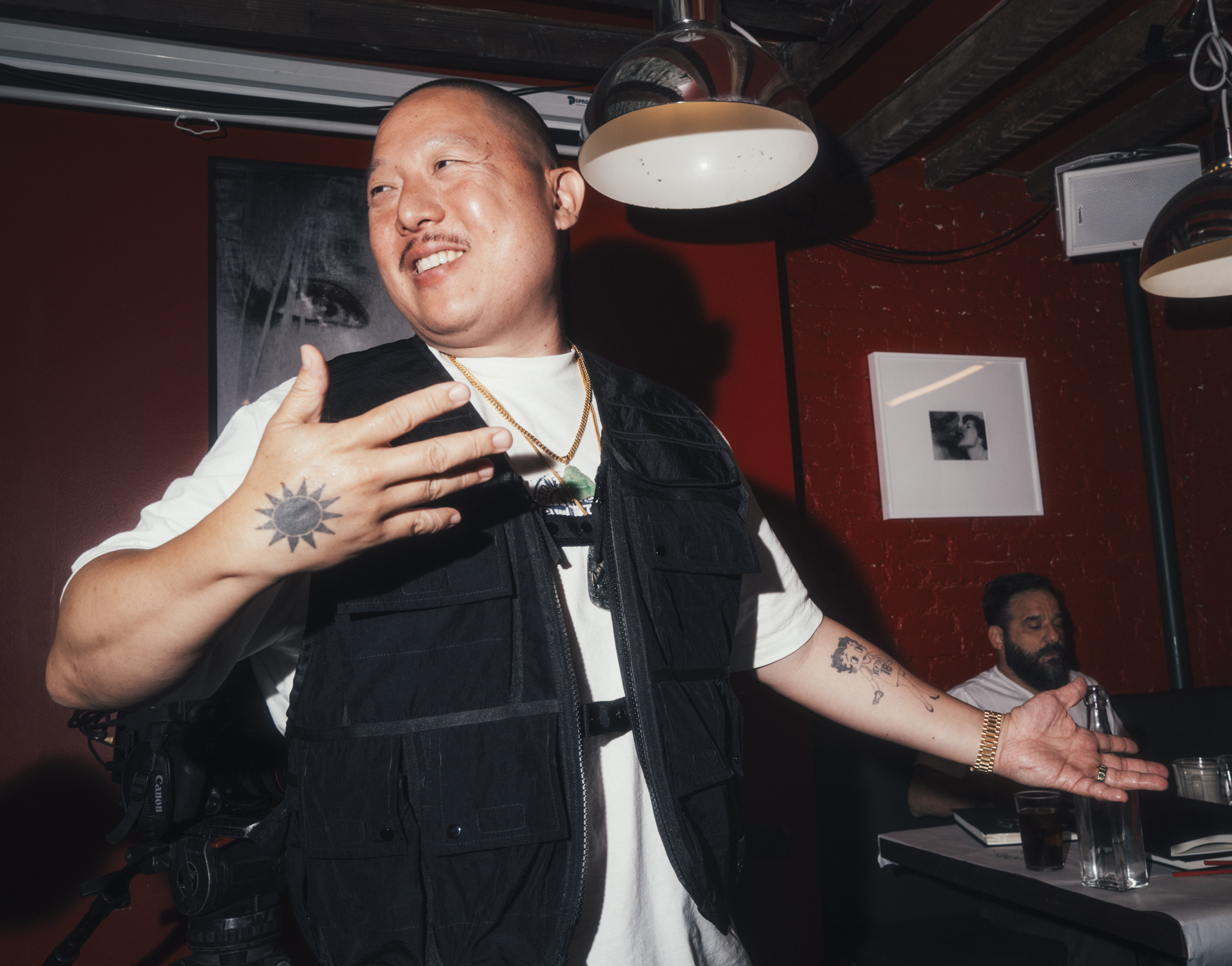
 Eddie Huang by Daniel Paik.
Six years ago, Eddie Huang was on top of a mountain in Taiwan feeling lost. He’d made the leap from downtown New York blogger to bona fide chef and media personality, opening dumpling dive BaoHaus in 2009 and hosting a Bourdain-style food and travel show on Vice’s TV channel. He’d directed a movie and published a best-selling memoir, Fresh Off the Boat. But like so many who manage to reach the top, the view turned out to be less than stellar without anyone to share it with.
So Huang did what he’s always done: write. It was on that Taiwanese mountain top that he started to draft his latest screenplay, Tuna Melt. In some ways, the story is classic Huang, a “toxic rom-com” about a scummy Los Angeles hitman nursing a wound from childhood. The world of Tuna Melt is specific; the characters, distinctly 2026. Huang knew he would need just the right voices to bring it to life. So last Thursday, a crowd huddled inside BaoHaus for an intimate table reading of Tuna Melt with Evan Mock, Chloe Cherry, Joey Bada$$, Chet Hanks, Colm Dillane, Kiersey Clemons, and more.
Huang’s firebrand persona isn’t a schtick. He may have traded Blogspot for Substack and a podcast, but he’s still got opinions and he’s not afraid who knows them. Yet he’s also interested in vulnerability and what it takes for men to access it. This was the engine that drove Huang’s last book, Come Undone, released last month. (The plot? A traveling food show host has to get over his personal hangups in order to accept love into his life.) And while a few writers are tackle masculinity outside of manosphere whining—Richard Gadd comes to mind—there’s still a dire shortage of men like Huang who are willing to write about sex and relationships honestly and openly. Amidst all of Tuna Melt‘s scammers, stoner-food restaurants, and streetwear moguls trying to make scumbum chic (or at least profitable), Huang’s screenplay offers a satirical but full-hearted send up of men terrified of intimacy—and a guide to getting over your own bullshit.
After the last page was read and the last bao bun chomped, CULTURED caught up with Huang as his team pushed the chairs back into place and reset the tables. After all, he still had a restaurant to run.
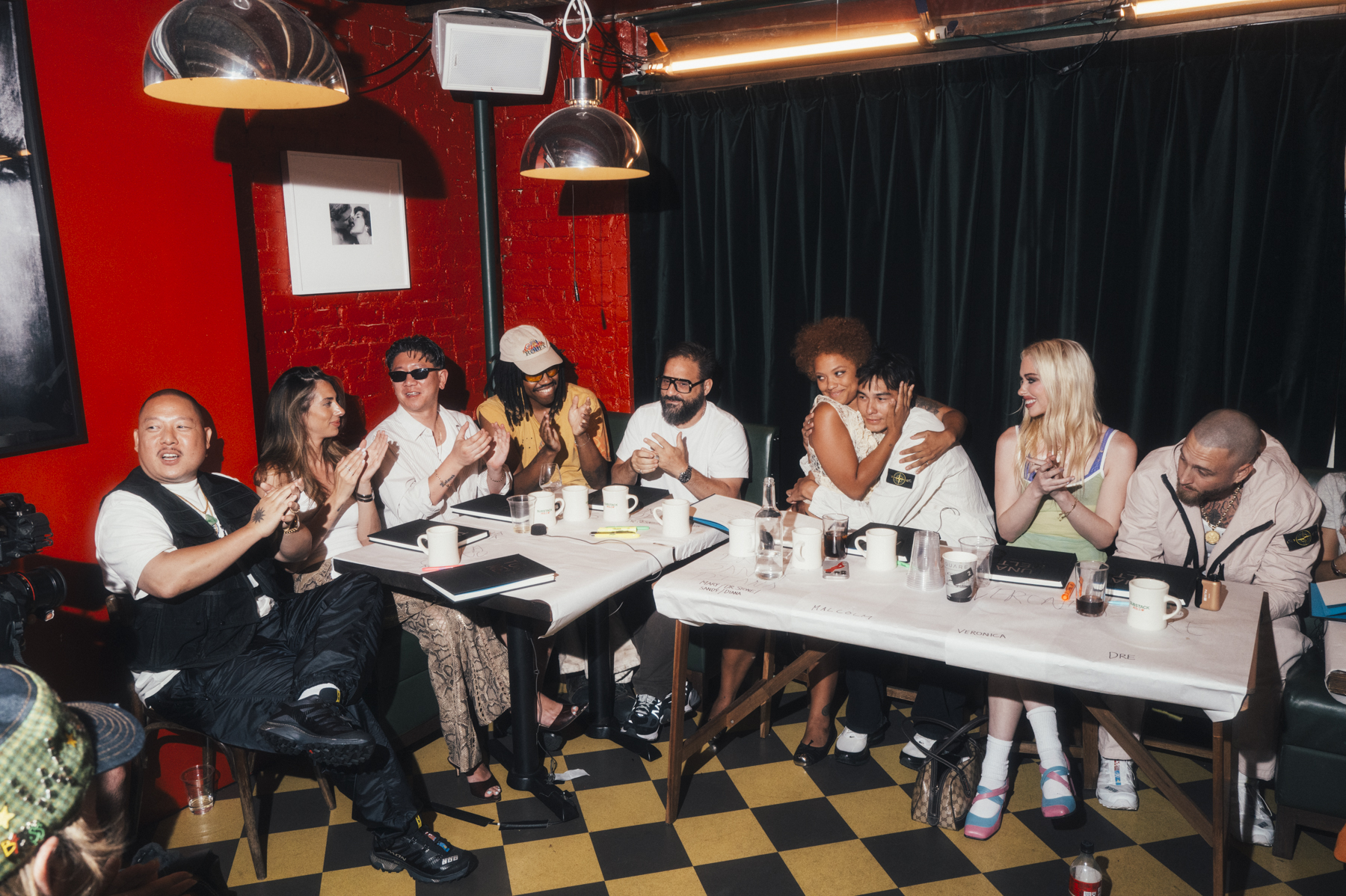 Cast of Tuna Melt by Daniel Paik.
How’s the scene over there?
Pretty crazy. We went from a table read to a restaurant within 20 minutes, but it was a lot of fun. People are not super buttoned up. We expect chaos and everybody buys in.
That’s how New York City restaurant life is, huh? You have to burn and turn.
Yeah. I definitely work with actors who are still whole humans. Everyone in our cast is incredible and understood what was going on. I’m in a restaurant. Of course you’re gonna set up.
Is this going to be the final cast for the film?
My preference would be that this is the cast. Everyone did an incredible job. Those are the leads that I want. Chloe Cherry was the first person we ever went out to for Veronica. We’ve always had her in mind, and she crushed it. It has to be Chloe and Kiersey [Clemons] as Mary. I’ve been trying to get in touch with Kiersey for years.
How would you pitch this movie—to an audience member, not a studio suit?
I write toxic rom-coms. Whether it’s Tuna Melt, or it’s my novel, Come Undone, they’re toxic rom-coms from the perspective of a man who’s embarrassed and ashamed. In Come Undone, it’s Hubie who’s embarrassed of the family he comes from. In Tuna Melt, it’s Malcolm who’s embarrassed about this sexual assault he was a victim of. Eventually he has to overcome this embarrassment and identity, and separate himself from it, and realize that he is a whole person outside of this. I tend to write very strong female characters—in my opinion—and the female characters that are the love interests usually have no patience for this shit.
That’s usually my work: The male character who’s been harboring this embarrassment forever meets a woman who’s like, Look, I’m glad you’re interested. Get it the fuck together.
How did this one start?
I had quit [the travel TV show] Huang’s World when the pandemic happened, and I ended up on a mountain in Taiwan. I had just finished writing and directing Boogie, and I thought that it would be fulfilling, but I felt really empty and alone. Even though I’d made all these things and been financially successful, I didn’t have a partner. I started to write from this place where you can have all these things—you can have money, power, respect—but nothing at all.
How did that translate into the movie?
I started to write Tuna Melt. I incessantly watched Pulp Fiction, and I really liked how it was not chronological; everything was out of place. Pulp Fiction is also a very existential film about what life means—what is this thing in the briefcase? I was a bit more literal than Tarantino was, though. I wrote from this place of loneliness and desperation, wanting to know what life was about on this mountain.
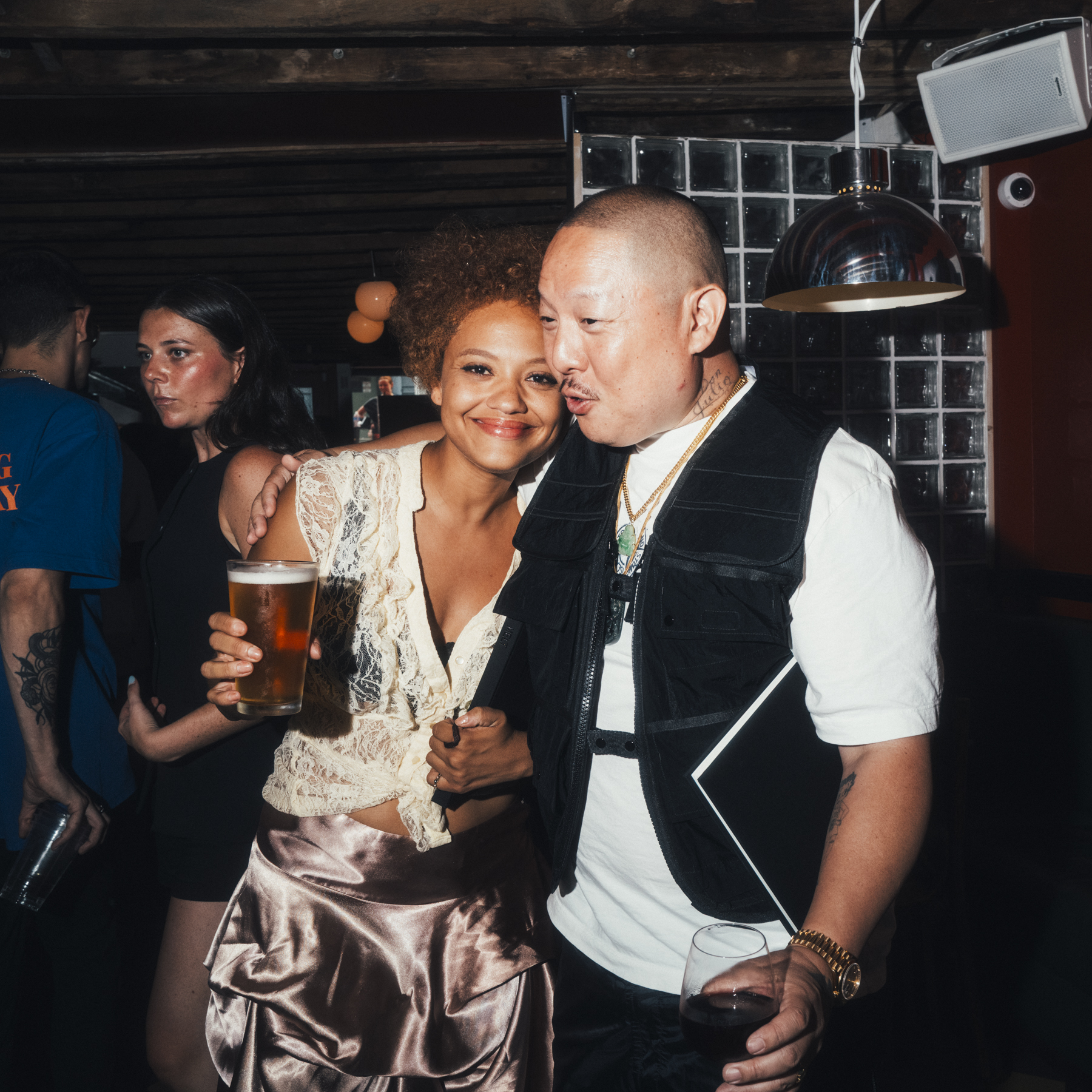 Kiersey Clemons and Eddie Huang. Photo by Daniel Paik.
Was this the first time you heard it read out loud?
Yes, and it was jarring for me. I was like, Oh my God, I can’t believe I’m saying this, but it was really cool that the crowd was into it. The response was fantastic and, man, it felt very full circle, very fulfilling.
Did people respond at the parts that you wanted them to?
Oh, yeah. There were a lot of laughs. A lot of people were very engaged.
I write a lot of humor as a defense mechanism. So I always feel like I need a joke. But it was really nice to finally be in public, hearing the work, and realizing that people really like the hushed, intimate moments.
Were there any other films that were touch points for you when you were writing it?
John Cusack and Woody Allen films that are very “male rom-coms.” There aren’t many people writing male rom-coms, especially with an internal monologue. I would say High Fidelity, Annie Hall, Manhattan. Those are the films I go back to a lot. When Harry Met Sally. Big fan of that one.
In When Harry Met Sally, [screenwriter] Nora Ephron grilled Billy Crystal and Rob Reiner extensively for the character of Harry. That’s how it gets so specific and funny with the men’s perspectives.
It’s a collective conversation about our struggles with intimacy. That’s what I love about those films.
There’s so many female writers out there that make sex and relationships and dating their beat, but you rarely find men who are willing to be vulnerable and honest and put their name to it. It feels like this big vacuum right now.
A lot of men want to try to write about intimacy without looking at their privilege, their wrongdoing, and without crucifying themselves. I think it’s impossible because, my man, we are in a patriarchal society. If you wanna talk about intimacy, you kinda just need to hang yourself first.
Do you see Tuna Melt and Come Undone as a pair?
What’s really interesting is Tuna Melt comes from an era before I wrote Come Undone. It’s definitely slightly more immature. The male character, Malcolm, is still really fighting his demons, really fighting the acknowledgement of his toxicity. I think Hubie in Come Undone is a lot more ready to shed his skin, so to speak. I’m sure you’ve met someone, man or woman, where it’s just, If you were just ready to shed your skin, you would be cool. Malcolm is not really ready to shed his skin, but the women in his life force it.
One of the things that you said is that the writer’s job is to challenge people. Is there anything in this script that you think might piss people off?
There’s a lot of stuff that I think will piss people off because they’re not ready to look at themselves.
There’s a parody of Ronnie Fieg and [his lifestyle brand] Kith—I think Ronnie Fieg and Kith will be upset. But, you are scaling a subculture. I think Kith and Ronnie, when you are participating in a subculture, you should be a bit more careful about how you scale it. So there’s commentary about that.
There’s a lot of commentary about how people look at past heinous acts. There’s a magazine girl in the film that is down to do a profile of a hit man because she thinks he’s cute, and he’s hot, and she’s horny. Like, dude, you can’t profile a hit man. You can’t put a hit man in the hot singles list.
There is a lot of commentary about Internet influencer culture. A lot of people are playing Mad Libs. They’re just like, Yo, I know this’ll go viral. I know if I put this and this together, the Reel is gonna go crazy, and I’m gonna make money. And very few people are taking a moment to ask, Should I? This film constantly asks not, Could you do it? or Would you make money doing it? but Should you do it?
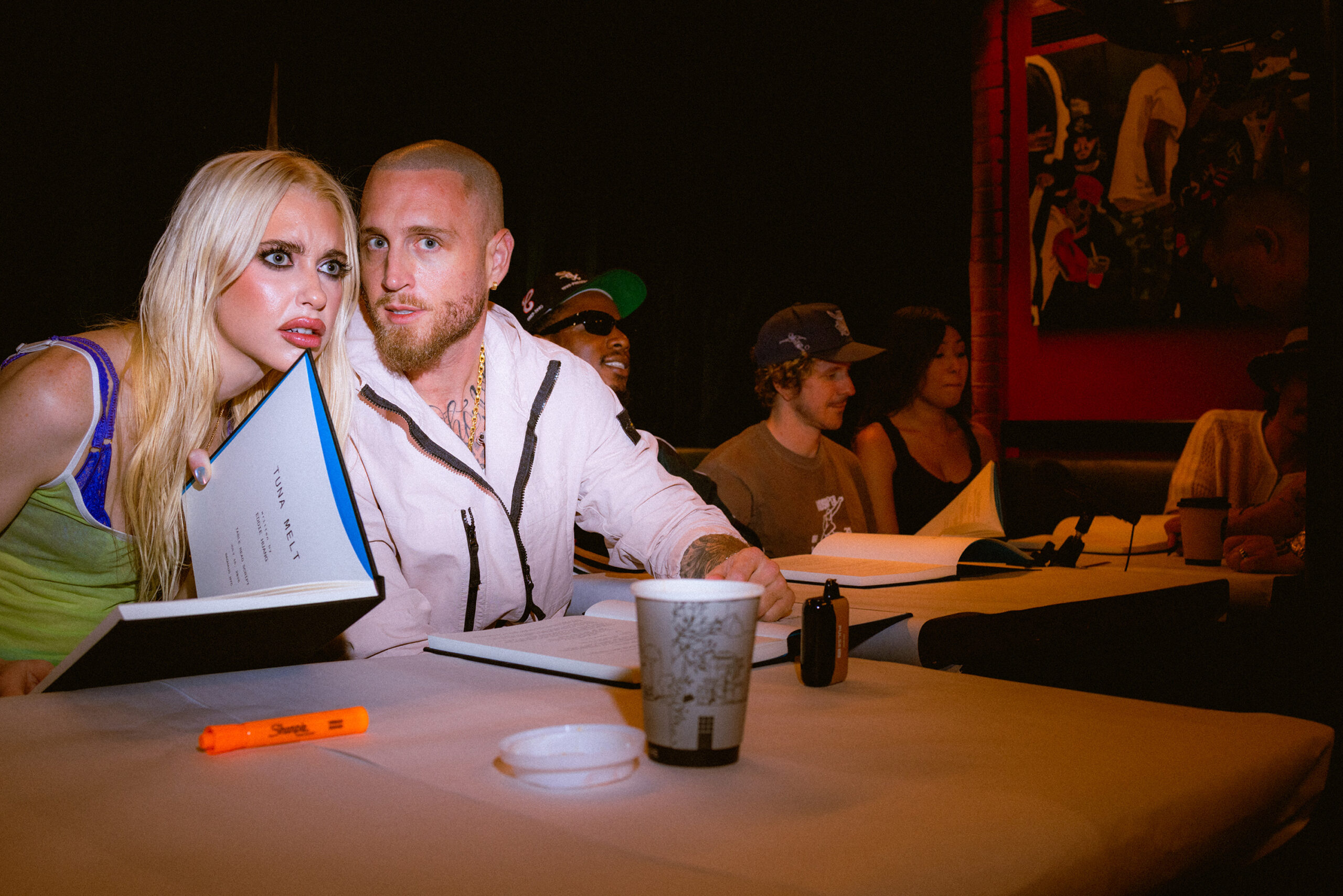 Chloe Cherry and Chet Hanks. Photo by James Gallagher.
That’s a question maybe people are not asking themselves enough these days. Because you mentioned subculture, how do you think about putting that on screen and not losing the authenticity?
We tried to get this film made for many years. People, financiers, studios, agents, managers were recommending like, Hey, get this actor. They’re financeable. This actor’s big. They’re just coming off this thing. And they kept recommending actors that had no kinship with the world and the culture that I write about in the film.
My stuff is very downtown New York. It’s very LA creative culture. I insisted on actors who are part of our world and move with us because otherwise, it’s kinda weird. I was like, Why don’t we get someone who’s from the world and then teach them how to act? That’s my approach to subculture: Don’t represent it if you’re not actually part of it.
It’s like trying to imagine someone making Kids with trained actors, or Penelope Spheeris trying to make movies about punk but not casting people off the street.
Kids is a fantastic example. It couldn’t have been anyone else besides Harold Hunter and Leo Fitzpatrick and Chloë Sevigny. The thing that’s beautiful about those films and those actors is like they never switched up. I bought a painting from Leo [who became an art dealer] that’s still in my restaurant. He and his wife come to the restaurant. We see Chloë walking down the street. These people have never left downtown New York.
What’s next here?
I feel like I have my cast. There was a lot of energy around the read. It went fantastic. People feel amazing. I’m going out to dinner with my team tonight. So I think we’ll go to the market in the next couple weeks.
More of our favorite stories from CULTURED
How Ina Garten, Everyone’s Favorite TV Chef, Learned to Trust Her Appetite
How ‘The Odyssey’ Opening Weekend Birthed Its Own Ticket Resale Black Market
What Do Basketball Stars Talk About in the Locker Room? Fine Art, According to Kevin Love
We Asked 18 Food Insiders Where (and What) to Eat in New York This Summer
Jarrett Earnest on How Lovers Claude Cahun and Marcel Moore Redefined Collaborative Artmaking
Sign up for our newsletter here to get these stories direct to your inbox.