
Thirtyyears ago, on a not very special episode of Friends (“The One With FrankJr.,” for the record) Ross and Rachel swapped “Celebrity Freebie” lists: topfives of famous people with whom they would each choose—and be allowed by theirpartner—to have consequence-free sex. Ever the culture vulture, Ross opted forIsabella Rossellini, leading to the most incongruous Blue Velvet shout-outin prime-time history. Rachel, meanwhile, chose Chris O’Donnell, John F.Kennedy Jr, Daniel Day-Lewis, Sting, and, in a shocker, ex–Hardy Boy ParkerStevenson. The heart, it has been said, wants what it wants.
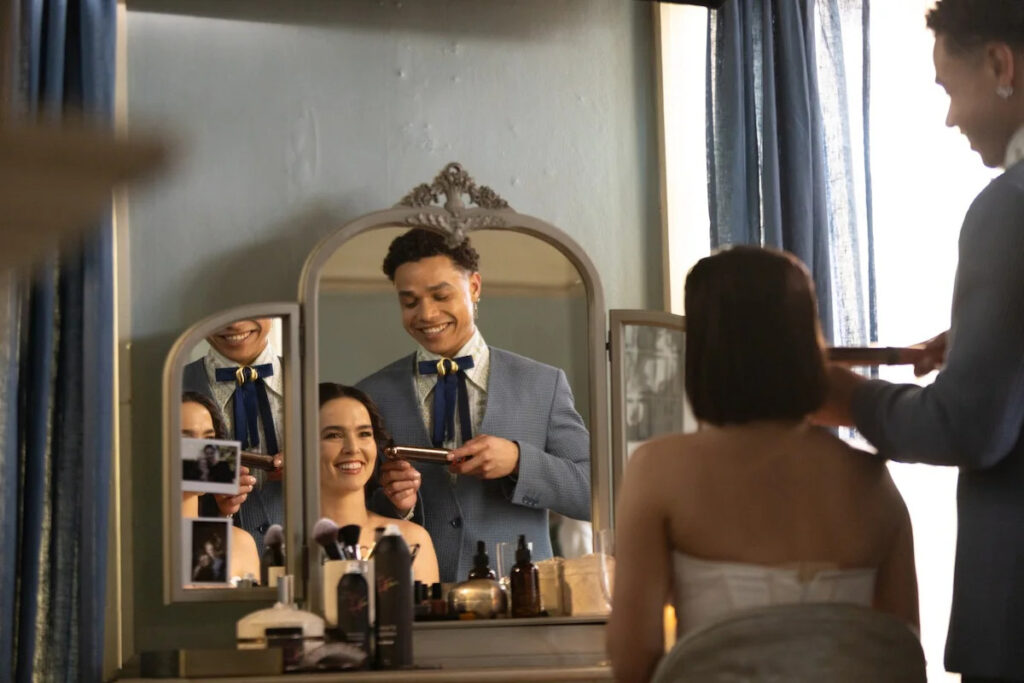
DavidWain’s new film, Gail Daughtry and the Celebrity Sex Pass, turns on anegregious no-strings-attached mishap, complete with a cameo from the erstwhileMs. Green. The setting is Wilbur, Kansas, all picket fences and strip malls,where former high school sweethearts Gail (Zoey Deutch) and Tom (MichaelCassidy) are set to be wed. She’s bubbly and sweet, beloved by her neighborsand beauty parlor clients; he’s gormless and visibly out of his depth. Both areseemingly happy to go through the motions till death do them part. Pregamingan author event at their local bookstore, Gail and Tom start hypothesizingabout their celebrity freebies; since the writer in town for the signing isJennifer Aniston—there to hawk a no-frills cookbook of “Sensible Suppers”—theyboth agree that she’d be a suitable fantasy fling.
Cutto Tom in flagrante delicto a few hours later in the back of the store withAmerica’s Sweetheart. “We talked about this,” he pleads to Gail, who’smortified, as is Jennifer, which doesn’t stop her from arranging to send Tomsome DVDs of Friends (he only knows her from The Morning Show). Heartbroken,but determined to get even on her own set of ethical terms—and egged on by herstandard-issue sassy best pal, Otto (Miles Guttierez-Riley)—Gail puts her gameface on. Otto is off to Los Angeles for a hairdressing convention and suggestsshe tag along. Their target: Jon Hamm, a handsome prince ensconced at theChateau Marmont.
Nosooner have Gail and Otto landed at LAX than they’ve caught a cab ride withRichard Kind, obtained some star maps, and learned about the best spots in townto get a burger (McDonald’s), a coffee (Starbucks), and a blow job (FootLocker). They also accidentally obtain the briefcase of a reigning Mafia queenbee (SabrinaImpacciatore) who has designs on bringing down the global financial system andis willing to kill the strangers who’ve made off with her documents. Otherimpediments to Gail’s righteous carte blanche booty call includemisfiring hitmen, unctuous personal assistants, and a machine-gun-toting”Weird” Al Yankovic, who helpfully tells her and her friends to “eat it” whilechasing them off his property.
David Wain does not make realistic, or even halfway plausible, movies. This laxity ishis badge of honor, and he wears itwell.
Sufficeit to say that Wain, who once cast Aniston opposite Paul Rudd in 2012’s Wanderlust,does not make realistic, or even halfway plausible, movies. This laxity ishis badge of honor, and he wears itwell. Where a status-climber like Judd Apatow cultivates a strenuous, andlargely disingenuous, naturalism—John Cassavetes by way of SNL—Wain hasno use for respectability. He’s yet to abandon the slovenly, see-what-sticksshtick of Wet Hot American Summer (2001), an epochal work thathas informed a swath of postmillennial alt-comedy. By sticking to his guns—andalso letting them misfire, or shoot blanks—Wain runs the risk of seeming likean inept veteran, when he’s actually an old master of his very particular chosenform.
GailDaughtry and the Celebrity Sex Pass is not a good-looking movie: Kevin Atkinson’s cinematographyis so hypnotically bland that Main Street USA and the Inland Empire becomevirtually indistinguishable from one another. The performances are broad to thepoint of active mugging; the storyline doesn’t so much strain continuity andcredibility as leave them to bleed out in a ditch. This is all to the good.Wain and his co-writer, Ken Marino, who appears as a veteran paparazzo helpingGail navigate the City of Angels, have each worked on plenty of “normal”television and streaming series since their days on MTV’s The State. They’vehad successful careers meeting the industry halfway—especially Marino, who’susually the funniest part of whatever he’s in. What they refuse to do is makecompromises on their own time. Instead, they play a game of (rubber) chickenwith themselves and the audience, torquing artificiality and contrivance intoits own screwily lucid sort of worldview: a wryly complacent gaze into thepop-cultural abyss.
Wainis often called a satirist or a parodist, which is true for instance of thewinking, ruthless Nora Ephron–esque They Came Together (2014), whichleaves vintage rom-com tropes to ripen and rot on the New York City pavement.The label doesn’t always fit, however. “I don’t consider Wet HotAmerican Summer a spoof at all,” Wain told The Film Stage; “it’sjust a movie really sourced in actually going to summer camp, and it’s funny.”The skeleton key to unlocking the director’s sensibility—not that it’snecessarily airtight in the first place—might just be Wet Hot’s gee-whiz,summer-stock metaphysics—the wholesome, theatre-kid excitement of getting yourfriends together and putting on a show. Think of the wonderfully sincere sequencewhere a group of preteens perform “Day by Day” from Godspell, analmost enchanted interlude that feels plucked from memory. And then there’s thefinal act of Wain’s deceptively conventional and Apatow-adjacent 2008masterpiece Role Models (co-written with Marino), in which theprotagonists are finally reconciled by a rousing game of Medieval cosplay—animmersion in nerdculture enacted with a welcome lack of condescension toward characters andaudience.
Itmakes sense that such an inveterately playful filmmaker would finally getaround to riffing on The Wizard of Oz: Victor Fleming’s 1939 classic isthe primal scene of Hollywood escapism, after all. The sheer slack-jawedobviousness of the references here is part of the point: “Gail Daughtry”inverts “Dorothy Gale” as surely as “Otto” scrambles “Toto,” and Hamm eventuallyrefers to himself as a wizardly “man behind the curtain.” Within the film’sEmerald City framework, John Slattery, playing a B-list celebrity, serves as amodern version of the Cowardly Lion (“Put ’em up, put ’em up,” he mumbles,shadowboxing in his garage). Ben Wang, playing a Creative Arts Agency rookie,is a scatter-brained Scarecrow manqué, and Marino as the cynical, heartlessphotographer has shades of the Tin Man. Slattery’s performance is wonderfullyunhinged; he’s funniest when he’s being used as a punching bag, whetherrhetorically—as in an uproarious series of text messages narrating hisincremental estrangement from Hamm (who’s left his buddy on read for severalyears)—or literally, as when he gets a hotel room door slammed on his ankle 34times, each jolt punctuated by its own piercing yelp of “Ow!”
There is a fineline between liberated and lazy, and Gail Daughtry refuses to pick alane on principle.
DavidLynch used to suggest that most of his movies were spiritual remakes of The Wizard of Oz, and Wain’s embrace of low-rentsurrealism can feel Lynchian at times; by following a guileless ingenuethrough a freaky version of “Hollyweird,” Gail Daughtry becomes thedirector’s Mulholland Drive, right down to the script’s winking anxietyabout the perils of show-business-as-usual. There aren’t a lot of comedydirectors who are so willing to deal in outright alienation effects, like therepetition-compulsion of Slattery’s battle with the door, or the gratuitouslybrutal violence of a late action sequence seemingly staged in one of the samelocations as Quentin Tarantino’s Once Upon a Time in Hollywood.
And thenthere’s the narrator, played by the honey-voiced character actor Fred Melamed,who starts out cheerful and folksy about Gail and her friends but beginswearying of the WTF nature of the material around the same time we do.Melamed’s descent into raging dyspepsia is a signal that Wain knows very wellhe’s wasting his—and our—time and trusts that we don’t mind. There is a fineline between liberated and lazy, and Gail Daughtry refuses to pick alane on principle. The swerving is the point; the pleasure resides in the high-minded notion—rooted in the golden rule ofimprov—that all jokes, including and especially the bad ones, are createdequal.
It’shard to reconcile deliberately half-hearted humor with real emotion, and GailDaughtry and the Celebrity Sex Pass is deliberately underwhelming both as alove story and as an attack on the culture industry. Wain loves his offhandanticlimaxes; no surprises for guessing that, choosing between a cheating dorkon the one hand and Don Draper on the other, our heroine finally choosesherself. But Gail’s parting words sum up the movie, its makers, and theirpassions so nicely that they bear repeating. “Let’s keep it loose and freaky,”Deutch tells Hamm before they float off together in a hot air balloon,somewhere over the rainbow.