
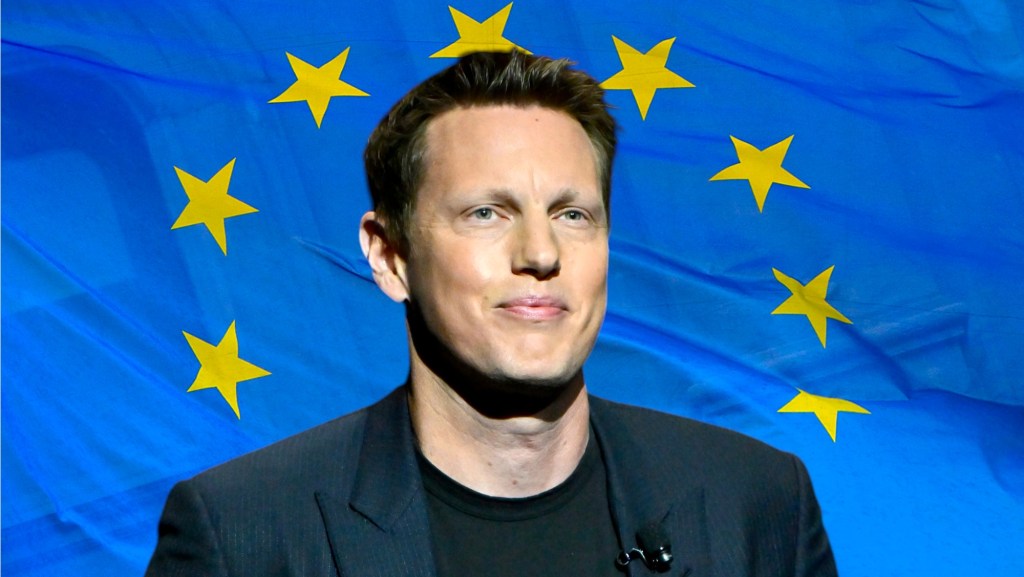
Paramount‘s $111 billion deal to acquire Warner Bros. Discovery (WBD) has taken a major step forward after securing approval from the European Union’s antitrust authority. As was previously reported, Paramount has agreed to remedies, mainly exiting its international distribution deal with Universal Pictures.
The European Commission’s greenlight of the media mega-merger Wednesday was welcome news for David Ellison as he contends with legal challenges in the U.S. and regulatory uncertainty in the UK.
In a statement, Paramount called the approval “a major milestone in completing the transaction in line with the publicly stated timeline” and said the EU findings “directly refute key assumptions that underpin the state AGs’ complaint seeking to block the transaction.”
Paramount has planned to close in the third quarter, and specifically the end of September. The Ellisons had agreed to pay a substantial so-called ticking fee to Warner shareholders for each day after September 30 the deal is not closed.
The lawsuit filed by California Attorney General Rob Bonta and 11 other states claims the proposed merger violates antitrust law in three markets — for wide release films, blockbuster films, and cable network licensing. Earlier this week, the judge in the case granted a temporary restraining order that has paused the merger for 14 days. The AGs are now preparing a petition for a preliminary injunction to block the deal from closing pending the outcome of a trial.
A hearing on the injunction is set for August 3 the Northern District of California.
Separately, the Writers Guild Of America is also seeking a preliminary injunction to block the deal.
In today’s decision, the European Commission did not find the merger posed undue pressure on film production, or in audiovisual content. Rather, it said there are a sufficient number of film studios in the European Economic Area to compete with a merged Paramount-WBD, ticking off U.S. majors Disney, Universal and Sony, smaller players like Amazon MGM, A24 and Lionsgate, and European studios.
The States’ suit in the U.S. focuses on the big five Hollywood studios, which would drop to four in a Paramount-WBD combination. It does not consider smaller players in determining the relevant market.
In “the AV value chain,” the Commission said its investigation showed “enough alternative competitors remain to exert sufficient competitive pressure on the merged entity in the EEA.” That applies to pay TV channels for children, where it found that “streaming platforms offering children’s content will continue to act as a competitive constraint on the merged entity’s TV channels.”
Said Paramount: “The European Commission rightly considered streaming platforms as competing directly with linear TV. These conclusions further undermine the market definition relied upon by the state AGs in their complaint.”
Distribution Remedy
With film distribution, the Commission did find, as expected, that as a result of the transaction, “there will be high concentration and increased transparency in the EEA countries where Paramount has a structural partnership with Universal, due to the addition of Warner’s film portfolio.
“The partnership focuses on the distribution of Paramount’s and Universal’s films to cinema operators through their joint venture, United International Pictures (‘UIP’). The transaction would have meant Warner’s films were also distributed via UIP and, without the commitments, it would have led to worse rental and distribution terms for cinema operators, ultimately disadvantaging consumers.”
The Commission said the EU requires termination of Paramount’s stake in UIP in the EEA within 13 months from the closing of the transaction.
It stipulated that, for a period of ten years, Paramount will not, directly or indirectly: enter into any agreement or understanding with Universal to jointly co-distribute films in the EEA; that it will not shift the distribution of Warner’s films from Warner’s existing distributor to the theatrical distributor used by Paramount, where that distributor also distributes Universal’s or Disney’s films in all UIP countries in the EEA (Bulgaria, Croatia, Czechia, Cyprus, Denmark, Estonia, Finland, Greece, Hungary, Iceland, Latvia, Lithuania, Norway, Poland, Portugal, Romania, Slovakia, Slovenia and Sweden); and in the UIP countries in the EEA where Paramount and Universal do not share the same distributor. shift the distribution of Paramount’s films from Paramount’s existing distributor to the theatrical distributor used by Warner, where that distributor also distributes Universal’s or Disney’s films.
The Commission said these commitments “fully address the competition concerns identified by the Commission by ensuring that the films of the merged entity will not be distributed jointly with those of Universal or Disney.”
It noted the decision is conditional upon full compliance with the commitments and an independent trustee under the Commission’s supervision will monitor implementation.