
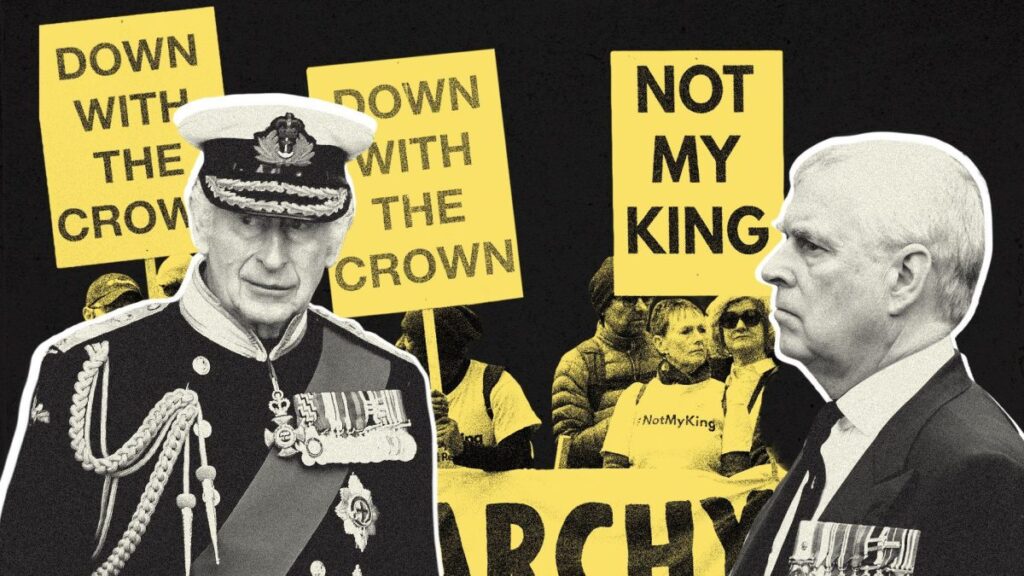
During the Order of the Thistle ceremony at St Giles’ Cathedral in Edinburgh last month – the ancient ceremony at which the King bestows Scotland’s most senior order of chivalry – those filing in for the honours could not avoid the message spelt out in giant capital letters on the other side of the road: “WHAT DID YOU KNOW CHARLES?”
This referred, of course, to the King’s disgraced brother, Andrew Mountbatten-Windsor. The Royal Family have tried desperately to build a firebreak between the ex-duke of York and the rest of the family. His public appearances have been ended, his titles and honours stripped away, and he has been dispatched into a kind of internal exile in Norfolk, as far from the public gaze as they can manage. Yet still the flames are lapping at the royal door.
“This may take quite a while, but the real damage to the monarchy has not yet happened,” a well-placed Westminster source told me. Some even believe that if the net finally closes around the ex-prince, he could yet settle abroad – potentially in the Middle East.
It is a measure of how the ground has shifted.
The respected British Social Attitudes survey shows that while more than 88 per cent of people in 1983 thought it “very” or “quite” important to have a monarchy, by 2024 that figure had fallen to 51 per cent. Almost half – 46 per cent – now say having a monarchy is “not very” or “not at all” important, including a majority of those aged 44 and under.
Almost 25 years ago, I introduced a debate in Parliament on royal finances. Other than two sparsely attended government statements, it was the only occasion royal matters were discussed in my 18 years as an MP.
My debate was attended by just three people – the government minister replying (Baroness Primarolo), a government whip, and me. MPs simply weren’t interested in royal finances, doubtless to the Palace’s satisfaction.
‘Royal finances no longer off limits’
There were a good few MPs who were, at best, lukewarm about the monarchy. But ingrained deference, the rules of the House that make it hard to raise royal matters, fear of the political risk, and genuine respect for Queen Elizabeth, if not always her wider family, combined to mute any criticism.
Today, that landscape has been transformed. The Queen is no longer with us, revelations about the scale of royal wealth have cut through with the public, and the disgrace of Andrew — once his mother’s favourite son — have combined to drive support for the monarchy down further still.
The media no longer treats royal finance as off-limits either. A few years ago, I went on BBC Radio 4’s Today programme to argue that the Duchy of Cornwall — the private estate that funds the prince of Wales — was not historically a private estate at all, and should be folded into the Crown Estate, with its profits going to the Treasury rather than into Charles’s pocket.
It was, in my view, a fair interview, with the BBC presenter putting the opposing opinion. Yet within the hour, the BBC issued an apology on air to Charles, then prince of Wales. At the time, a source told me that followed a call to the programme from St James’s Palace.
Contrast that with last month, when Charles revealed how much tax he pays — presented as a great act of transparency, though he had in fact disclosed the same as prince of Wales. That day I was interviewed 13 times, for various BBC TV and radio outlets and several national papers.
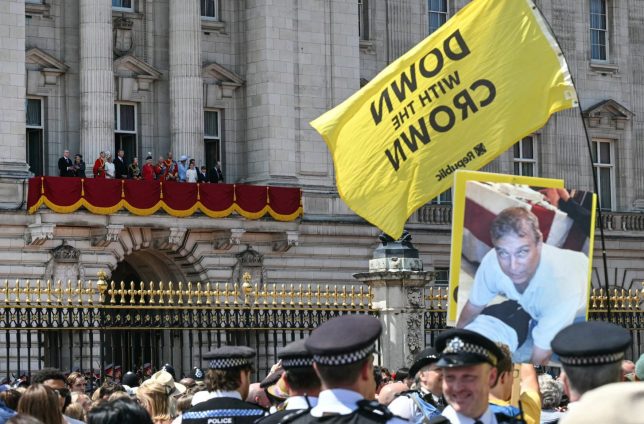 Anti-monarchy protesters outside Buckingham Palace in June as the Royal Family watched the King’s birthday parade ‘Trooping the Colour’ (Photo: Justin Tallis/Getty)
Nowhere is the change more visible than in the sizeable demonstrations organised by the anti-monarchy group Republic that now follow Charles around the country. The group also maintains that the numbers who turn out to support the monarchy on such occasions are dwindling.
At the royal garden party at Holyrood House in Edinburgh last month, a banner unfurled on a nearby hill read: “Cut the Half Billion Royal Budget.” Fuel has been added to that fire by news that the Sovereign Grant — the core taxpayer funding of the monarchy — is close to doubling, to around £100m a year.
Back in 2024, a Channel 4 documentary put royal finances firmly in the spotlight. It revealed that the Duchies of Cornwall and Lancaster — whose profits are taken respectively by William and Charles — had charged the Army rent to conduct training exercises (“yomps”) across Dartmoor, charged the Royal Navy to moor its ships, and charged the NHS millions to park ambulances in an empty warehouse. The royal pair have since made some concessions — exempting the Scouts and the RNLI, for instance — but much, including the arrangements with the Armed Forces, remains unchanged.
Andrew investigation ‘kicked into long grass’
The extent of any lasting damage to the monarchy may hinge on what the police and the Crown Prosecution Service decide to do with the results of the investigation into Andrew’s time as a UK trade envoy.
“We are already getting the mood music preparing us for the issue to be kicked into the long grass,” says the royal author Andrew Lownie, whose bestselling biography of the ex-prince, Entitled, laid out much of the case against him. “Bringing cases under Misconduct in Public Office are tricky.”
In my experience the police have historically been reluctant to bring charges against any royal, however clear the evidence. The Royal Family may be banking on that reluctance being enough to see them through again.
Add to this the speech Charles delivered to Congress during the recent US state visit, seen by monarchists and republicans alike as a triumph, reinforcing the argument that the royals can wield a kind of soft power that elected politicians cannot. The warm noises coming from William and Kate – his focus on homelessness, her completion of the Three Peaks Challenge – have helped prop up support too.
But complacency would be unwise.
Andrew Mountbatten-Windsor denies all wrongdoing.
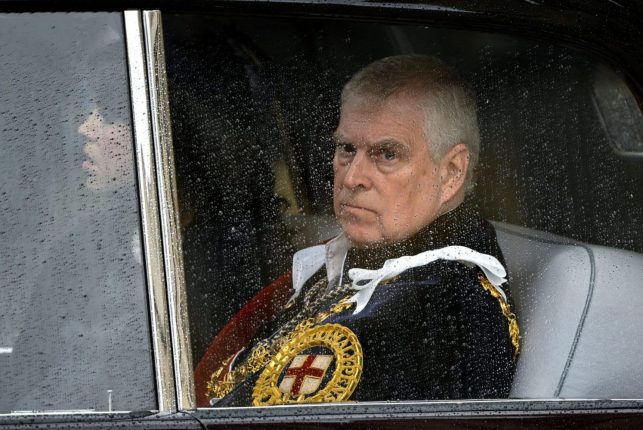 Andrew Mountbatten-Windsor pictured in 2023. ‘In my experience the police have historically been reluctant to bring charges against any royal, however clear the evidence,’ writes Norman Baker (Photo: Toby Melville/Getty)
Worryingly for Charles, the questions being asked are no longer confined to his brother. “Andrew has opened a Pandora’s box,” says Ingrid Seward, editor-in-chief of Majesty magazine and a royal biographer. “There is a new demand for transparency, and while there is a need for more of it, acceding to this will inevitably lead to yet more demands.”
‘Open season’ on Andrew
Parliament has so far stayed largely mute on the royals, with MPs hemmed in by the 1844 parliamentary “bible”, Erskine May, which bans “casual, insulting, or critical remarks about the Sovereign, the heir to the throne, or other senior members of the Royal Family.”
The present Speaker, Lindsay Hoyle, has nonetheless declared open season on Andrew, and signalled that questions about royal finance — and the Duchies of Lancaster and Cornwall in particular — are likely to be ruled in order.
A Commons test came on 14 July, courtesy of the Green MP for Brighton Pavilion, Siân Berry. “The Royal Family should be as transparent as any other public authority,” she said. “That is why I am introducing a bill to end the outrageous exemptions that still exist in the Freedom of Information Act, so that the public, politicians and the press can truly hold this shadowy institution to account.” The bill passed its first stage without opposition.
The monarchy is the only part of the public sector effectively exempt from the FoI Act — notwithstanding promises made to me by a government minister, while the legislation was going through parliament, that this would not be the case.
Duncan Hames, director of policy and programmes at Transparency International – the anti-corruption watchdog – adds: “The Royal Gousehold is a public institution funded by millions of pounds of taxpayers’ money, yet it sits outside the Freedom of Information Act that holds the rest of the public sector to account. If the public are footing the bill, they have a right to know how that money is spent and how decisions about it are made in their name.”
The problem for the royals is that a blanket of secrecy can lead to practises being followed that would not be followed if the expectation was that they would become public. Just ask MPs who had their expenses lit up in harsh light back in 2009.
That appetite for scrutiny is reflected in the polling too: A BMG poll for this newspaper in March found 63 per cent of Britons back opening up the monarchy’s finances to the same public scrutiny as government spending, against just 19 per cent opposed – support that held across the political spectrum, including among Conservative voters.
The poll, conducted in the wake of Andrew’s arrest, also found overall support for the monarchy itself was continuing to bump along the bottom at the historically low figure of 49 per cent, down from 52 per cent in 2023.
“The royals have lost their shield – the late Queen,” says Graham Smith, chief executive Republic.
Baroness Hodge, the former chair of the Public Accounts Committee, told me: “The monarchy will need to modernise the way it deals with its finances. A failure to respond to the growing concerns of the British public can only damage the reputation of the monarchy, and I do not want that to happen.”
Seward, the royal biographer, is relaxed about the polling though. She points to ups and downs during the late Queen’s reign too, and maintains the current decline is “not irreversible”.
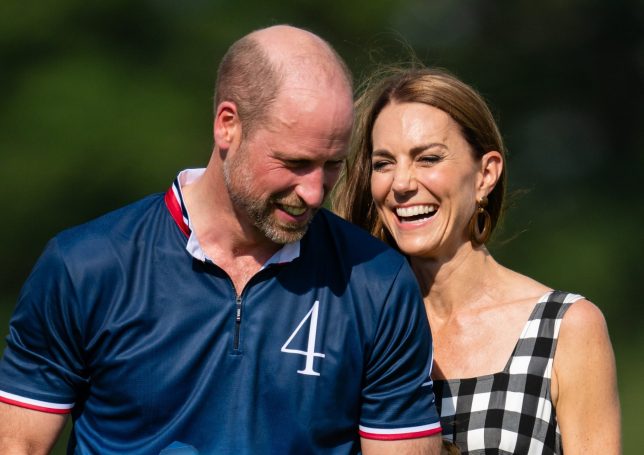 William and Kate still remain popular among the public despite the controversies engulfing the wider Royal Family (Photo: Samir Hussein/WireImage)
Much, she concedes, will depend on William and Kate. “His father is nearly 78, the Duke of Kent is 90, the Duke of Gloucester is over 80. William isn’t going to be duty, duty, duty. He is the epitome of a modern prince, putting family before duty.”
Whether the public shares that fondness for a more modern monarchy remains to be seen. William is already facing accusations of being workshy, for taking on far fewer royal engagements than his septuagenarian father and aunt, Anne.
‘Last chance saloon’
Others would push back on that framing: William’s defenders argue he is not doing less, but doing things differently – trading the packed diary of official engagements for a smaller number of causes, chiefly homelessness, pursued with the discipline of a campaign rather than the duty of an office.
Author Lownie, himself a monarchist, is blunt about the stakes: “This is last-chance saloon for the Royal Family. After the scandals of the York family, wider questions are now being asked about royal privilege and accountability. This is an opportunity to make themselves fit for purpose in the 21st century.
“If they continue to say nothing and hope the problem goes away, they are finished, and deserve to be.”