
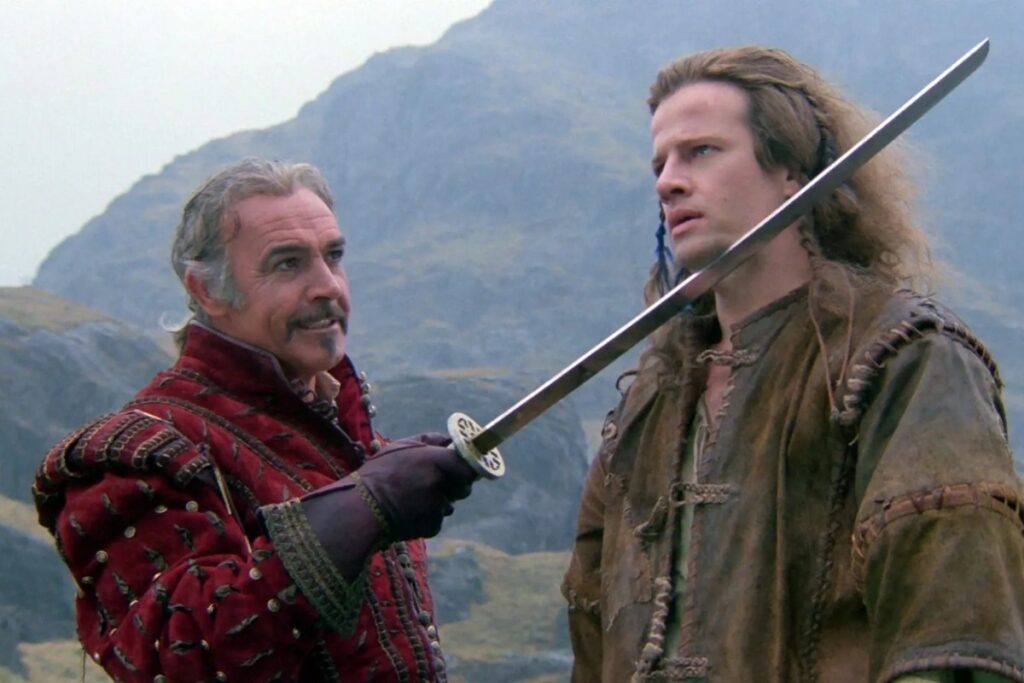
“There can be only one!” has echoed across stadiums and arenas for four decades, a battle cry born from Christopher Lambert’s 1986 cult classic Highlander, directed by Russell Mulcahy. The line, delivered amid Connor MacLeod’s clashes with the Kurgan, outlived the film’s shaky box office to become sports shorthand for ultimate victory. That legacy now heads into a remake starring Henry Cavill and Russell Crowe.
Every stadium has heard it at some point, that guttural roar meant to crush an opponent before the final point is even scored. Few chanting it actually know they’re quoting a swordsman from 16th century Scotland, born from a film that flopped at the box office before conquering pop culture from the sidelines. That line traces back to a blade fight nobody expected to matter decades later, and now the source material itself is getting a second life on screen.
A phrase that transcended cinema
Some movie lines drift so far from their source that people forget where they came from. “There can be only one!” is a prime example. Athletes shout it before playoff games, broadcasters drop it during elimination rounds, and tournament brackets have borrowed it for decades. Yet the phrase was born in Highlander, the 1986 cult film directed by Russell Mulcahy that mixed Scottish history with urban fantasy.
A cult classic with timeless influence
Released nearly 40 years ago, the film starred Christopher Lambert as Connor MacLeod, an immortal Scottish warrior who spends centuries dueling others of his kind. The line first appears early on, when the story jumps back to 1536: during a clan battle, a knight in dark armor and a skeletal helmet, later revealed as the Kurgan, prepares to behead MacLeod and delivers the prophetic words.
The phrase then echoes throughout the story. MacLeod’s flamboyant mentor Ramírez, played by Sean Connery, repeats it while explaining that immortals must fight until a single one remains. MacLeod himself says it at a decisive moment. The film underperformed at the box office on release, but its layered mythology slowly earned it a devoted following and multiple sequels.
Why the line became legendary
Why did this particular quote outgrow its own movie? Because it distills competition to its purest form: one winner, no exceptions. That makes it a natural fit for sports, where sudden-death formats and championship finals mirror the film’s high-stakes duels. Commentators and fans adopted it so widely that many people today use it without knowing its cinematic origin, much like the word “paparazzi,” borrowed from a character in Fellini’s La Dolce Vita.
The syndicated TV series starring Adrian Paul, which ran throughout the 1990s, pushed the expression even deeper into pop culture. By expanding the lore to a weekly audience over 6 seasons, the show kept the phrase alive long after the original film left theaters.
The saga returns with a remake
The story is far from over. A remake is currently in production, with Henry Cavill in the lead role and Russell Crowe attached to the cast as Juan Sánchez-Villalobos Ramírez, the mentor role originated by Sean Connery. The project, released by Amazon MGM Studios under its United Artists banner and backed by StudioCanal, aims to introduce the immortals’ battle to a new generation while honoring the 1986 original.
Directed by Chad Stahelski, the filmmaker behind the John Wick franchise, the new version promises the kind of swordplay the premise deserves. Fans will soon find out how the most famous line in the saga sounds coming from a new MacLeod, four decades after it first rang out in that parking garage duel.