
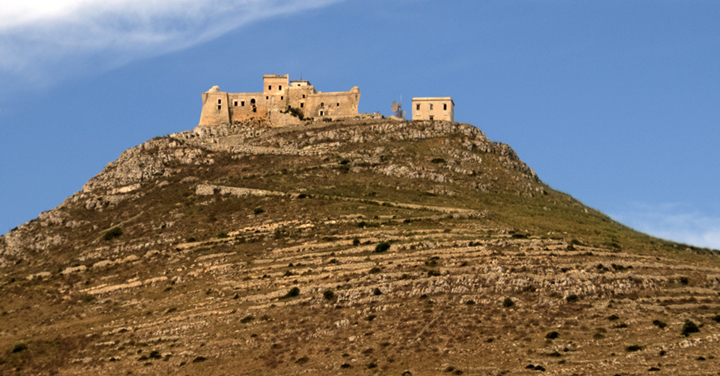
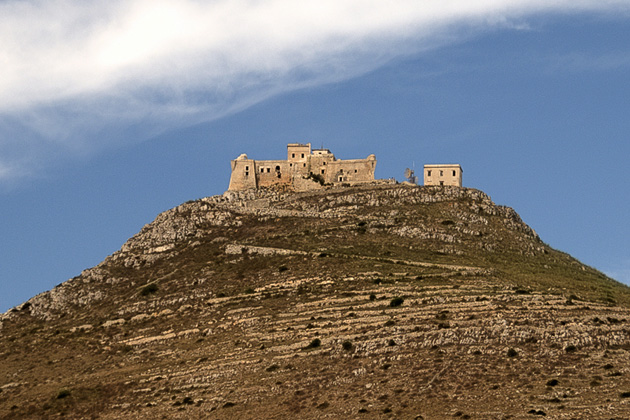
The Odyssey film location: the palace of Odysseus and Penelope at ‘Ithaca’: Castello Di Santa Caterina, Favignana, Italy | Photograph: Wikimedia / Roberto
CAST |
Matt Damon,
Anne Hathaway,
Tom Holland,
Robert Pattinson,
Zendaya,
John Leguizamo,
Jon Bernthal,
Charlize Theron,
Elliot Page,
Lupita Nyong’o,
Samantha Morton,
Himesh Patel,
Mia Goth,
Benny Safdie,
Logan Marshall-Green,
Ryan Hurst,
James Remar,
Bill Irwin,
Brian Vernel,
Rafi Gavron
The film’s locations are divided up into five practical locations – plus underwater and studio filming:
The first feature film shot entirely in the IMAX format, primarily using new lighter and quieter cameras specifically developed for this production.
It begins after the sacking of Troy when Odysseus (Matt Damon) and his men depart on the perilous journey home to Ithaca. Odysseus’s wife Penelope (Anne Hathaway) waits, not knowing if he’s alive or dead, while she’s courted by countless boisterous freeloading suitors, hoping to ascend the throne.
MOROCCO
This version of the story focuses on atonement for Odysseus having transgressed the law of Zeus when he tricks the Trojans with the famous wooden horse.
Rather than the familiar pony on wheels, this horse is reimagined as an offering to the sea god Poseidon left mired in the sand.
The beach, from which the Trojans take the gift as a prize back to the city is at Essaouira, a Moroccan port on the Atlantic coast.
Essaouira’s famed ramparts, which we don’t see in this film, appeared on screen in Orson Welles’s 1949 adaptation of Othello. More recently, the Skala de la Ville, a historic coastal fortress, was used as ‘Astapor’ in TV’s Game of Thrones.
Essaouira is just over 90 miles west from Marrakech and can be reached by a three-hour bus journey.
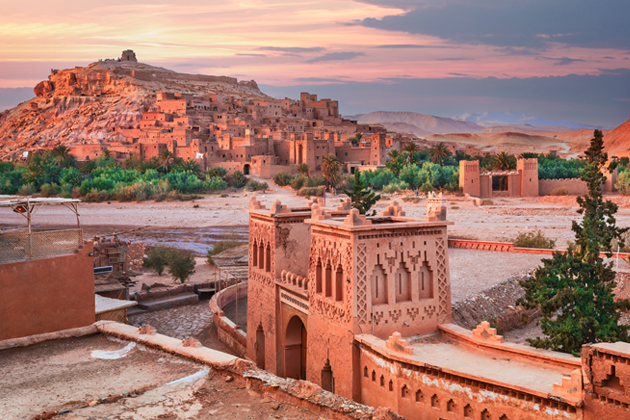
The Odyssey film location: the city of ‘Troy’: Ait Benhaddou, Morocco | Photograph: iStockphoto / emicristea
To find the movie’s ‘Troy’, travel around 115 miles by road southeast from Marrakech to visit the familiar Ksar of Ait-Ben-Haddou, the fortified ksar (a traditional Berber fortified village or granary) near Ouarzazate.
No fewer than 60 extra structures were temporarily added for the film, including the pillared ‘Temple of Athena’ and the city gates, altogether covering 2.5 acres (110,000 sq feet) which cinematographer Hoyte van Hoytema rigged with banks of portable LEDs supplementing the (very carefully contained) flames for the spectacular destruction of the city.
Standing on the former caravan route between the Sahara and Marrakech in the foothills of the High Atlas Mountains, Aït Ben Haddou is a great example of southern Moroccan earthen clay architecture and in 1987 was designated a UNESCO World Heritage Site.
The spectacular site is already a movie star, having appeared in films such as Ridley Scott’s 2000 Oscar-winner Gladiator and his 2005 Kingdom Of Heaven, David Lean’s Lawrence of Arabia, the 1962 epic The Last Days of Sodom and Gomorrah (co-directed by Sergio Leone and Robert Aldrich), 1985’s Jewel of the Nile and – inevitably – Game Of Thrones as ‘Yunkai, the Yellow City’).
Aït Ben Haddou is accessible by bus from Marrakech.
The market town of Tahanaout in El Haouz , about 20 miles south of Marrakech, was also used for parts of the city.
Racked with guilt, Odysseus finds his memory dulled by eating lotus flowers supplied by the obliging Calypso (Charlize Theron) on the isle of ‘Ogygia’. Unwittingly, seven years pass before he begins to remember his journey home.
The pristine beach of ‘Ogygia’ is Dune Blanche (the White Dune) – a crescent of pale sand about 20 miles from Dakhla in Western Sahara. Not a top tourist spot, it is popular with kite surfers.
There is controversy though as Western Sahara, classified as non-self-governing by the UN has, since 1975, been administered by Morocco. Since this land is claimed by the Sahrawi independence movement, an open letter signed by the likes of Javier Bardem and Pedro Almodóvar among others condemned the shoot as whitewashing Morocco’s colonialism and called for the Dakhla scenes to be cut. They weren’t.
Dakhla is generally safe from crime for tourists but, as a disputed territory, there are specific regional sensitivities and military checkpoints.
Back to top ⏏
ITALY
All of the film’s Italian locations can be found off the coast of Sicily, an island you can reach via one of two airports: Catania (for the eastern side of the island) and Palermo (servicing the west).
It’s to the west of Sicily you’ll find the palace of ‘Ithaca’ where Penelope and her son Telemachus (Tom Holland) wait year after year for the return of the king, so central to the story.
The exterior, perched atop a hill, is Castello di Santa Caterina, a castle crowning Monte Santa Caterina on the island of Favignana, the largest of the three Egadi Islands just off the west coast of Sicily. (the interior was created in the studio in Los Angeles.
The location was perfect but, without permission to build an access road, a funicular lift was needed to carry equipment and supplies, while cast and crew needed to hike up the hill every day for the two weeks of filming here.
Alongside the palace was built the pig farm to which the ever loyal Eumaeus (John Leguizamo) is later exiled.
The castle is abandoned and you can only reach it as the actors had to, by foot via a steep, rocky ascent which can take between 30 to 45 minutes, but rewarding you with spectacular views.
Off the north coast of Sicily are the volcanic Aeolian Islands of Vulcano, Basiluzzo and Lipari which stood in for the mythological island of ‘Aeolia’, where Odysseus and his crew are subjected to terrible challenges by Poseidon.
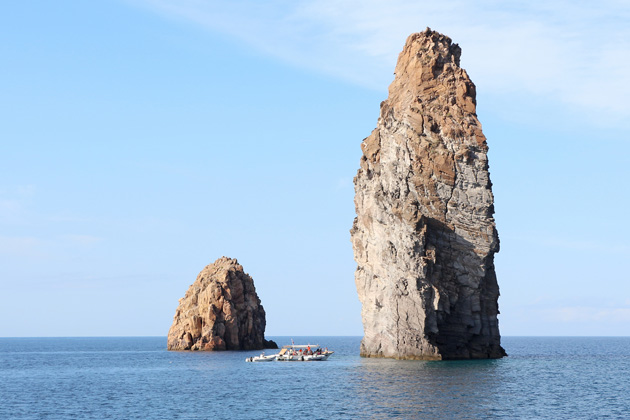
The Odyssey film location: the ‘Wandering Rocks’: Faraglioni di Lipari, Aeolian Islands, Italy | Photograph: Wikimedia / Bernard Gagnon
The crazily shaped vertical sea stacks standing in for Homer’s ‘Wandering Rocks’ are not digital creations but the Faraglioni di Lipari, two formations just off the southwestern tip of the island of Lipari, which are believed to have been Homer’s inspiration.
Called Pietra Lunga and Pietra Menalda, they are remnants of active volcanoes. Erosion has worn away their outer layers, leaving only the more weather-resistant columns of solidified magma known as “necks” or “volcanic spines”.
Off the western coast of Lipari are the waters of the Pietra del Bagno shoal, where the crew’s ears are stopped and Odysseus is tied firmly to the mast to avoid the beautiful but tormenting Sirens’ song.
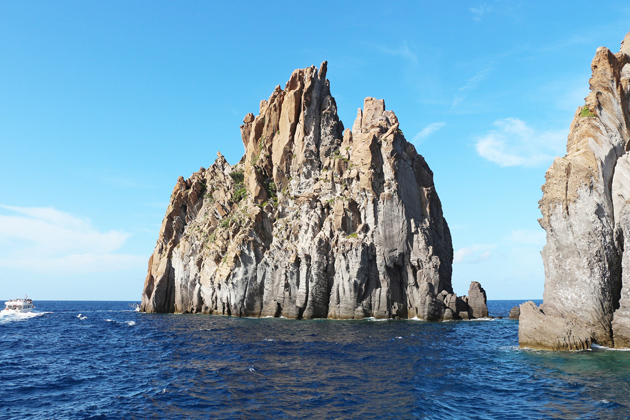
The Odyssey film location: the boat has to avoid six-headed Scylla: Scoglio Spinazzola, Basiluzzo, Italy | Photograph: Wikimedia / Bernard Gagnon
But that’s not the end of it by a long way. Avoiding the deadly whirlpool of Charybdis, the ship has to negotiate the treacherous channel where the six-headed Scylla picks off the crew one by one, which is at Basiluzzo, a smaller island between Lipari and the volcanic isle of Stromboli. The channel runs between the main island’s west coast and that towering jagged rock, which is Scoglio Spinazzola.
Basiluzzo is uninhabited, with no regular public ferries or docks, so if you do want to visit, you’ll need to book an organised boat tour from Lipari or Panarea.
To visit the Aeolian Islands, it’s best to fly to Catania and take the two-hour train journey to Milazzo, from where you can catch ferries to the various islands.
Back to top ⏏
GREECE
The Greek locations can be found in the Peloponnese, the large peninsula of southern Greece, reached by the Isthmus of Corinth land bridge. Reach it via Kalamata International Airport.
One of the first supernatural horrors faced by Odysseus’s crew on their journey is the terrifying, yet oddly pitiful, one-eyed giant Polyphemus (Bill Irwin) they encounter when they stop for supplies.
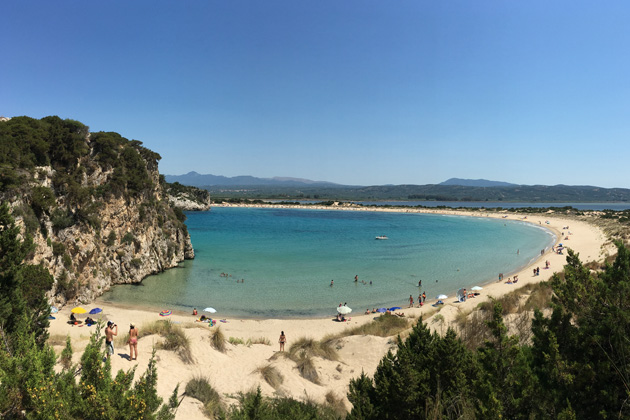
The Odyssey film location: Odysseus and the crew stop for supplies at the ‘Island of the Cyclopes’: Voidokilia Beach, Peloponnese, Greece | Photograph: Wikimedia / Georgios Michalagas
The ‘Island of the Cyclopes’, the gorgeous horseshoe-shaped cove, where they recklessly burn the village, is Voidokilia Beach, Messenia down in the southwest tip of the Peloponnese.
Following a stray sheep in order to find the rest of the flock, the crew comes across a cave inhabited by the giant, who’s happy to munch on any available human.
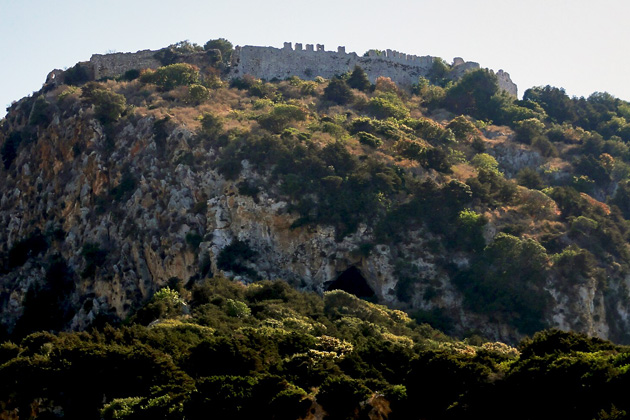
The Odyssey film location: the cave of Polyphemus the Cyclops: Nestor’s Cave, Peloponnese, Greece | Photograph: Wikimedia / Fae
This is the real Nestor’s Cave, above Voidokilia Beach, in which the crew find themselves trapped. Surprisingly, we’re not suddenly whisked off to a soundstage for the cave interior as is standard practice. The scene was filmed inside the cold, echoing chamber.
Unfortunately, the cave is not open to visitors, and the entrance can only be seen from a distance. It was occupied as long ago as 6,000 BC and, the legend claims, Nestor, King of Pylos kept his cattle here.
If the movie’s Cyclops, a combination of animatronics, puppetry, and Irwin’s physical performance, seems oddly familiar, the image was inspired by Francisco Goya’s painting Saturn Devouring His Son in Madrid’s Museo del Prado.
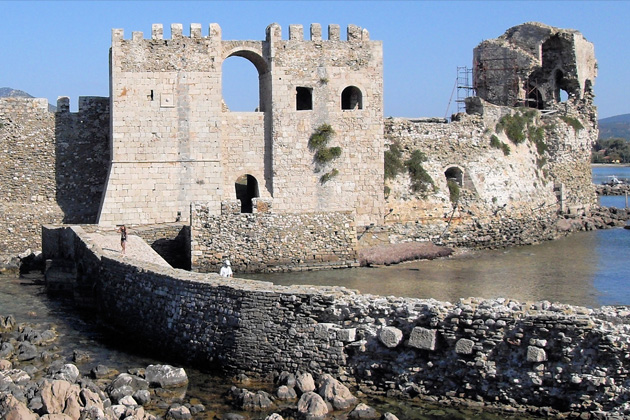
The Odyssey film location: Telemachus tries to find news of his father at the palace Menelaus: the Bourtzi, Methoni Castle, Peloponnese, Greece | Photograph: Wikimedia / Rauenstein
Methoni Castle, also in the Peloponnese but a little to the south, is a 16th century fortress later enhanced when it was occupied by the Venetians. Sitting at the tip of a peninsula connected to the mainland by a stone walkway is the Bourtzi, an octagonal tower which became the palace of Menelaus, King of Sparta (Jon Bernthal) and his wife Helen (Lupita Nyong’o) to which Telemachus ventures for news of his father.
It’s open to visitors (admission fee) except Tuesdays. As ever, always check ahead for times.
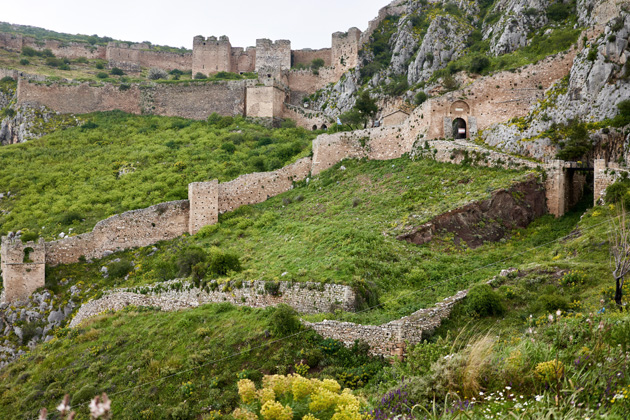
About 120 miles to the northeast, the flashbacks of Agamemnon’s (Benny Safdie) arrival in ‘Mycenae’ to a terrible welcome home from his vengeful wife Clytemnestra (also Lupita Nyong’o), were filmed 24 miles northeast of the real Mycenae at the fortified castle of Acrocorinth, overlooking the city of Corinth. Admission to the grounds is free, but the paths can be steep and uneven.
Back to top ⏏
SCOTLAND
The sun-drenched Mediterranean gives way to a cooler, mistier world when, lost at sea, the band come across what appears to be the welcoming coast of ‘Aeaea’, a stretch of pale, pristine sand overlooked by a pine forest. Desperate to find supplies, they enter the forest only to be attacked by terrifying armoured giants called Laestrygonians.
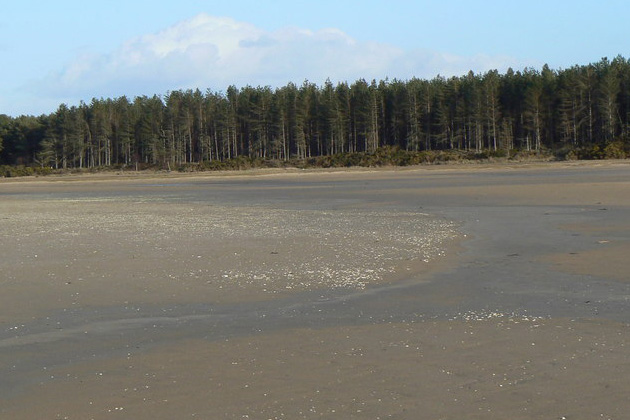
These pine groves are the vast Culbin Forest, on the Moray Firth coast about 25 miles northeast of Inverness in Scotland. You’ll find a car park northeast of the town of Forres and the A96.
As he did with the Cyclops, Nolan avoids too much reliance on CGI, bringing the giants to life through old-school forced-perspective and wirework as Odysseus’s men are thrown around like puppets.
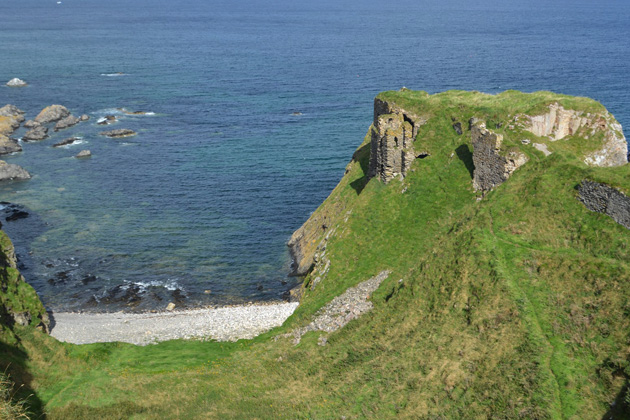
The Odyssey film location: the home of Circe on ‘Aeaea’: Findlater Castle, Firth of Moray, Aberdeenshire, Scotland | Photograph: Wikimedia / John M
The crew flees back to the ship but, without supplies, soon need to land again at lush green cliffs. The modest home of Circe (Samantha Morton), the generous and seemingly harmless woman who offers them food, was constructed just over 40 miles further east of the forest at Findlater Castle, atop the coastal cliffs east of the seaside town of Cullen on the A98.
To avoid damaging the Castle’s ancient surviving walls, Circe’s home was constructed on the approach to the promontory, next to its surviving ‘bailey’, taking great care not to impact the site’s unique archaeology.
You can visit but, obviously, take care on the narrow paths with some treacherous drops.
Back to top ⏏
ICELAND
After persuading Circe to return his crew to their human form, Odysseus asks her for help, and learns that he needs to get directions from Tiresias (James Remar) whom he can find by venturing to the underworld of ‘Hades’.
There’s another change of locale. The dark realm was filmed in southern Iceland during the endless, eerie “midnight sun” of June.
Odysseus’ ship, trading archaeological authenticity for immersive reality (to the irritation of scholars of Ancient Greece), is a modified Viking longboat, the Draken Harald Hårfagre, which was moored in the small port of Landeyjahöfn, and sailed to each of the many coastal locations when needed. Visit the boat’s website to discover its current whereabouts.

The Odyssey film location: the underworld realm of ‘Hades’: Black Sand Beach, Hjörleifshöfði, South Iceland | Photograph: Wikimedia / Attila Geréb
In the underworld, Odysseus finds himself facing the unquiet shades of the past on the black sands of Hjörleifshöfði, a steep, isolated headland surrounded by open volcanic flats on the coast of South Iceland east of Vik, with views toward Myrdalsjokull and Katla.
Vik is about 115 miles easy of Reykjavik, on Route 1. You could drive it in two-and-a-half hours if you’re willing to ignore the magnificent scenery en route. Better to take your time – or maybe use the bus service.
Back to top ⏏
MALTA
It’s not a location, but underwater photography, shipwrecks, and close-range ocean battles using practical effects and the newly-adapted IMAX cameras were filmed at the Mediterranean Film Studios in Kalkara on Malta, which is home to some of the world’s largest water tanks. The facilities have previously been used by the likes of the 1981 Clash of the Titans, Robert Altman’s 1980 Popeye, Captain Phillips, Assassin’s Creed and – of course – Game Of Thrones.
Back to top ⏏
LOS ANGELES
Although as we’ve seen, the exterior of Penelope’s palace on ‘Ithaca’ was filmed off the coast of Sicily, the huge interior where she constantly weaves and where the final act plays out, was built on Stage 12 at Universal Studios Hollywood, 100 Universal City Plaza, Universal City in the San Fernando Valley just north of Hollywood. Yes, it’s the home of the spectacular studio tour / theme park.
Back to top ⏏