
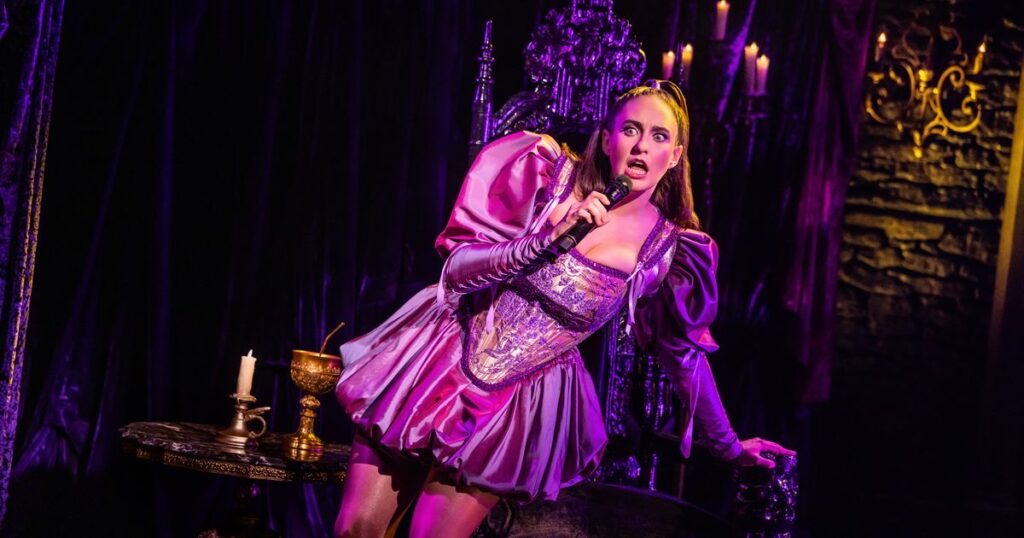
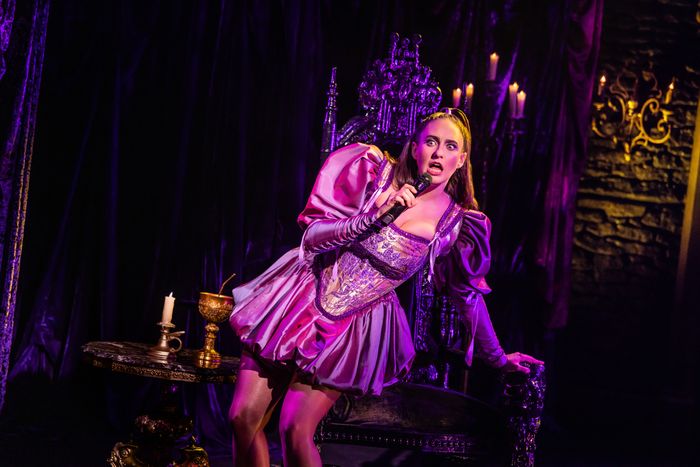
Cat Cohen in Broad Strokes at the Lortel.
Photo: Matthew Murphy
Cat Cohen would love to be special, just not too special — a protagonist but not someone who actually experiences too much drama. At the Lortel, her one-woman show plays out on a candlestick-heavy gothic set by Derek McLane that resembles a Barbie Dreamhouse modded for a Meat Loaf video, and Cohen enters in an haute-Ren-faire pink maiden’s dress by Kelsey Randall. But Cohen, who performs a mix of comedy and music as if she’s Sara Bareilles’s rambunctious younger sister, quickly punctures the mood with one of her run-on jokes: “It’s thrifted,” she says of the dress. “It’s not, but wouldn’t that be amazing if it was? No, I got it made custom, like a dumb bitch.” That’s not even the end of that particular run. Cohen’s comedy in Broad Strokes has her doing quick switchbacks between the limiting expectations of millennial feminine relatability. In this case, the line of thinking zooms past a joke about love languages and into a punch line that’s a pileup of proper nouns: “My dream is to be fingered while using Apple Pay to buy a Baggu bag.”
If you know Cohen’s work, as many in my audience seemed to, the zigzagging quality of Broad Strokes’s opening moments captures her loose but dense style. In her jokes and songs, she throws handfuls of daggers at recognizable targets to an audience that’s young, too online, and partial to jokes about ketamine. Within the space of a verse, some of her jokes will hit cleanly — you do have to hear her purr “Baggu” — while others wildly miss the mark, whether for being too easy or too coyly self-defensive or delivered so hastily they don’t have time to breathe. Watching Cohen’s work in the past, I’ve found myself by turns impressed, frustrated, won back by dint of her relentless ability to work a room, and then frustrated again by her tendency to write lyrics in which the emphasis falls on the wrong syllable. The tension, as this performance unfolds, builds because something has knocked her (or the persona she has created) out of her typical eddy of delusional grandeur and self-punishment and made her incontrovertibly a main character: a freak stroke Cohen experienced at 30 while watching Selling Sunset. All her life, as she describes it, Cohen had seesawed between seeing herself as a normal girl (“I like Sauvignon Blanc, I like Zara — the tops; the pants don’t fit”) and as a Victorianish hypochondriac, a woman of drama and maladies who should be convalescing by the sea. Suddenly, the latter suspicion gets confirmed: A doctor tells her that she has a literal hole in her heart and that she must cancel a planned tour of Europe (always pronounced like she’s hiccuping Champagne) and get an expensive, extensive operation.
Medical news of that kind is terrifying to receive, even if Cohen and her director, Alex Timbers, keep the mood light. (The two make a charmingly maximal collaboration; he’s a showman, she loves a show. Let her take over for Bobby Darin in Just in Time and do her throaty impression of a jazz singer.) She punctuates the story of her hospitalization with a quick sketch of an oblivious gay nurse and an aside about how getting texted your results out of the blue feels as intrusive as someone accidentally sending shit-talk about you directly to you. It’s also a good plot: We know Cohen will make it through, but we wonder how having main-characterness thrust upon her will change her.
Cohen honed her act at the forefront of a clique of comedians who performed cabaret comedy, often at Club Cumming, in the late 2010s. And as my colleague Kathryn VanArendonk noted in a review of Cohen’s 2022 Netflix special, the fact that so many comedians — Rachel Sennott, Meg Stalter, Rachel Coster, Esther Fallick — were influenced by her has the effect of making Cohen’s own work overfamiliar. (She’s working too in a mode that itself recalls the camp liberal-arts philosophizing of Kate Berlant and John Early.) That special, stalled by the pandemic, was built around many of Cohen’s jokes about dating woes but had to accommodate the destabilizing admission that she had in fact found a happy relationship with a boyfriend. In Broad Strokes, Cohen advances her character further toward a new frontier, though gently and hesitantly. The boyfriend is still around (he does an admirable job getting her through the hospital and is the butt of a very funny joke about a blowjob), but there are still plenty of jokes about exes and her incessant need to be liked. Broad Strokes often resembles a greatest-hits reel of Cohen’s classic comedic interests, yet it’s most engaging when Cat Cohen, author, is seriously pushing the persona of Cat Cohen against the sieve of being a serious adult. How far into your 30s can you cling to the identity of having been “young for my grade” in school? She modulates into a darker register near the end of the quick 65-minute show, in a song about her fantasies and fears of an alternate, quieter life. It’s a Stepford-ish sequel to her song about going upstate. “I want to be a normal girl / Had a baby, it didn’t hurt,” she sings, “City got crazy so we moved to the burbs / My husband could kill me with his hands, but he won’t.”
The metatext here is that Cohen is also trying to fit her persona inside the particular demands of a specific burgeoning type of comedy-theater solo show. Broad Strokes follows in the footsteps of solo performances like Josh Sharp’s Ta-da!, Alex Edelman’s Just for Us, Morgan Bassichis’s Can I Be Frank?, and Berlant’s Kate, all via super-producers Mike Lavoie and Carlee Briglia, that try to function as both comedy and theatrical confessional and can tie themselves in knots trying to serve both masters. Broad Strokes is less insistently self-aware than other entries in this catalogue, though the same currents are at play within it. How much must Cohen tell you about her trauma to elevate this from just an hour of comedy to something else? Does she want to?
Although this performance does dip into a reckoning with her more basic shadow self, Cohen brings Broad Strokes to its conclusion briskly and with minimal bathos. She doesn’t discount the destabilizing experience of her heart operation, but in character at least, she would prefer not to linger on it. She offers the pat lesson that because a bad thing happened, good things may also happen, and a goofy closing number keeps swerving away from her surgery to ramble about psychics on the beach and friends who are hooked on ChatGPT. It’s a moment that reveals both the pleasures of Cohen’s persona — she has created a character who can metabolize anything with humor, from a minor slight from a blonde at a birthday party to life-threatening medical distress — and the limits of her style. To achieve that effect, Cohen will bend any rule for the sake of a good joke, even and especially at the level of songwriting: Her lyrics break scansion more often than they keep it, and her melodies doodle aimlessly in order to contain her pileup of observations. The joke contained in the jokes often is that the songs are funny because they are formless, but they are indeed still formless. A touch of structure or a clean rhyme scheme would go a long way. Broad Strokes provides a mirror experience to watching Rachel Bloom’s Death, Let Me Do My Show (also a Mike and Carlee joint), in which her focus on watertight parody songwriting held the show’s emotional effects at bay. Somewhere between looseness and rigor lies the best way to render a cabaret act as theatrical comedy. You have to make something special but also familiar. You have to be the heroine but also — as dreary as it may seem — sometimes that normal girl.
Cat Cohen: Broad Strokes is at the Lucille Lortel Theatre.
Sign up for the Vulture Daily
An entertainment newsletter for the pop-culture obsessed.
Vox Media, LLC Terms and Privacy Notice
Related