
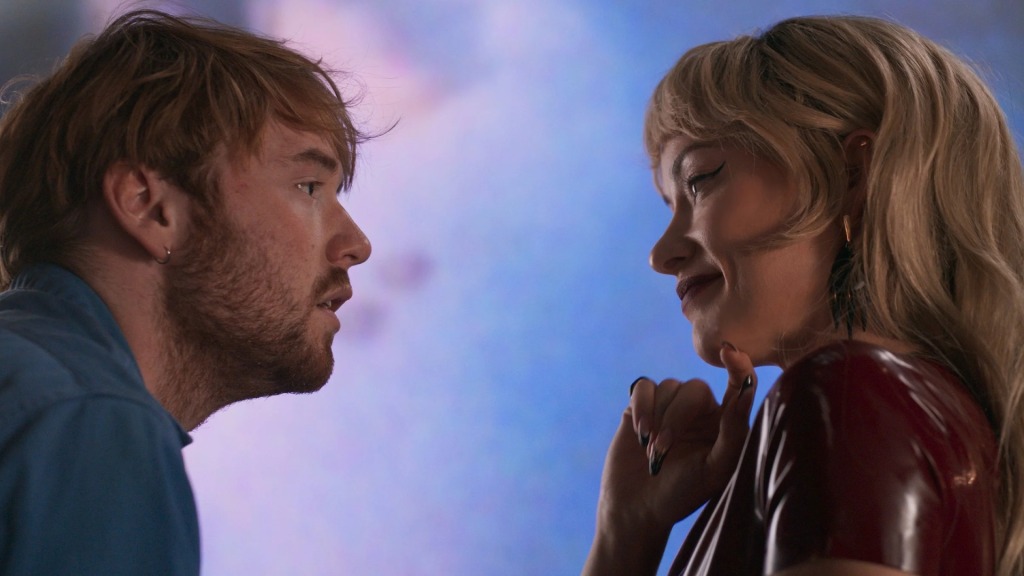
Since Cooper Hoffman made his film debut in Licorice Pizza, a film made by a friend of his father Philip Seymour Hoffman, the actor has been typecast in a way almost entirely unlike young stars of his ilk. He’s not an action hero, or a zany comedian, or a heartthrob hunk, or an anonymously handsome everyman who can be slotted into the latest brand-accurate live-action piece of IP. Rather, Hoffman’s early career has seen him become the go-to young man who falls head-over-heels for an older woman, capturing something essential about the experience of getting in over your head when crushing on someone out of your league (and your age demographic).
An underage teen getting involved with cool older girl Alana Haim is really different than a twentysomething employee getting sucked into a BDSM-heavy Sunset Boulevard situationship with his boss Olivia Wilde (as happens in Gregg Araki’s I Want Your Sex). Both of these are different from a college kid projecting immature feelings onto his older classmate Leslie Mann (as happens in Maude Apatow’s directorial debut Poetic License). Yet, the same kinds of coming-of-age principles apply to all these movies, as do Hoffman’s strengths as a performer. From his very first role, his bouncy, happy-go-lucky, Labrador-like confidence—an embodied sense that everything will go right for him, if only because his sunny worldview refuses to allow other possibilities—overwhelms the other telltale signs of a precocious movie youth.
This arrives fully formed in Licorice Pizza, where teen actor Gary Valentine acts older because he’s a Hollywood professional already adept at hustling, a guy trained to be “on” from a young age, to whom performing is as natural as breathing. Why wouldn’t he want to play another, older role—the young romantic—especially as his youth-centric acting work dries up? Valentine’s puppy-love circling of 25-year-old photo studio employee Alana (Haim) is more about what she represents than her as a person, a common thread among Hoffman’s early age-gap kinda-romances. Alana seems like a door to an adult world he keeps pretending to know like the back of his hand, even though Licorice Pizza cares enough about her character to reveal that she’s mostly just faking it too.
This dichotomy operates in a more obvious way in Poetic License, where Leslie Mann’s Liz—a woman who audits a poetry class at the university where her husband teaches—becomes the object of relatively innocent infatuation for two of her college-aged classmates (BFFs played by Hoffman and Andrew Barth Feldman). Even if Liz wasn’t the mother of a high school senior about to enter college in her own right, Mann is literally the mother of director Maude Apatow. The mommy issues are palpable.
The boys’ stereotypical desire for a mature, motherly presence (that also has the possibility of romance) is sweet at times, but it is also inescapable. Thankfully, Liz’s own dissatisfactions with her life are given plenty of space, which helps separate the film from more one-sided comedies featuring messy men and put-together women. There’s an honesty to Poetic License‘s unearthing of the subtext pervading the era of slacker dude comedies (these man-children want moms!), and it all plays much more palatably because of Hoffman’s earnestness. He’s not looking to be taken care of, he’s striving to be taken seriously.
This unifying factor across these roles is perhaps why all these women end up actually giving him the time of day. Hoffman’s performances rely on soft, energetic affability—it’s an alluring approach for his female foils, especially those worn down by the world of men, looking to find appreciative male attention or otherwise bask in the glow of nonthreatening desire.
This comes to a head in the most explicit and subversive of these onscreen relationships: that in Araki’s horndog dramedy I Want Your Sex. But the film isn’t subversive because it portrays a younger man as the more-than-willing submissive to an established female dom. Rather, it’s subversive in the context of Hoffman’s other early roles—this age-gap relationship actually does lead to a painful power imbalance. Araki weaponizes Hoffman’s boyishness to give his character Elliott a leg-humpingly potent sex drive—all that guileless charm is poured into various kink scenarios—one that confrontational artist Erika Tracy (Wilde) takes full advantage of.
Like in Pillion, Elliott has an aptitude for devotion and a partner happy to exploit it. Erika sees plenty of potential in this manic doofus, and their Secretary fling allows him to sexually come of age, discovering all the enjoyable ways he can leave the world of prudes behind…before getting predictably burned by a woman who everyone warns him will chew him up and spit him out. The heartbreaking moments work just as well as the funny, sexy ones, because Hoffman succeeds at conveying just how legitimizing it is to be taken seriously by someone you admire.
One of the funniest jokes in I Want Your Sex is a framing device where some cops, questioning Elliott about a crime, describe him as being groomed by Erika. Elliott protests that this was all very consensual, and part of Hoffman’s talent lies in how easily he makes this statement believable, silly, and disarming all at once. His onscreen characters might be impatient to grow up, but they’re also invested enough in the present that their relationships always feel honest. The actor’s bright presence in these films, his visible admiration of his scene partners, his slack-jawed grin that almost breaches himbo territory—these aren’t qualities shown off by many rising stars, which might be why Hoffman’s early career doesn’t have many peers. Like so many of his characters, he already seems like he’s on his way to bigger things, like he naturally fits into a more established world and is simply stuck in another for the time being thanks to a temporal fluke.