
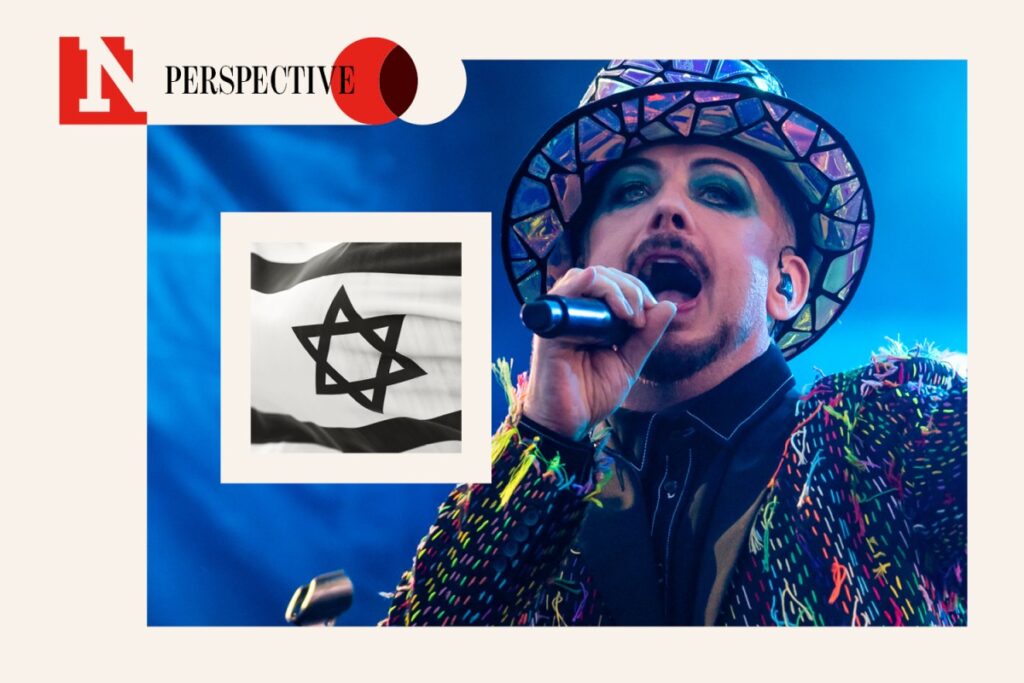
“You say genocide, I say war,” Boy George sings in “We Will Dance Again,” a new pro-Israel song igniting discussion over its lack of ambiguity and its jarring clarity.
In an era of celebrity laments about suffering on all sides and safe appeals to peace and statements written to offend as few people as possible, Boy George attempts to cut through the usual evasions in a reggae-tinged track he posted to X and Instagram on July 26 with the Hebrew title “עוד נרקוד” and the caption “Shalom.” The song invokes the October 7 Hamas attack on the Nova music festival, rejects the genocide charges against Israel and turns solidarity with Jews into its chorus.
The result is a revealing declaration of allegiance, one that stands in contrast to the many visible Gaza-related celebrity gestures that have leaned toward ceasefire campaigns, Palestinian solidarity and careful neutrality.
Read More on Analysis
“We Will Dance Again” points to the new rules now governing celebrity politics. Rules that revolve around a single concept: Showing compassion is no longer enough because the audience wants to know where the loyalties lie.
These rules are unwritten, unevenly enforced and constantly shifting, but they govern the celebrity outrage economy with remarkable force.
Rule 1: Neutrality No Longer Works
The safest celebrity statement used to be the broadest one and it involved condemning hate, mourning civilians, praying for peace, saying no to extremism…and not saying much else.
That language still exists, but in the Israel-Gaza debate, it increasingly lands among many critics as evasion. A statement that might once have sounded humane now risks sounding like an attempt to slip through the argument without choosing a side.
Boy George’s song strikes a chord because it refuses that middle register. “You say genocide, I say war” is not a plea for shared sorrow but a choice of vocabulary, and therefore a choice of side. The chorus goes further: “If you’re ever confused: I stand with the Jews.” There is no room there for interpretive rescue.
That is the first rule of celebrity politics now. Clarity has become the performance.
Rule 2: Every Platform is Political
Boy George posted his new track directly on social media, where music is not just heard but clipped, quoted, denounced, praised and dragged into arguments that can last for months.
That matters because modern celebrity politics is judged in the same spaces where it is distributed. On X and Instagram, the public is not merely being asked to listen to the song, it is being asked to line up for or against it.
The same dynamic shaped the red Artists4Ceasefire pins at the 2024 Oscars. The pins were small enough to sit on a lapel, but visible enough to become one of the night’s political symbols. They did not need a speech to work, the image and the environment did all the work.
Rule 3: The Art is the Statement
Remember a time when the actor gave an interview, the singer signed a letter, the director posted a statement and the art itself remained, at least formally, separate? Goodbye to all that.
Boy George’s song does not merely endorse a position or invite a conversation, it’s the position itself.
No Music for Genocide, an international cultural boycott initiative, has pushed the same logic from the opposite direction, urging artists and labels to remove or geo-block their music from Israel. The Eurovision boycott campaign has turned participation in a song contest into a test of political legitimacy.
The new question is not only what artists say or where they say it, but which audiences they are willing to reach, which audiences they are willing to refuse and whether culture itself can be used as leverage.
Rule 4: Backlash Confirms the (Right?) Choice
In the older celebrity-politics model, backlash was something to survive, but now the drama often functions as evidence that the speaker has been sorted correctly.
Is everyone screaming at you? Congratulations!
Melissa Barrera was dropped from “Scream VII” after social media posts about Israel and Gaza and Susan Sarandon was dropped by UTA after remarks at a pro-Palestinian rally. Their fans interpreted those cancellations as further evidence that their idols were being silenced or penalized for speaking out and were therefore deserving of even more praise.
In reverse, Boy George had to know a pro-Israel song rejecting the genocide charge would draw backlash and that bluntness suggests that was not a flaw in the release but part of it.
Rule 5: The Old Liberal-Celebrity Consensus Has Cracked
Boy George’s song may feel rare because the most visible parts of celebrity culture can often skew progressive, and the progressive cultural position on Gaza has increasingly leaned toward ceasefire demands, Palestinian solidarity and boycott campaigns.
But the industry is not as unified as its loudest signals can make it appear. Gal Gadot, Jamie Lee Curtis, Jerry Seinfeld, Helen Mirren, Mayim Bialik, Michael Douglas and others appeared on pro-Israel entertainment-industry letters after October 7. Billie Eilish, Mark Ruffalo, Ramy Youssef, Ava DuVernay and others were associated with ceasefire gestures at awards-season events.
Celebrity culture once offered a relatively predictable moral vocabulary, but Gaza has scrambled that, as evidenced by Boy George’s new song, which lands inside that cracked consensus—especially because he is a figure long associated with queer pop culture and the broader liberal imagination.
Rule 6: The Audience Now Grades the Vocabulary
In today’s celebrity politics, it’s not just what public figures believe but the words they choose that define them. Audiences scrutinize every term and every omission, treating the vocabulary itself as a moral and political statement.
Did the actor say “hostages” but not “Gaza?” Did the singer say “ceasefire” but not “Hamas?” The audience no longer hears only the words that are spoken but those that are missing, which makes Boy George’s “You say genocide, I say war,” feel even more poignant.
Rule 7: Silence Speaks
The final rule may be the most punishing one: a celebrity can still say nothing, but the audience may not interpret that silence to mean nothing.
Boy George’s song matters because it makes that dynamic explicit, turning a political vocabulary choice into a declaration of allegiance. Today’s audiences no longer hear only expressions of empathy but look for evidence of placement.