
Photo: Jon Laytner for New York Magazine
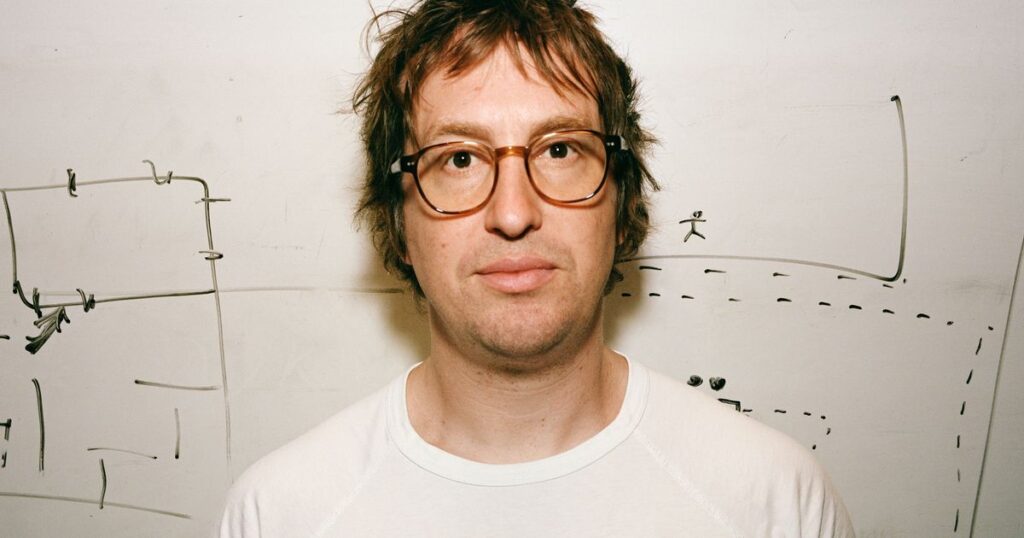
On a leafy corner in Toronto’s Roncesvalles neighborhood, Matt Johnson leads me into his apartment. The cozy one-bedroom he shares with his fiancée features a washer-dryer squeezed into the kitchen, a coffee table doubling as storage, and living-room walls lined with movie posters: Back to the Future, The Fifth Element, Harmony Korine’s Gummo. Along the narrow hallway, bookshelves burst with first editions of John Updike, battered Stephen Kings, graphic novels, dime-store paperbacks, board games, books about mythology, children’s fairy tales, and Warhammer rule sets. Home is where Johnson reads, writes, and spends mornings, unless he’s at the coffee shop up the street or at Zapruder Films, the production company he co-founded with longtime collaborator Matthew Miller, a 15-minute walk away. “This is a magic place,” he says.
Despite the July heat and the Ontario wildfires blanketing the city in a jaundiced haze, Johnson’s practically bouncing as he watches me scan the bookshelves. Within seconds, he’s pulling out things to show me. Updike’s The Coup: “It’s about a French African ruler who goes on an adventure and loves women!” John Braine’s Room at the Top: “This book utterly changed my life.” Elena Ferrante’s The Story of a New Name: “Have you read this? Doesn’t get better than that, eh?” A thick spine reading “COMSTAT” in the corner catches my eye. “Oh, that’s funny,” he says, retrieving what turns out to be a binder. “That’s actually my Magic cards.” Inside are neatly sleeved Magic: The Gathering collections, X-Men drawings he made with his brother as a kid, and, on the first page, his father’s old business card with a young Johnson’s scribbles. “My dad was in sales,” he says. “Sales plus reading — that’s the secret of my life.”
The 40-year-old Canadian filmmaker is weeks away from the premiere of A24’s Tony, his first film produced within the American studio system, which is slated for limited release on August 7. Starring The Holdovers’s Dominic Sessa as a young Anthony Bourdain, the film is a sorta-kinda biopic that draws inspiration from a few chapters of the late chef turned writer and travel personality’s breakout 2000 memoir, Kitchen Confidential, zeroing in on the mid-1970s period when he first starts working in restaurants in the seaside haven of Provincetown, Massachusetts. Johnson’s film reworks those pages into a classic coming-of-age tale: A young lout lies, runs away from home to chase a girl, stumbles into a dishwashing job, and gets his ass whipped into shape.
It’s an unexpected choice for Johnson’s Hollywood entry. His first two features were loose, low-budget films starring himself and made by messing around with friends; they were built on spontaneity and the belief that a movie reveals itself in the edit. 2013’s The Dirties, a found-footage comedy-drama produced in his 20s and populated with real students, sees him and collaborator Owen Williams embed in an actual Toronto high school as bullied, movie-obsessed teens filming a revenge flick, a premise that curdles into a portrait of Johnson’s character as an edgelord school shooter in the making. His follow-up, 2016’s Operation Avalanche, again with Williams, pushes the guerrilla instincts further: The pair, posing as student documentarians, sneak into real NASA locations for a story about two CIA agents tasked with faking the moon landing in 1967.
Running alongside those two films was the project that made Johnson a cult figure: Nirvanna the Band the Show, an idiosyncratic late-aughts web series that became a Viceland show between 2017 and 2018. It follows fictionalized versions of Johnson and a friend, musician Jay McCarrol, as they pursue absurd schemes to get their band booked at the Rivoli, a once-storied Toronto venue. Each episode barrels forward with the logic of a live-action cartoon, hijacking the visual language of everything from My Dinner With Andre to Dog Day Afternoon, while cramming in references to pop culture, video games, and Canadian esoterica. Its public sequences, shot among unsuspecting bystanders, blur performance and reality. In Nirvanna, style is substance, an expression of Johnson’s own culturally saturated persona, who’s convinced, like a middle-schooler operating on Underpants Gnome logic, that reality will bend to sheer force of will.
What started as Johnson goofing around with friends reached an apotheosis earlier this year with the release of Nirvanna the Band the Show the Movie, a Back to the Future–riffing feature integrating newly shot escapades with decades-old footage of Johnson and McCarrol that created unexpectedly poignant beats on growing older. The film earned rave reviews at SXSW, was acquired by Neon, and sent Johnson and McCarrol crisscrossing North America on a nearly sold-out screening tour. “I didn’t expect it at all,” Johnson says. “It was very humbling.” Once known mostly to Toronto cinephiles, he now routinely gets recognized on the street. Out by his apartment, a honeymooning couple from Santa Cruz, California, stops us. The starstruck groom says they attended a Nirvanna screening in San Francisco and he’s a huge fan, and Johnson shares plans with the couple for the series’ upcoming DVD release. “I’m happy you guys got married,” he tells them as we part. Johnson will also be a groom in the near future; his wedding in Toronto is scheduled for the day after Tony hits theaters in New York and Los Angeles.
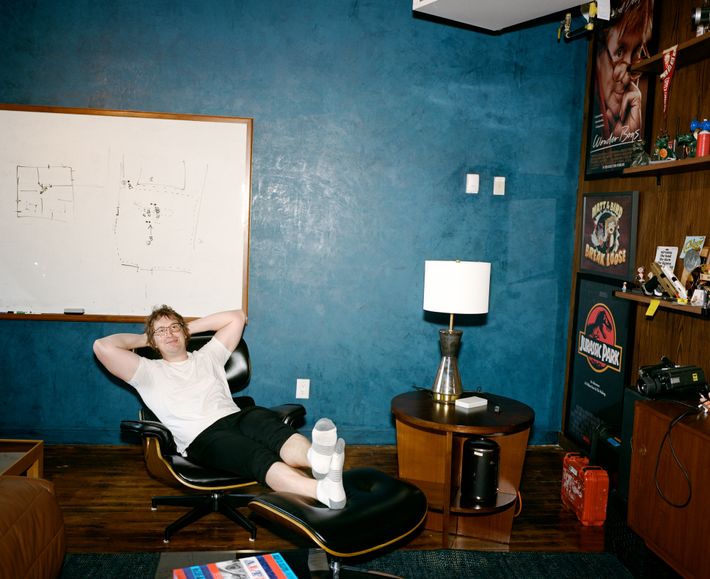
Photo: Jon Laytner for New York Magazine
Johnson leads us into the Revue Cinema, the independent theater where he catches at least one film a week. (Among his movie takes: “Heat 2 is a huge, huge mistake.” “Wonder Boys is a great, sadly forgotten film.” “The first half of Malcolm X is good and then it devolves into nonsense.”) Gazing across the empty hall, he recalls marveling at how young the crowd was at the sold-out Nirvanna showings there. Youth is a thread he returns to often. He treats childhood as a wellspring, describing his Nirvanna characters as impersonations of real kids: how they speak and scheme, their playfulness and total disregard for social friction and boundaries. He talks about being shaped by childhood obsessions — watching Star Wars and Star Trek: The Next Generation, playing Magic: The Gathering under the covers by flashlight — and how motivated he is to pass that wonder forward. “I was so spoiled with all of these cultural artifacts that I was literally drowning in them. It was, like, orgasmic,” he says. “At the same time, I think it created in me a feeling of You owe.”
Nirvanna expanded Johnson’s profile, but it was 2023’s BlackBerry that transformed his career. The film turned the smartphone’s rise into a story of two founders — Jay Baruchel’s quiet, technically gifted Mike Lazaridis and Johnson’s sweet, fun-loving Doug Fregin — bulldozed into a global empire by Glenn Howerton’s screaming, shit-breaking Jim Balsillie. Prior to signing on, Johnson says he was “a scumbag Toronto filmmaker that was totally broke but not upset about it.” Years of shoestring productions had given him creative freedom, but Zapruder Films was running out of money, and with Viceland Canada having folded in 2018, they couldn’t make more Nirvanna. A longtime advocate for first-time filmmakers, Johnson had even considered an opportunity teaching film at the University of British Columbia, having loved his experience teaching at York University between 2018 and 2021.
So when producer Niv Fichman brought Johnson and Matthew Miller a nonfiction book about BlackBerry’s rise and fall that the CBC had optioned as a TV series, they expected to write the script, collect a paycheck, and move on. Johnson took the job partly out of patriotism; he was bothered that so few people knew the smartphone was a Canadian invention. He also found his way into the story by approaching its three leads as competing facets of himself: Fregin’s innocence, Lazaridis’s technical obsession, and Balsillie’s megalomaniacal ambition. The hired-gun TV assignment morphed into a feature — Johnson’s most conventional film to date — and he started going out to established actors like Howerton and Baruchel. “It was so much like that David Foster Wallace quote,” Johnson says. “We thought we could do it cynically and it would have no effect on us. Then it rolled out of control.”
BlackBerry became a critical darling, earned a Golden Bear nomination, swept the Canadian Screen Awards, and landed on the National Board of Review’s list of the best independent films of 2023. Hollywood started calling. Johnson had been developing another project (described as a “TSA comedy”), and Josh Safdie began flying him to New York to work on it. But many of the early opportunities — more biopic-adjacent, corporate-bro stories in the vein of BlackBerry, including an adaptation of Michael Lewis’s Flash Boys — held little appeal. Among those was Tony, a Black List script by Todd Bartels and Lou Howe that King Richard producers Tim and Trevor White brought to Johnson. He initially passed, largely because he barely knew Bourdain’s work. “In my head, he was no different from Guy Fieri,” Johnson admits. He was also wary of taking on a figure whose legacy had been elevated into secular sainthood after Bourdain’s 2018 suicide. “He clearly means a lot to other people,” Johnson says. “Why would I step into the fray of something like that?”
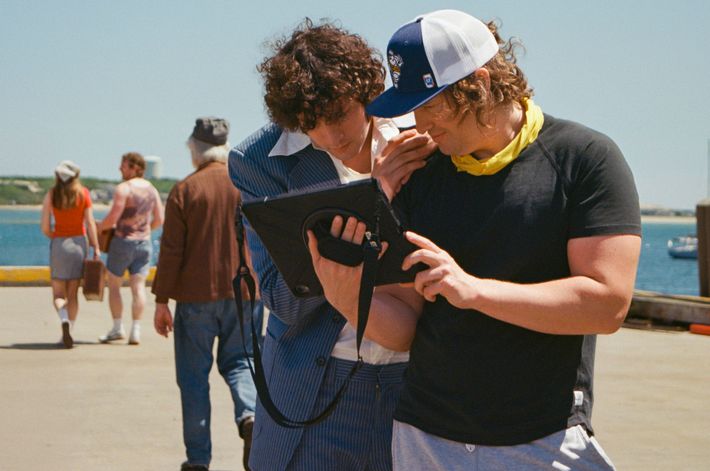
The answer came through a lunch date with Dominic Sessa in New York. Johnson had loved Sessa in The Holdovers and arranged the meeting, during which the two instantly hit it off. By that point, Johnson had moved past the Bourdain project, but discussing it with Sessa “transformed what was a kind of dull prospect into something shiny and new.” Both were drawn to what this period of Bourdain’s life represented: the unstable, unfinished years when someone is still inventing himself. Johnson pieced together the basic building blocks of the story on the spot. “We told A24 that we were thinking about making this movie, and they said, ‘You’re going to make this movie with us right now,’” he says.
With Sessa filming Tony.
Photo: A24
After leaving the Revue, Johnson waltzes us into Anchor Fresh Fish Market, a weekend favorite, for fish jerky. At the register, he points out the knife he bought, along with a dozen oysters, after figuring he should learn how to shuck while writing Tony. The movie is as much a biography of Bourdain as it is of Johnson. The character of Bourdain’s mother, played by Dagmara Dominczyk, is directly inspired by Johnson’s mother, a physician whose exacting standards both intimidated and shaped him. “She’s a very sweet, nice woman, but as a child, I was terrified of her,” he says. “She would often say, ‘I love you, but I don’t like you.’” (Their dynamic even surfaced in The Dirties, when Johnson filmed his mother without her knowledge, capturing her response to what she thought was a question from her son rather than his character: “You say a lot of wacky things. I don’t know why you do that. For effect, I guess.”) Like Tony’s protagonist, Johnson grew up convinced he was meant for more. “My whole childhood, I was always told by my teachers and people in my outside-the-house world that I was destined for something,” he says. “That was not my experience at home whatsoever. That left me with a feeling of Well, I had better do something.” The young Bourdain’s early self-mythologizing echoed Johnson’s own instinct to invent himself before he’d earned it: “Lying and manipulating — putting on a false identity of somebody who has achieved something even though I had done nothing — was a way to patch things over because I felt there was an expectation on me to be great.”
Tony imagines Bourdain as a young man trying on identities, sketched with just enough of the real figure’s contours drawn from Kitchen Confidential to feel familiar: arriving in town in a crisp, light-blue seersucker suit modeled after Pierre Cardin; burning his hand on a blazing-hot cast-iron pan; witnessing a chef bone a new bride behind the restaurant. Head perpetually hung, Sessa’s Bourdain is a gun looking for somewhere to point, caught between opposing role models: Leo Woodall’s hedonistic, hypermasculine Masshole and Antonio Banderas’s regimented, elegant face of the culinary world. That restlessness, and how it breeds a combustible urge to cross lines, shows up in a number of Johnson’s creations. The Dirties includes a scene where Johnson’s out-of-touch high-school character is in blackface, while the Nirvanna web series has bits that carelessly chase juvenile provocation, including stray uses of racial accents and slurs. Johnson sees that material as part of the messy process of adolescence, but it can come across as edgelordism, a term Johnson relates to differently than most. “To me, that is just the persona of a kid literally trying to find the edge of the social boundary that he’s in. I find it so unbelievably addictive, and it animates me,” he says. “Of course, I’m an adult now, and so that’s been sublimated into a usable personality where I’m not seeking out the edge at all times whatsoever.” The Viceland series retains that boundary-pushing impulse but with more restraint and a sharper grasp on the joke being on its leads. When Johnson’s character deadpans about Jewish people hating Christmas, for instance, the humor is rooted in watching him dig a deeper hole for himself.
Johnson has been asked about those choices often enough that he notes he should have “a canned answer by now.” He views it “in the way that I would look at any young person who’s, in their own way, trying to find a way to be funny: I’m completely openhearted about it.” He feels sorry for the times the show didn’t land the way he and McCarrol intended, but he’s “completely unjudgmental” toward his younger self. Would he have done anything differently? “Absolutely not,” he says. “That would be like me going back in time and slitting my own throat. It made me — for better or worse.”
Filming Tony was a bruising experience. “It was a combination of how I shoot movies colliding with the American system — and I mean colliding,” he says. The sheer scale of the machine felt alien. Without his full production team, who couldn’t join the Provincetown shoot because of visa red tape and cost, Johnson was a man stripped of his native tongue, learning on the job and unable to replicate his loose, experimental style inside the new infrastructure. He recalls a perfect Atlantic sunset and wanting to just let Woodall and Sessa exist within it while the camera rolled, an instinct that time and money wouldn’t allow. “It’s not like there was a single person saying, ‘No, you can’t do that,’” he says. “I mean, sometimes there was. But the kid in me was not invited to set, to use a metaphor.” Johnson, rarely prone to negative feelings, felt “complete and total dread” during the filming; exhausted near the end of the shoot, he was talking through a scene with Stavros Halkias when the comedian told him, “Oh, man, even you can’t make it seem like this is a good situation anymore.” He ultimately found his creative footing again after working with Miller to build the studio’s trust, gain more control over postproduction, and reunite with his longtime creative team. (His usual editors, Curt Lobb and Robert Upchurch, cut the film, while McCarrol does the music.) “I got to make the movie I wanted to make, even though we took the long road there,” he says.
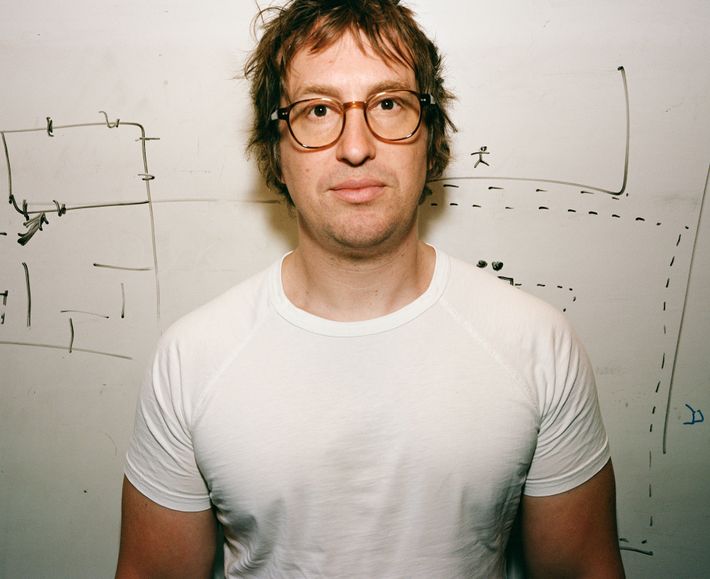
Photo: Jon Laytner for New York Magazine
The result is a surprisingly straightforward film. Tony is missing the electric How did they pull that off? audacity of The Dirties, Operation Avalanche, or Nirvanna and lacking the scruffy edges that made BlackBerry feel so alive. But it’s still unmistakably a Matt Johnson film. After all, what are the pirate-ship kitchens Bourdain recounts early in Kitchen Confidential if not a more dangerous, adult version of the juvenile hijinks that have always fascinated Johnson? He also intermittently taps into something genuine about Bourdain as an individual and a symbol. In the movie’s most potent scene, Tony spins a story for Nancy, the girl he’s chasing (played by Emilia Jones), who believes he’s in Provincetown on a writing scholarship and has no idea he’s actually working in a kitchen. He describes a solitary writer’s life — places he’ll never visit, experiences he’ll never have — intercut with images of him bonding with his kitchen co-workers: swimming, fishing, taking guidance from Banderas’s chef. It’s warm with the pleasure of watching this kid come into being and, for anyone who knows Bourdain’s story, the implied person he will become.
Johnson is currently working on another small Canadian film, a true-story caper about a Vice editor’s side hustle as a drug-mule recruiter with Finn Wolfhard slated for the lead. He’s also developing an adaptation of Magic: The Gathering for Legendary, a job he first angled for a decade ago. He’ll inherit parts of the Dune production apparatus for the project — storyboard artists, costume designers, locations — and if the cards fall right, it will be a trilogy. When I ask him how he feels about juggling his passion for small-scale projects with his friends and his growing Hollywood cachet, he answers — after a brief interruption when a fan stops to ask for a photo. “I’ve been really careful after the experience of making Tony, which wound up great,” he says. “I’m trying to only do projects where I feel like only I could do them, where it’s really needed for me to be a part of it.” But even he concedes there’s no going back. “It’s probably never going to be the same as it was when it was four or five of us making The Dirties and we were just at a film school, but I’m trying my best to keep the spirit alive.” He’s fine if the bigger swings don’t land. “There’s no such thing as the Hollywood stuff ‘not working out.’ It’s like asking the wrong person to marry you and they say ‘no,’” he says. “Would I be fine making small projects in Toronto for the rest of my life or even going back to teach at York? These are all great outcomes.”
Tony premieres in Los Angeles and New York on August 7 followed by a wide release on August 21.
Sign up for the Vulture Daily
An entertainment newsletter for the pop-culture obsessed.
Vox Media, LLC Terms and Privacy Notice
Related