
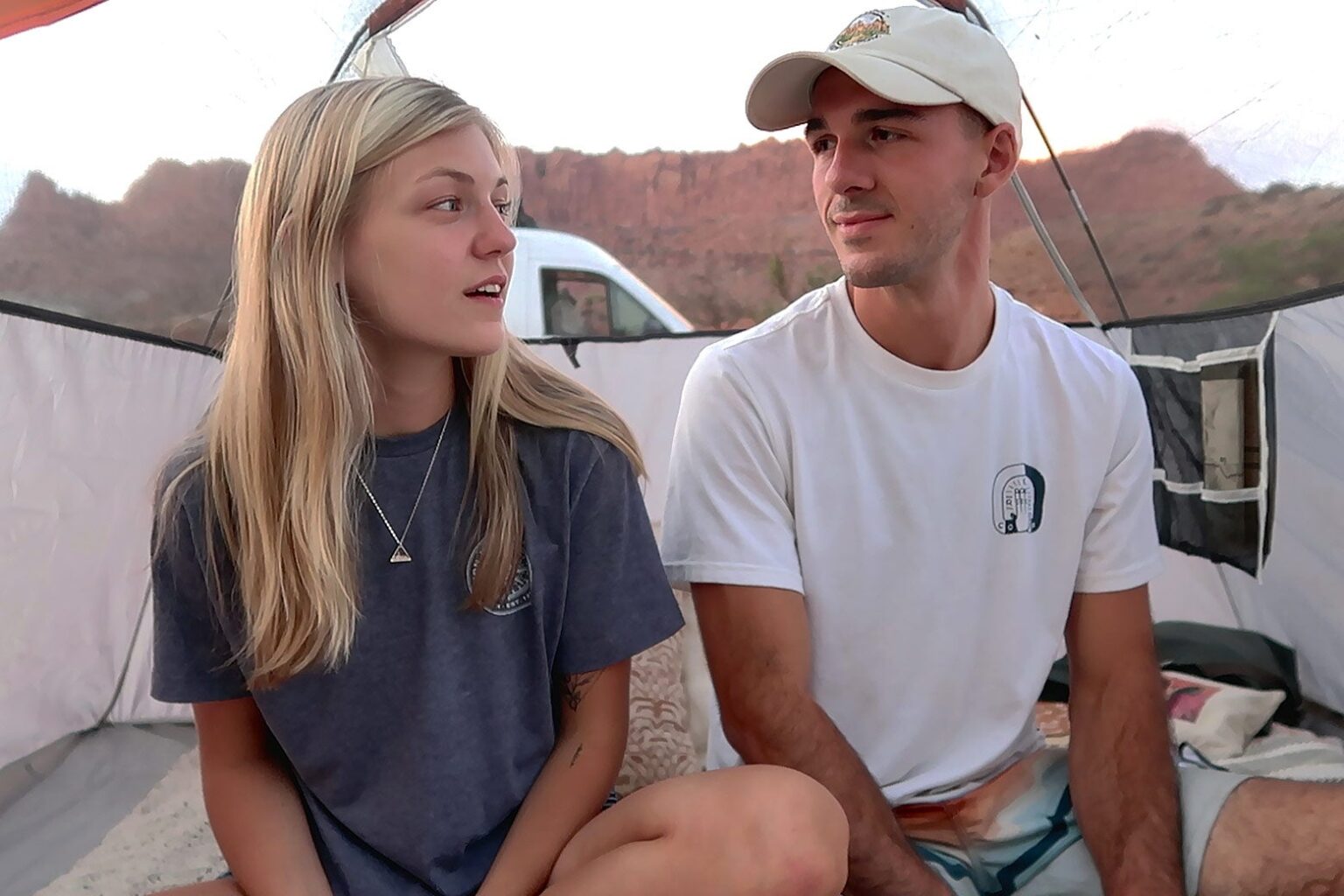
At the end of Netflix’s new true-crime documentary American Murder: Gabby Petito, the three-episode series finally gets around to examining the role of the media in the sensational case of the 22-year-old vlogger whose 2021 disappearance sparked an online frenzy. Filmmakers Julia Willoughby Nason and Michael Gasparro include a clip from a CNN morning show in which journalist Mara Schiavocampo remarks on “missing white woman syndrome,” the now-familiar complaint that the media will turn a case like Petito’s into a nationwide story while ignoring missing people of color.
She’s not wrong, but in this instance, what mesmerized the public about Petito wasn’t just her blond prettiness, but the fact that as an aspiring #vanlife influencer, she’d uploaded so much sheer evidence to her social media feeds. This abundance of videos, snapshots, and blog posts, not incidentally, also becomes a bonanza for American Murder: Gabby Petito; Petito herself created much of the video in the series. A long-standing complaint about true-crime media is that it focuses more on perpetrators than on their victims, but until recently most murder victims were ordinary people whose lives weren’t extensively visually documented for public consumption. Because Petito’s career plans depended on her fostering parasocial relationships with members of her audience (only ”a few hundred” followers before she went missing), she produced a lot of content designed to make that audience feel like they knew her—and also her boyfriend, Brian Laundrie, the man who strangled her and then ended his own life weeks later.
In style, American Murder: Gabby Petito is unexceptional. It uses the occasional re-created scene and an A.I. voice based on Petito’s to read passages from her travel blog, and the soundtrack features lots of dissonant scraping on a violin. The series’ viewpoint is shaped by the perspective of Petito’s family and friends, who provided home movies of toddler Gabby and sat down for extensive interviews. Petito’s father admits that at first, he bristled at the notion that his daughter’s race drew unfair attention to her murder—a natural reaction, because of course his loss is an overwhelmingly significant event to him, as it is for nearly everyone interviewed for the series.

Luke Winkie
Her Dad Was the BTK Killer. Their Daughter Was Gabby Petito. Why Would They Ever Agree to This?
Read More
Such is the sway the family has over the documentary that relatively little attention gets paid to the aspect of the case that most seized the public’s interest: how the search for Petito exploded into a real-time investigation on social media, especially TikTok, where amateur sleuths scrutinized Petito’s posts for clues to her whereabouts and Laundrie’s guilt, spinning out ever more elaborate and often absurd theories with each passing day. As Rachelle Hampton observed on Slate’s ICYMI podcast, this soon devolved into “digging through old Instagram captions and comparing them to new ones” or “finding [Petito’s] Spotify playlist and parsing the lyrics for code like it’s a Taylor Swift album drop.” Several creators found themselves in the position of reaping profitable views and likes from the death of a young woman who got few of either during her life.
On the other hand, a band of vanlife influencers really did aid authorities in the search for Petito. Kyle and Jenn Bethune—who make content about living in a bus with their three children—were driving through a park in Wyoming when their dashcam incidentally captured the image of Petito and Laundrie’s white Ford van in some brush by the side of a road. After TikToks about Petito’s disappearance went viral, the Bethunes reviewed that old footage and identified the van. Petito’s remains were found not far away, and the discovery was seen as a demonstration of the power of social media—both to draw attention to missing-person cases and to provide actionable clues to law enforcement.
It was a win for the influencers, but American Murder: Gabby Petito doesn’t not inspire much enthusiasm for the profession. Some of the most arresting footage in the series comes in the form of police camera recordings made when officers in Utah pulled over Petito and Laundrie after receiving reports of a man slapping a woman on the street in Moab, Utah. Taped about two weeks before Petito’s final communication with her family, the footage offers a picture of Petito and Laundrie’s relationship that is drastically different from the carefree image she strove to present in her social media posts. Weeping uncontrollably, Petito complains of “OCD” and anxiety, and maintains that she was the aggressor toward Laundrie as the couple squabbled over her phone. “The happiest people on social media usually have the darkest skeletons in their closet,” Petito’s best friend opines in an interview.

Ellin Stein
“Wellness” Has Had Its Scammers From the Beginning. A New Netflix Series Tells the Shocking Story of One of the Worst.
Read More
The Problem With The White Lotus
Into Thin Air Has Been Attracting Criticism for Decades. Now Jon Krakauer Is Finally Going Nuclear.
What’s Fact and What’s Fiction in Netflix’s Apple Cider Vinegar
Netflix’s New Scammer Show Is Great. There’s Just One Problem.
But just how happy do Petito and Laundrie appear in her posts? In the clips shown in American Murder: Gabby Petito, the couple’s extravagant smooching and cuddling always gives way to sidelong glances at the camera that seem to ask, See how in love we are? That creepy impression—common in the posts of influencer couples—that the viewer has become a third party to their intimacy pervades these videos. Every so often Petito snaps at Laundrie for not being good at (or, apparently, very interested in) her tech setup, or frets about the light being “weird.” In another outtake, she runs through a series of delighted expressions while holding up her new drone, then drops the smile and says dully, “There should be one good one in there.” These glimpses behind the mask Petito attempted to create online make the moments when she beams into her camera register as particularly forced.
If social media helped locate Petito’s remains, it’s hard to ignore that it may have also contributed to her winding up in that Wyoming riverbed. Would she have gone on the trip in the first place if it hadn’t offered the prospect of online stardom? And how much strain did the need to produce dreamy images of their “vanlife journey,” as Petito put it, place on a relationship made fragile by Laundrie’s evident mental illness? The video that Petito left behind provides American Murder: Gabby Petito—and internet sleuths—with an unprecedented bounty of footage, yet it’s all footage intended not to reveal the truth, but to hide it. As is often the case with social media, we see so much, yet end up understanding so little.
Get the best of movies, TV, books, music, and more.