
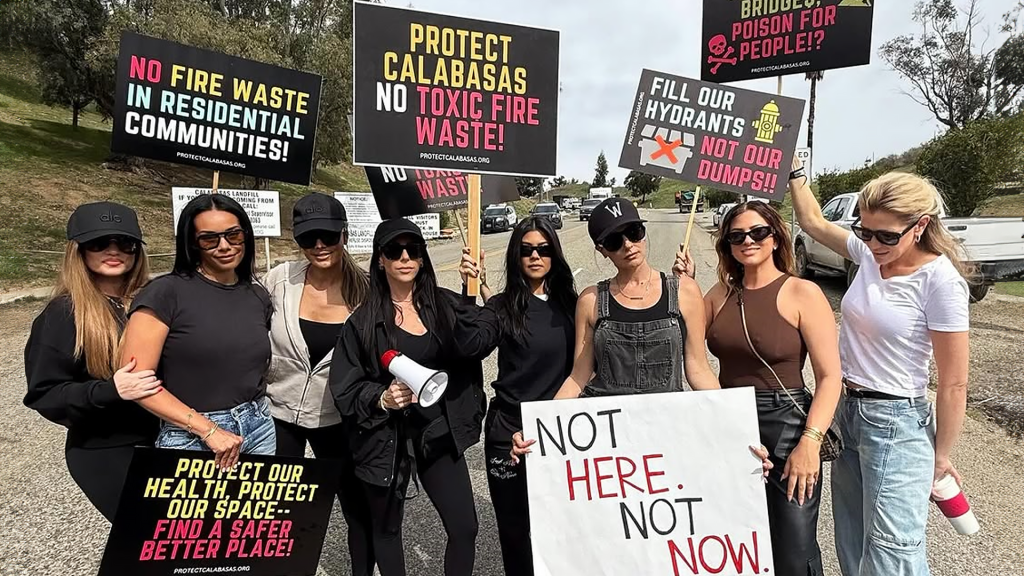
Despite Kardashian’s concerns, Michael Chee, a spokesperson for the LA County Sanitation Districts, has assured multiple agencies, including the EPA and the Army Corps of Engineers, that any certified waste is ‘non-toxic, non-hazardous’ and that any landfill is legally prohibited from accepting hazardous materials.
It’s difficult to ignore the ‘Not in My Backyard’ sentiment raised by Kardashian’s very public protest. Given the immense loss many families across LA are currently facing, an outcry to protect the ‘healthy, thriving’ community of Calabasas by some of the most privileged individuals in America feels a touch tone deaf.
And as many have asked beneath Kardashian’s social media posts, if wildfire debris isn’t to be disposed of in Calabasas, where is it supposed to go?
While some have accused Kardashian of wanting to dump the waste on ‘poorer communities’, the reality star has suggested debris be placed in the desert where there are ‘no people in harm’s way’.
Still, reeling off a list of Calabasas’ incredible environmental achievements, including a ‘no smoking rule, plastic bag ban, and bright sky ordinance’ in order to elevate the quality of life for locals highlights how out of touch many of the world’s 1% can be.
These are certainly things for a community to cherish and strive for, but they’re also near impossible in areas where poverty is rife. And at a time when many have lost their homes, kicking off – very publicly – about potential impacts on a ‘picture perfect’ community feels… ill timed.
Others have pointed out that the Kardashian’s environmental track record isn’t exactly aligned with Kourtney’s environmental warrior narrative.
‘Wasn’t her water usage like 300% during a drought lol’ said one comment beneath her Instagram post.
Indeed, during a brutal drought in 2022, Kim and Kourtney Kardashian were both caught disregarding LA’s strict water conservation measures at their homes in Calabasas, with both sisters regularly exceeding their monthly water allotment by more that 150%.
The family is also known to regularly fly via private jet, a mode of transport that emits at least 10 times more carbon dioxide per passenger than a commercial airline.
It’s not the wealthy and powerful who feel the environmental impacts of these decisions, either. It’s those in poor neighbourhoods and countries worldwide. Ironically, it’s the same disregard for the planet that causes devastating natural disasters like the very wildfires Kardashian is now up in arms about.
And no surprise, it’s not the homes of Calabasas residents that sit in ash and rubble. But god forbid any clean up efforts tamper with the picturesque biome of LA’s elite.
The Calabasas protest also brings to light the influence celebrities wield in shaping public discourse. While their platforms can amplify critical issues, there’s a fine line between advocacy and inadvertently perpetuating systemic injustices. By opposing the landfill expansion without proposing equitable solutions, high-profile figures risk reinforcing the very disparities they aim to challenge.
The tendency for affluent communities to deflect environmental burdens onto less privileged areas is a recurring theme in environmental justice.
Historically, low-income neighbourhoods and communities of colour have disproportionately shouldered the placement of landfills, industrial plants, and other polluting infrastructures. The National Academy of Sciences has documented that such communities face higher exposure to environmental hazards, leading to adverse health outcomes.
While local activism is vital in holding authorities accountable and safeguarding community health, it must be coupled with an awareness of broader systemic issues.
Only through inclusive and informed discourse can we hope to achieve environmental policies that are both effective and just.