
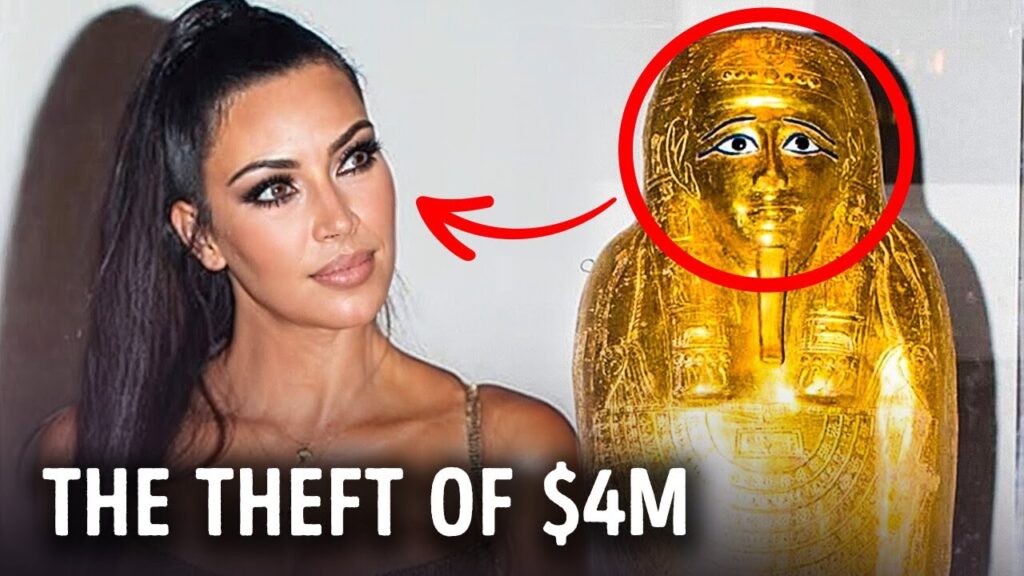
How Kim Kardashian Helped Get a Stolen Coffin Back to Egypt
[Music] Kim Kardashian is a fashion mogul, law student, and as it turns out, an accidental artifact whistleblower. Let me spill the tea. In one of pop culture’s biggest plot twists, Kim Kardashian inadvertently posed next to a coffin only a few people knew was stolen. Her picture went viral, and somewhere around the globe, one of the looters involved in stealing the coffin saw it. Just like that, she helped to unravel a $4 million antiquity smuggling ring. Let’s rewind. One of the looters involved in originally stealing the coffin was startled to see that the artifact had already been sold. His partners told him they were still waiting for a buyer. Since he didn’t get his share of the loot, he emailed the Kim Kardashian picture to an attorney in New York responsible for these types of cases. Together with Kim’s picture were some other photos of the coffin, still covered in mud, being taken from its original location. He told the attorney that the coffin had been stolen and gave him the proof he needed to go solve this case. Back in ancient Egypt around the 1st century BCE, a man named Ngemunk passed away. He was a high-ranking priest who served the ram-headed deity of Heracleus. And when someone like that passes away, their sendoff was special. Naj Monk’s coffin was a golden masterpiece. In ancient Egyptian belief, gold wasn’t just for show. It was sacred. It symbolized the essence of the deities and was thought to help people be reborn in the afterlife. This particular coffin even spelled out its inscriptions, linking the precious metals directly to divinity, rebirth, and the power of the sun. Fast forward to 2011. Egypt was going through major political upheaval and amid the chaos, tomb raiders took their chance. In the Alminia region near Cairo, lutters broke into Najamong’s site. They dug up his gleaming coffin and smuggled it out of the country. First, the coffin landed in the hands of a dealer in the United Arab Emirates who forged export documents claiming it was a Greco Roman artifact to disguise its true Egyptian origins. Then it traveled to Germany where a gallery owner had it restored and allegedly faked a license saying it had been legally exported back in 1971. With new papers and a polished look, it was passed to two French antiquities dealers who sold it to none other than the Metropolitan Museum of Art in New York for $4 million. And just like that, in 2017, Najunk’s Radiant Coffin was on public display once again. This time in New York, the Met was absurdly happy to have acquired this piece. All over New York, you could see buses advertising the Met’s new exhibition based on this ancient Egyptian relic. The Metropolitan Museum of Art is one of New York’s most prestigious museums. It’s home to some of the world’s biggest curators and once a year it hosts the celebrityfilled event known as the MetGala. In 2018, the yearly theme of the world famous Metgala was heavenly bodies. And that’s when Kim Kardashian walked onto the red carpet wearing a beautiful sparkling Versace gold dress. She was wandering around the museum when she saw something that matched her dress and posed in a photo next to it. Of course, the queen of the internet went viral standing right next to Naj Monk’s coffin. And that’s when it all happened. Someone self-described as friends with the original looters sent the photo to Manhattan’s assistant district attorney, Matthew Bogdanos. Bogdanos had been obsessively tracking down looted artifacts for the past years. He knew there were some important Egyptian artifacts on the illegal trading market, and when he saw the picture, he knew the coffin had really been stolen. The informant shared digital images of the tomb, confirming it had been looted in 2011. And as investigators dug deeper, they found the missing piece, a human finger bone still inside the coffin. Yep. When the looters threw away the mummy’s body into the Nile River, they left something behind, one of its fingers. But later on, this piece of evidence was key to proving the artifact’s origin. By 2019, the Met returned the coffin to Egypt, and its CEO issued a formal apology. The museum, now aware it had been duped, vowed to overhaul its acquisitions process and even try to recover the money. Meanwhile, one of the European men involved in the forging of the illegal documents of the coffin was arrested in Germany in 2020. He maintains the paperwork was legit. But hey, the evidence says otherwise. Just FYI, next time someone says Kim Kardashian is famous for nothing, remember Kim Kardashian accidentally helped to solve one of the art world’s biggest modern heists. Moving forward, this next story is also worth a few millions, but to some, it should never be sold. Chris Pepe was just seven when he first glimpsed the sparkling relics, tiny gems in a glass case at his great uncle’s house. Back then, they were just part of the furniture. But as he grew older, he learned the truth, that these weren’t just pretty stones. They were discovered beside what’s believed to be the actual remains of the Buddha. It all began in 1898 when Chris’s greatgrandfather, William Claxton Pepe, a British landowner in colonial India, excavated a mysterious mound near the village of Pipraa. Inside a deep stone chamber, he found bone fragments, gold, and crystal relicquaries. One box had an inscription in ancient Brahmi script stating the remains belonged to the Buddha himself and had been gifted to his clan, the Shikyas, after his cremation. The discovery rocked the world. News spread through international papers and scholars confirmed its authenticity. The discovery even helped map ancient Buddhist roots and identify Lumbini as the Buddha’s birthplace. Though it happened during the colonial era, the story is more complex than simple looting. Pepe gave most of the relics away. He gave the bones to the king of Syiam, which is now called Thailand, and the rest to Indian authorities. Only a few duplicates of the stones stayed with the family and were passed down through generations. When Chris inherited them in 2013, he and his cousins didn’t hide them. They launched the Pipraawa project, digitized family archives, and loan the relics to museums around the world from New York’s Met to Soul’s National Museum, always free of charge. But in 2025, the whole thing became controversial when the family planned to auction the gems at Sbies in Hong Kong. The Indian government intervened, even issuing a legal notice demanding the auctions halt, saying that the relics are sacred and a cultural heritage. They argued that the sale violated Indian and international laws, including United Nations conventions, and called for the relic’s repatriation to India for preservation and religious purposes. And talking about sacred items coming back home after more than half a century in exile, four ancient bronze sculptures looted from Thailand were finally given back. These pieces are known as the Ponche artifacts. They consist of three Bits Sava statues and one Buddha image that were unearthed in the 1960s by villagers in Beram province. If you’ve ever been to that part of the world, you’ll know most people are very devotional and connected to their spiritual beliefs. So unearthing something like that is as close to the sacred you’ll probably get in a lifetime. But the items were smuggled out and eventually landed in the Asian Art Museum in San Francisco. These statues are estimated to be 1,300 years old. They were tied to a man called Douglas Latchford, a notorious figure in the illicit antiquities trade. Now, after years of pressure, the museum has agreed to their return. Thai officials along with US Homeland Security confirmed the artifacts have been deaced and will be soon repatriated. This isn’t the museum’s first time returning treasures. In 2021, it surrendered ancient lentils after a lawsuit from US authorities. But this latest move hits close to home, literally for one of the villagers who helped discover the artifacts and never dreamed they’d vanish overseas. That’s it for today. So, hey, if you pacified your curiosity, then give the video a like and share it with your friends. Or if you want more, just click on these videos and stay on the bright
When reality TV meets ancient history, things get weird. Kim Kardashian once posted a casual photo that ended up spotlighting something far bigger than celebrity fashion—it exposed a stolen ancient artifact. The piece, linked to centuries-old treasures, sparked investigations and legal battles stretching across borders. What seemed like just another glamorous snapshot became the key to uncovering a mystery of looted antiquities. Sometimes, history doesn’t surface in dusty ruins—it shows up in the background of a viral post.
Credit:
CUNY TV Digital Series / YouTube
National Geographic / YouTube
Daniel R. Cambisi / YouTube
Voice of America / YouTube
New York Style Guide / YouTube
Eyewitness News ABC7NY / YouTube
National Geographic / YouTube
Sotheby’s / YouTube
CC BY-SA 3.0 https://creativecommons.org/licenses/by-sa/3.0/:
Thailandia: By Sailko, https://commons.wikimedia.org/w/index.php?curid=22569320
Animation is created by Bright Side.
—————————————————————————————-
Music from TheSoul Sound: https://thesoul-sound.com/
Check our Bright Side podcast on Spotify and leave a positive review! https://open.spotify.com/show/0hUkPxD34jRLrMrJux4VxV
Subscribe to Bright Side: https://goo.gl/rQTJZz
—————————————————————————————-
Our Social Media:
Facebook: https://www.facebook.com/brightplanet/
Instagram: https://www.instagram.com/brightside.official
TikTok: https://www.tiktok.com/@brightside.official?lang=en
Stock materials (photos, footages and other):
https://www.depositphotos.com
https://www.shutterstock.com
https://www.eastnews.ru
—————————————————————————————-
For more videos and articles visit: http://www.brightside.me
—————————————————————————————-
This video is made for entertainment purposes. We do not make any warranties about the completeness, safety and reliability. Any action you take upon the information in this video is strictly at your own risk, and we will not be liable for any damages or losses. It is the viewer’s responsibility to use judgement, care and precaution if you plan to replicate.
4 Comments
Any Kardashians fans here?
No
Is this real beacuse it seems rather unusual
coffin