
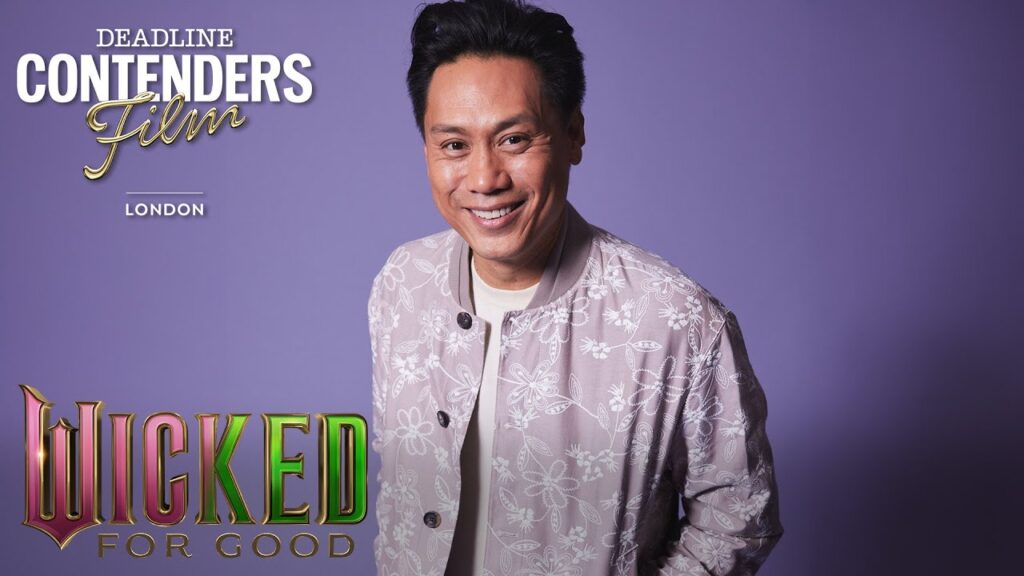
‘Wicked: For Good’: Jon M. Chu on Directing Ariana Grande & Cynthia Erivo in the Epic Finale
This is the first time Ariana has to lead a movie. So, um, that is a giant responsibility and not everyone can can do that. You have to have an energy that sustains and not just one movie. Oh, you’re in charge of two movies. I’m Baz Bammy Boy, uh, Deadlines Breaking Baz columnist and international editor at large. I’m so excited to be moderating the panel for the spectacular musical Wicked for Good. And I’m delighted that Oscar nominated filmmaker John M. Chu will be joining us to wave his magic wand and cast a spell or two or three over all of you. Anyway, the film is the epic conclusion to to last a war season’s wicked, which saw Cynthia’s Alphaba, the Wicked Witch of the West, soar away on a broomstick into exile and estranged from Ariana Grande’s Glenda the Good. Their actions in part one have consequences which we see play out in Wicked for Good. Is their friendship over for good? Will they ever be reconciled? Please help me welcome John M. Shu, the director of the stunning Yes, I’ve seen it, Wicked for Good. So, listen, you know, look, it’s fair to say in the show, the stage show, after defying gravity at the first end of the first act, y there’s not much left to do, but somehow you have found a two and a half hour movie, an extravaganza. So, how did you do it? How did you how did you and Stephen the lyricist and Mark Platt the producer say, “Okay, this is what we’re going to do to whiz up.” Yeah. Well, well, uh, you know, I saw the the show before everyone went on Broadway. Um, and so I was a sort of patient zero at a certain point, so I remember what it felt like to watch this new Steven Schwarz musical with no context. And I thought the second half was the meat. I thought the second half was like the reason to be. You get all this setup and all this thing and she gets out and she breaks out and that’s the fairy tale side. But the second half is the adult selves looking back at their dreams and their hopes and and and what they thought the world was and their stories and all of it shatters and the consequences of the choices that you think are so easy in the f I mean they’re tough but when you do it but the consequences are even tougher how to stick through it. And so for me, what I think the second half really needed for me was just I want to know more about their these individual women’s experience of going through that. How lonely is it when you make a choice like that and you have to stand up to power and you feel like you’re the only one doing it and that’s a very heavy lonely experience. And then what happens when the home that you’re fighting for you realize may was never built for you. Sure. and should you be there when they actually want you dead? What is home in in those questions? And what happens when you’re someone like Glenda who who has this bubble of protection? You don’t ever have to deal with the truth if you don’t want to even though you’ve witnessed it. What do you become when you know the truth? Are you able to then pop your bubble of privilege and and and and and let it in? I think to me those were the bigger questions of the wicked saga that for us we were able to do that. So talking to Stephen and to Mark and we needed more songs because we needed more avenues into that mindset. Musicals are great because you it’s not about being bigger, it’s about being deeper into these characters minds and and and and what they’re going through. And so we we have new songs that that we get to witness how they uh go through these these thoughts um and the audience can experience what it feels like. So and how did you decide which songs and how to place them and who would sing them? I mean did I mean it would have been pretty cruel had they just been for uh just for one or the other? For sure. Um those were a lot of discussions, but I knew we knew the areas um uh we knew the areas of where we needed more information. So, it was either going to be a scene or it’s either going to be a song. And working with someone great like Stephen, he was like, I I have an idea for that. Let me give me give me 48 hours and he’ll send me a voice memo and I’ll hear it. I’m like, okay, that’s I think that’s what we want to say. And then we’ll all discuss. Is that really what it’s going on? Is it just about home or is about her identity or is it about do we do we pin it on Glenda like an actual friend and how specific you know and so on and so forth. Yeah. And how and and how and because you shot this film continuously as it were. Yeah. How did that work? Because you know in in the first part they’re what can one say they are young women but they are women in the second part. Yeah. Yeah. So, how did you get the emotions when they’re shooting one scene and then you’re doing part two scene the same day? I mean, how did that work? Well, I think that’s been the hard part about even for the first movie talking about it is because we we have done the whole thing. We shot, you know, one day we’re in Shiz, the next day we’re in for good and the next day they’re they’re setting things on fire and the next day they’re coming to class for the first day. I think what we could not talk about um a year ago was how technical and how amazing all the actors had to be and and our cast and crew had to be in order to jump. We we made this sort of board or at least I made a board in my office that um had every scene. Um and it wasn’t about the plot of the scene. It was about what we want the audience to be feeling. What’s our storytelling guide through this? And so, um, we could always follow and where they were and and we had little pickpoints cuz in my head it was sort of like Pleasantville. Each of them would have to ask a question of their reality. And there’s like the fake question, but then there’s the real question and then there’s the acceptance of the question or the resistance of that question. And so we mapped it on each of the characters and we when I was working with Ari and Cynthia, we would map where that is. And so we had sort of had pickpoints of knowing, okay, this is before the big question, but it may be leading up to the question. Um, and credit to Ari and Cynthia. I mean, they w I didn’t have to sit there the night before and be like, “Hey, what what this is what’s happening.” Like, they were in it. Like, I’ve never seen anyone. It was like veterans that were doing this. And I thought Cynthia and uh, well, both of your leading ladies, but Cynthia is like a sort of badass character. Yeah. She looks no nonsense. And when she swoops I’ve seen it and and when she swoops in in that first scene Yeah. Wow. I know. I was she’s I wanted to see her in her full power like she finally steps out in at the end of movie one and and you want to see like okay what does that become? How badass can she be? there was this um and and I think it’s um you know when you look at a musical you can think of it as like oh it’s just dancing and singing and dancing and and it feels like almost like it turns into a comedy but actually for me when I as a as a theater kid loving musicals going to musicals every weekend uh shows in San Francisco whether it’s ballet season opera season or musical season and and and and a and a and a lover of music and playing music has always spoken to me in a much deeper place you know when you have your breakup and you’re running on a treadmill and you hear that song and and it allows you to feel things and and and really go deeper that with with it and and and dance as well. Um I was never a dancer dancer but I was friends with all these dancers and they’re the ones who would help me on my films and stuff but I got to know them so deeply and I think movement can also do that. So using all those tools to get into a character and to understand a relationship much deeper. Um I think people just sort of like oh musical whatever but I this is actually allows you to get closer to the drama of it. I mean the thing about musical theater is that they’ve got to have triple threats. They’ve got to act. They’ve got to be able to sing. They got to dance. They got to have presence and your leading ladies have this. Yes. Don’t they? So what so what did you say to Ariana and Cynthia for part? Did you say listen you’ve got to step up you’ve got to do this that and the other? I mean what how did they Yeah. I mean they um this is the first time Ariana has to lead a movie. So um that is a giant responsibility and not everyone can can do that. You have to have an energy that sustains and not just one movie. Oh, you’re in charge of two movies. Cynthia has that presence. She’s done it before. So they actually really were is beautiful to watch them grow. They were really helping each other. Um and uh and and and and again we were partners in this. This wasn’t me as the director saying, “Hey, this is what the scene is. You need to step here, blink here, go over this way.” To me, the way I I There are some directors who do that and that’s great and they’re they’re genius and I love those movies. For me, I’m not that kind of person. I’m not that smart to be honest. I love to find it. I love to find I but I love to find it. I love to find it with my actors and I love to find it with my DP and I love to all of us be in the same soup and squeeze it as hard as we can and and um and that means that they we have to leave room uh for us to have a lot of discussion to prioritize that over technical stuff on the day and it’s seems sort of paradoxical because a musical is also very technical. I mean, we we you have the pre-records, you have the the BPMs that have to go, you have their ear wigs that have to be in their ear, so it doesn’t feel as naturalistic as you’d want, but we try to make it so so you can get the most truth out of what they’re doing. And so, we had a pianist, a live pianist there all the time. And so, for me with them was just like, let’s just dig at the truth. The good news is they were such great singers, so experienced with an earwig that that wasn’t a thing for them. And I’d done stuff with that. So, it wasn’t a thing for me. it. I’d done big movies, um, big visual effects movies. I’ve done big dance numbers. None of that was a technical challenge for me. Of course, we were doing it at a scale we’ve never done, but it wasn’t the focus. Uh, when you get an amazing crew, what it allows you to do is have space to say, “Okay, we’re only now we’re just trying to get the truth on this on this little sensor and through this lens.” And so that’s what we focused on. We said, “Hey, ignore everything else. Ignore the green. Ignore the stuff. Let’s just like look at what this character would do here right now. Go. And what I thought was beautiful and it reminded me, you know, the sort of big epics of the 50s and 60s of um, you know, you got the big sweeping dance numbers and show busy numbers, but then intimate moments. Yeah. And we shouldn’t give too much away here, but you know, there’s some lovely scenes between Johnny Bailey and Cynthia, Cynthia’s Alphaba. Yeah. And how did you get them to do what they do? Well, you have to see that part. Um, again, you know what’s great when you hire great actors, um, they are not swept up in the the the presentation of it. They’re swept up in, okay, they are falling in love. We don’t have a lot of time for them to fall in love. It’s just not it’s just not built like that. So, we have to watch them fall in love. So a song like as long as your mind for people who know the show is when you know they’re they’re actually knee to knee on the ground holding each other and and her first words are kiss me too fiercely and so you’re like okay that and the whole song is about this this intense moment but what we found is like oh we don’t I I don’t believe that they’re there at this point in this movie. So the intention of this song has to shift a little bit. We can get there but maybe it’s about them finding each other. Maybe it’s more hesitant. Maybe when she says, “Kiss me too fiercely,” she’s hoping. She’s yearning for like, “Will he or won’t he or will I or won’t I?” Uh, and maybe it’s not necessarily about him at first. Maybe they’ve just escaped and they’re just trying to get their breath back and they’ve just gotten so close to the wizard and Glenda again and it was almost too close to the sun and they just need a release and so they’re separate in their worlds and they’re watching each other during the beginning of this and we watch them closer and closer and he’s looking around at the nest that she’s built since the last movie and it’s beautiful. She’s made a home for herself and he’s looking at the pro she’s collected all the propaganda that they say about her. how wicked she is, how evil she is. And he’s looking at it and he’s like, “You survived this. You have created a beautiful place.” And he says, “You’re beautiful.” And she won’t believe it. And she says, “Uh, you don’t have to lie to me.” And he steps all the way to her and then he gets on his knees and he looks at her uh and he says, “I’m not lying.” And she she’s almost she doesn’t she resists it. She’s like, “Well, well then what is it? What is it if it’s if if you’re not lying to me?” and she sees that it’s just seeing things in a different way and the the that connection allows the song to emerge from that. So it’s not sexual, it is like more intimate and sensual and I think that’s what allows this song to become what it felt like on stage because on stage you you have a different barrier to cross and you feel those things but but we have to actually take the audience step by step into how it feels to follow. I mean your film has to eclipse the stage show which it does and you know and bring passion. Well, thank you so much, John Chu, John M. Chu, thank you for making great movies. Thank you for Wicked parts one and two. Thank you. Yes. And we look forward to seeing you again.
Go behind the scenes of Wicked: For Good with Oscar-nominated director John M. Chu as he discusses bringing Broadway magic to the big screen! In this exclusive interview, Chu shares how he guided Ariana Grande in her first lead film role, collaborated with Cynthia Erivo, and transformed the iconic stage musical into an epic two-part cinematic experience.
Discover the creative process behind adapting the beloved musical, from selecting songs to capturing intimate emotional moments, all while balancing technical challenges like pre-recorded tracks and choreography. Chu also shares his insights on storytelling, character development, and how musicals can be more than spectacle—they’re a deep dive into human emotion.
Whether you’re a fan of the original Broadway show, Ariana Grande’s screen debut, or epic musical films, this interview reveals the artistry, challenges, and passion behind Wicked: For Good.
Connect with Deadline online!
https://www.facebook.com/deadline/
https://twitter.com/DEADLINE
https://www.instagram.com/deadline/
3 Comments
I am so proud of Ariana. Queen Wicked : the Ariana Grande movie
I’m seeing Jon M Chu in a few weeks at the Savannah Film Festival! I can’t wait!!!
My gratitution to Jon Chu is unlimited.