
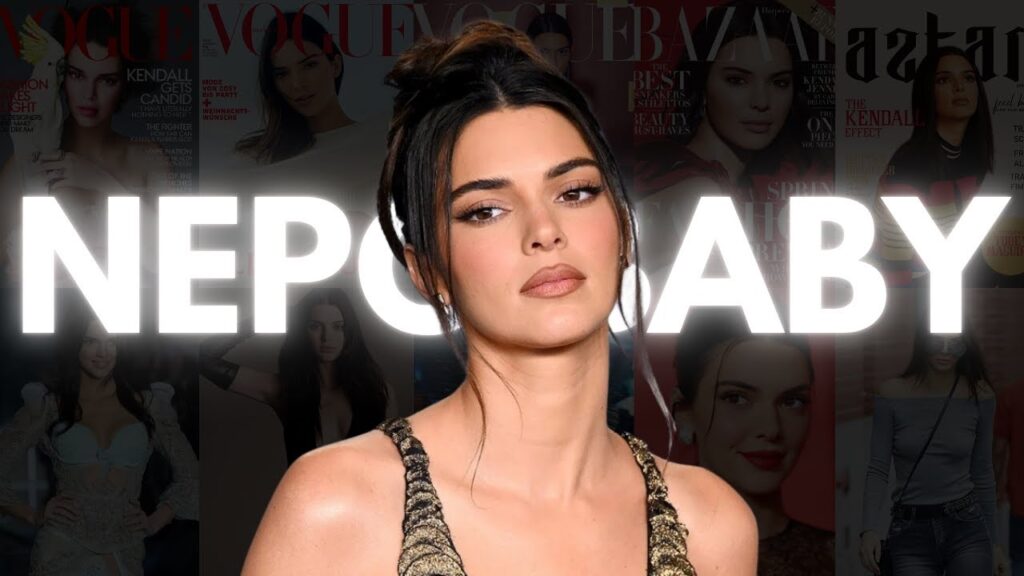
Is Kendall Jenner A Victim of The Fashion Industry
She had the walk. She had the face. She had the last name that made headlines before she ever stepped on a runway. But the moment Kendall Jenner entered fashion, she wasn’t greeted with applause. She was met with cold stairs, closed circles, and whispers behind the scenes. She didn’t earn it. Just another reality star playing dress up. At 18, she walked Mark Jacobs with bleached eyebrows and a see-through top. And suddenly, the world had an opinion. too privileged to be real, too beautiful to be relatable, too famous to be respected. Because while most girls clawed their way into castings, Kendall skipped the line and everyone noticed. She wasn’t just a model. She became a symbol. To some, a symbol of everything wrong with fashion in the Instagram era. To others, a girl born into chaos, trying to carve out a space that was truly hers. So, who is Kendall Jenner really? A paper thin mannequin sculpted by media and money. A privileged face who walked through doors others had to break down. Or maybe a young woman punished for being too visible too soon and too quiet to defend herself. Whatever you think you know about Kendall Jenner, trust me, this isn’t a story about fashion. It’s a story about power, perception, and the price of being seen. Kendall Nicole Jenner was born on November 3rd, 1995 in Los Angeles, right at the intersection of two worlds. On one side, a legacy of athletics from her father, Olympic athlete Bruce Jenner, now Caitlyn Jenner. On the other, media, reality TV, and a long trail of scandal from her mother, Chris Jenner. By the time Kendall was learning to walk, there were cameras pointed at her family’s living room. At just 11 years old, Kendall’s life officially entered the public domain. She became a background character in a television phenomenon, Keeping Up with the Kardashians. While her friends were heading to school with backpacks, Kendall was bringing the Jenner name to TV screens every week, where tears, drama, and the spotlight were part of daily life. But the curious thing is, Kendall wasn’t like the rest of them. In a family that thrived on loud voices, flashy fashion, and constant attention, Kendall was quiet, reserved, and often lingered in the background. She didn’t dream of becoming an influencer. She didn’t dream of being a reality star. What she wanted was fashion. At 14, Kendall began expressing a serious desire to become a professional model, not to get famous, but to carve out a life beyond the family brand. She begged her mother Chris not to hover, not to let her be labeled as a reality TV model. She didn’t want privilege. She wanted a real shot. But that was almost impossible because no matter how silent she stayed, the name Jenner spoke for her. When Kendall signed with Willilhina Models, no one talked about her skills or presence. They said another Kardashian trying to pretend she’s a model. And when she made her debut in Teen Vogue, the first comment was, “She’s not a model, she’s a product.” From a young age, Kendall learned a painful lesson. In fashion, being born too high on the ladder is a sin of its own. February 2014, age 18, New York Fashion Week. Kendall Jenner walked her very first runway, not for a small brand or a student collection, but for Marc Jacobs. She wore a sheer top, bleached eyebrows, and a face like ice. No cute makeup, no celebrity smile. This was fashion, and it was also a statement. She wasn’t there to be adorable. She was there to be seen as a real model. And just like that, the firestorm began. In the headlines, she was called Kim Kardashian’s little sister who made it to high fashion. On social media, the comments poured in. There’s only one reason she got picked, her last name. Mark Jacobs is pulling a stunt. But behind the spotlight, Kendall was playing a much harder game. She showed up to casting calls like any unknown model. She left the name Jenner off the forms. She avoided signing with her mother, Chris. She wanted to challenge herself by playing by the industry’s real rules. And then, despite the public outrage, Kendall was booked for major shows. Givvanchi, Chanel, Balain, Fendi, Diane von Fenberg. At Chanel, under the legendary Carl Loggerfeld, Kendall didn’t just walk. She closed the show as one of the couture brides, a role usually reserved for the house’s most cherished muses. Carl called her fresh, modern, and clean, a break from the old molds. Olivier Rustang of Balain named her his muse, calling her the face of the new generation. Then in 2015, Kendall became the global face of Estee Lauder, a rare beauty contract, especially for someone of her generation. Kendall wasn’t just walking runways anymore. She was fronting the biggest campaigns, Calvin Klein, Versace, La Perila, Mango, Vogue, and she was booked out like a real model, not a social media star. In 2017, Forbes declared Kendall the highest paid model in the world, surpassing Jazelle Bunin, who had held the top spot for 14 years. The fashion world, whether they liked it or not, had to admit she wasn’t just surviving in fashion. She was dominating it. But at the same time, the criticism reached a boiling point because the higher she climbed, the more people wanted to pull her back down. Some anonymous models spoke out. We’ve trained our whole lives, worn our souls thin going to castings, and she walks in with the Kardashian name and gets the show. The truth was Kendall hadn’t done anything wrong, but she couldn’t erase where she came from either. And in an industry that loves the from nothing to everything narrative, it struggled to embrace someone who didn’t start at zero. But Kendall didn’t fight back. She just kept walking, kept booking, kept being Kendall. When Kendall Jenner was named the highest paid supermodel in the world, the first thing the internet did wasn’t congratulate her. It was outrage because to many in the industry, the title supermodel is something you earn with sweat, sacrifice, and scars. And Kendall, in their eyes, was just a pretty girl with a built-in fan base. But everything truly unraveled over a can of Pepsi. In 2017, Kendall appeared in a highly controversial Pepsi ad. In the video, she removes a blonde wig, steps away from a photo shoot, and joins a street protest. At the climax, she hands a can of Pepsi to a police officer. And somehow, tension dissolves. Maybe to the creative team, it was about peace, unity, a new generation. But to the public, it was a tonedeaf mockery of real protests, particularly the Black Lives Matter movement. Pepsi was accused of whitewashing politics, turning activism into aesthetic, and Kendall, the face of the campaign, became the target. She was called tonedeaf, insensitive, blindly privileged. A storm of backlash erupted across every platform. Models, journalists, and activists all spoke out. Kendall said nothing at first, no statements, no social media response. But months later, on an episode of Keeping Up with the Kardashians, she broke down in tears. I would never purposely hurt someone ever. I would never do something to hurt a movement. I felt really bad. I truly feel like I’ve learned from it. But to the public, a late apology wasn’t enough. She hadn’t written the ad. She didn’t direct it. She was just the face. Still, Kendall Jenner became the scapegoat, the symbol of how shallow a marketing campaign could be. But the Pepsi scandal was only one chapter. The deeper discontent came from other models. In a 2018 interview, Kendall said, “Since the beginning, I was super selective about the shows I do. I was never one of those girls who did like 30 shows a season or whatever the those girls do.” To her, it might have been a careless remark. To the runway community, it was a slap in the face. Those girls weren’t just random. They were the hundreds of young women waking at 5:00 a.m. wearing out their heels, running from casting to casting just for a few seconds on a catwalk. The backlash was instant. Models fired back on Twitter and Instagram, “We don’t get to be selective. We get to survive. Imagine insulting the hustle when the hustle is all we have.” Though Kendall later clarified and her PR team stepped in, the image of her as the girl who doesn’t understand the grind had already settled into the public consciousness. On runways, people began to see her as a glamorous robot, polished, emotionless, lacking presence. Clips of her walking were mocked. Dead eyes, no soul. She was compared to Naomi Campbell, Jazelle Bunin, even Bella Hadid. And many said Kendall lacked fashion soul. But perhaps the most bitter truth was this. Even when she tried to stay silent, the industry demanded she speak. And when she did speak, they demanded she shut up. In a world where every model is now judged by their influence, Kendall, even when saying nothing, became the poster child for privilege that must be challenged. After all the controversy, the criticism, and countless online verdicts, many assumed Kendall Jenner would disappear or quietly step back from the fashion industry like so many social media stars before her. But she didn’t disappear. She didn’t speak out either. She chose a different kind of response, working and showing up. While the public continued debating her talent, Kendall was booking campaigns with Versace, Givvenshi, Jacmus, Jimmy Chu, Fendi, not as a reality star, but as the top model of the Instagram generation. In 2022, she landed the cover of Vogue US, and continued appearing in British Vogue, Vogue Japan, Vogue Paris, publications once notoriously dismissive of influencer culture. She didn’t force herself to be edgy like Bella. She didn’t storm back with noise like Naomi. Instead, Kendall chose silence, consistency, and her own rhythm. Over time, she crafted a signature style, subtly sexy, minimal, but sharp, modern femininity with a quiet power. On Tik Tok and Pinterest, images of Kendall in oversized blazers, widelegg jeans, dark sunglasses, and iced coffee became the blueprint for the Y2K grown-up aesthetic. A look that Gen Z reimagined into a trend. Without saying a word, she became the silent muse of a generation that experiences fashion through Instagram and mood boards. Because the truth is, most of today’s audience doesn’t know much about runway. They know fashion through imagery, through vibe. And Kendall is the embodiment of fashion, but not trying too hard. Exactly what this era worships. She didn’t stay still in the role of a model either. She ventured into business, launching 818 Tequila, which became a multi-million dollar brand. Despite drawing new backlash for allegedly appropriating Mexican culture, she’s shown up everywhere from the Met Gala to the rebirth of the Victoria’s Secret Show. Always present, always quiet, and always noticed. No loud feminism, no moral preaching, no dramatic clapbacks at the media. Kendall chose a kind of fame that doesn’t need to be loved, only seen. She stands as proof that in a world of scandals, outrage, and overpoliticized messaging, sometimes the most powerful way to exist is to explain nothing at all. And that’s what makes up the strange legacy of Kendall Jenner. She’s not a classic icon like Cindy Crawford. She’s not a rebel like Kate Moss. She’s certainly not a razor sharp phenomenon like Naomi or Gigi. She is the girl who quietly walked through the spotlight without ever stepping out of it. Kendall Jenner never apologized for where she came from. She never demanded anyone’s approval. She simply stepped onto the runway, eyes cold as stone, and kept walking as if the noise behind her didn’t exist. She’s not the most perfect supermodel. She doesn’t have Naomi’s legendary walk. She doesn’t carry Bella’s rebellious expressions. She doesn’t radiate Jazelle’s innate hot coutur presence. But she is the symbol of a new era where influencer and high fashion are no longer separate worlds. Where a girl born into the glare of reality, TV can through quiet resilience reshape what it means to be a model for an entire generation. Kendall never needed to be anyone else. And perhaps she never even tried to become what people expected. The question is, is she a product of the media or its most honest reflection? Did she steal opportunities or pay the price of being visible too soon? Maybe she’s the villain in some models stories. Maybe she’s the victim of a spotlight that never turns off. But whatever the role, Kendall keeps walking, keeps showing up, keeps being herself. She didn’t invent the look. She lived it. Quiet, polarizing, and unbothered.
Is Kendall Jenner A Victim of The Fashion Industry
Kendall Jenner was born into fame — but not into acceptance.
She walked for Chanel, led campaigns for Estée Lauder, and topped Forbes as the highest-paid model in the world.
But behind the glamour was a storm of backlash: accusations of privilege, stolen opportunities, and not “earning” her place in fashion.
Was Kendall a nepo baby who skipped the line — or a young woman punished for being too famous, too early?
👇 Drop your thoughts in the comments:
Is Kendall the villain of the runway… or just a misunderstood face of a new era?
#KendallJenner #RunwayDrama #ModelScandal #RunwayLegends #KardashianJenner
9 Comments
So she’s like the tori spelling of modeling industry… I can respect that.
Actually she is a successful and popular model ONLY because of her family
I love her ❤
Thank you so much
I really do see her differently now ❤
Ich kenne den Spruch mit dem Geld ähnlich: Wenn du jemandem Geld leihst, umarme ihn ganz fest. Es kann sein, du siehst ihn zum letzten Mal.
U do realise that she has the family connections and financial backing to do anything and yet she chose to be a model…
She's beautiful. Whats the issue?
You are Wonderful ❤
Chris Kim her trans whatever , messed her up# she's lovely