
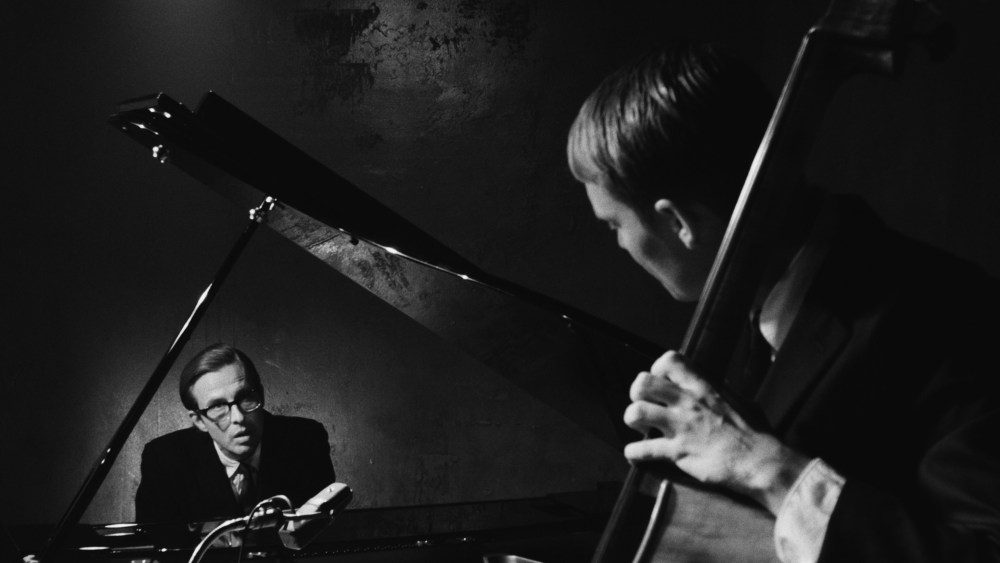
The jazz piano of Bill Evans was characterized by grace and poise, a lightness of touch yielding a plaintive depth of feeling, that belied a life beset with chaos and tragedy. It would be easy for an Evans biopic to lean into the latter, as music biopics tend to do — turbulent biographical incident being forever more screenplay-ready than intangible creative ability and process. A far taller order is to convey the artist’s personal torment in the precise key of his own art, and it’s this trick that Grant Gee‘s nimble, restrained but quietly plangent “Everybody Digs Bill Evans” pulls off with considerable beauty and feeling.
Proving true the reliable maxim that biopics fare best when eschewing cradle-to-grave portrayal for a tighter, more selective focus, the film is adapted from Welsh author Owen Martell’s short 2013 novel “Intermission,” a fictionalized account of Evans’ immediate, shellshocked response to the death of Scott LaFaro, gifted young bassist of the Bill Evans Trio, in 1961. Though it sporadically flashes forward to other moments of seismic loss in the pianist’s own too-short life, “Everybody Digs Bill Evans” honors the scope of its source, conveying a lifetime of mental illness, substance abuse, familial tension and musical genius via a few months of intense grief and creative paralysis. What could feel contrived emerges as elegant and honestly felt, a study not just of the tumult that often produces great art, but the silence too.
Premiering in competition at the Berlin Film Festival, the film is a particularly notable narrative debut for Gee, the veteran British filmmaker behind such music docs as “Joy Division” and Radiohead’s “Meeting People is Easy,” as well as the latter band’s landmark “No Surprises” music video. His is a CV comparable to that of Anton Corbijn around the time he made his Joy Division-focused 2007 biopic “Control,” though if that was an obviously apposite segue into feature filmmaking, Gee’s evident affinity here for the rhythms and aesthetics of midcentury American jazz is less expected.
That air of conviction is no small feat for a modest Irish-British production with a predominantly European cast, in which Ireland’s County Cork must stand in for both New York City and costal Florida, though the deeply saturated Indian-ink blacks of Piers McGrail’s predominantly monochrome cinematography — drawing richly on the jazz-scene portraiture of photographers like William Claxton and Lee Friedlander — go a long way toward assisting the illusion. An even bolder risk is the casting of Norwegian actor Anders Danielsen Lie, his angular features less distinctive under heavy two-tone glasses and shellacked hair, as Jersey boy Evans, though it feels spiritually right: The Joachim Trier regular’s stock-in-trade is a refined, recessive melancholy that fits the Evans aura to a T.
A vigorous opening sequence, cut with mounting, cadent tension by editor Adam Biskupski, swerves from the Bill Evans Trio performance in June 1961 that was recorded for their album “Sunday at the Village Vanguard” to the car accident that killed the 25-year-old LeFaro mere days later. A haunted stillness sets in, as the stunned, withdrawn Evans is retrieved from his shabby Manhattan apartment by his straight-arrow older brother Harry (Barry Ward). Harry insists the musician stay with him, his wife Pat (Katie McGrath) and their adoring daughter Debby (Tallulah Cavanaugh) — the inspiration for Evans’ celebrated standard “Waltz for Debby.”
Forced insertion into family life, however, can’t shake the pianist out of petrified mourning or his ongoing heroin habit — the latter having also forced a break in his relationship with longterm girlfriend Ellaine (Valene Kane), a loyal but frail fellow addict. Ward gives a softly wrenching performance as the protective but roilingly envious Harry, whose own musical dreams were lapped by his brother’s talent, and who must eventually admit the limits of his influence. And so he passes Evans into the care of their retired parents Mary (Laurie Metcalf) and Harry Sr. (Bill Pullman) in Florida.
There begins a halting, passive-aggressive rehabilitation process, fraught with unspoken shame and reproval, but characterized overall by an everyday patience, a focus on small domestic routines and gestures of familial affection, that brings about a kind of serenity — however temporary — in the addled musician. There’s a gentle sadness in the fact that Evans comes closest to peace when farthest from his music, and that this distance cannot be sustained: One achingly lovely scene sees his parents silently listening to their son play in the next room after he thinks they’ve gone to sleep, rapt with awe for the talent they know might be his undoing. Metcalf and Pullman are both wonderful in their shuffling ordinariness, reenacting long-obsolete parental dynamics with a kind of rueful, hopeful denial.
“Everyone Digs Bill Evans” — that pointedly cheerful title lifted from another of his albums — thrives on such tacit ironies and stoically endured wounds. It only gives way to more agonized rushes of feeling when the timeline occasionally, briefly, hurtles forward to later milestones of pain in the 1970s, and McGrail’s lensing blushes into deep, burnt-out Kodak color. Mostly, however, Gee’s sophisticated, stealthily moving film folds any bursts of emotion into its exquisitely dark shadows, letting Evans’ limpid but heartsore music do most of the weeping.