
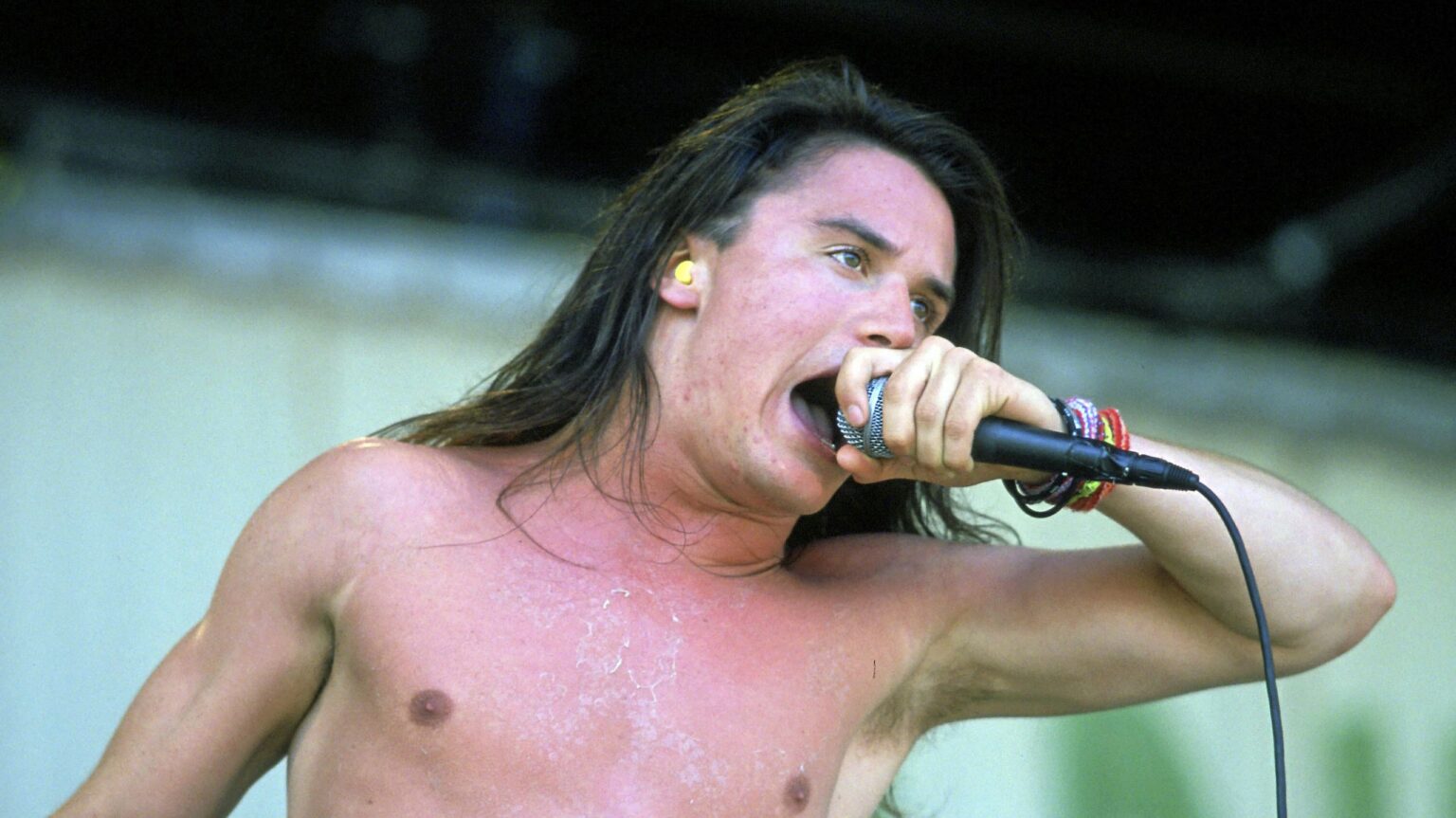
When Faith No More returned with their third album The Real Thing in 1989, the San Francisco rockers not only had a new singer in Mike Patton, they’d also written what would quickly become the biggest hit of their career.
Epic was released as the second single from the album in January 1990, and had begun life as a jam between bassist Billy Gould, drummer Mike Bordin and keyboard player Roddy Bottum.
As Gould described it, the track was “conceived naturally as a riff in the studio between Roddy, myself and Mike that later got fleshed out into an entire song”.
You may like
In truth, the band were in a place of uncertainty at the turn of the ’90s. Initial sales of The Real Thing were disappointing after the first single, From Out Of Nowhere, had flopped.
It was the decision of their label, Slash Records, to let the group pick the second single, and though the A&R team weren’t particularly keen on Epic, for the band members themselves it was one of the bona fide highlights on the album. But even by their own admission, they had “very little expectations of it becoming a commercial hit”.
As fate would have it, the track performed very successfully across the globe, topping the Australian charts for three weeks, peaking at No.2 in New Zealand and climbing to No.9 in the US Billboard Hot 100.
By blending elements of rap, funk and classical with heavy rock, Epic would also lay the groundwork for the wave of nu-metal that followed later in the decade.
In 1997, Billy Gould explained how “a lot of our songs start music first, lyrics later” and how its title was “a kind of code word” because “it was a preposterous grandiose thing!”
He continued: “We’ve always had a sort of campy, semi-serious approach to writing, with these big cinematic sounds. Patton wrote the words to it about a week after he joined the band. I remember him explaining it to me and I didn’t know him very well, so I wasn’t sure what to make of it.”
The song is lyrically ambiguous, with Patton’s enigmatic lyrics continually alluding to “it” though never quite articulating what “it” actually is. Interestingly, the word ‘epic’ is never mentioned during its 4 mins 53 secs.
In a 1990 interview with Circus Magazine, Patton explained that lyrics like “it’s in your face but you can’t grab it” were about “sexual frustration” in its various forms, airing his grievances with both sides of the coin (“sex and lack of sex”).
You may like
When the conversation later turned to masturbation, the eccentric frontman explained how “most people don’t like to talk about it” but he nevertheless counted himself as a big fan, adding “that’s kind of what Epic’s really about”.
Guitarist Jim Martin can be seen playing a black Gibson Flying V with a mirror pickguard in the video, which was mostly likely plugged into a Marshall or Mesa/Boogie amp for the recording.
Martin can also be seen wearing a t-shirt that says ‘A Tribute To Cliff Burton’ – as the Metallica bassist who had died a few years earlier was a schoolmate and close friend of Martin’s.
The guitarist’s parts evolve throughout the song – starting with simple E, B, C and D power chords. In the second verse he introduces a bluesy riff that features an E7#9, a shape commonly referred to as ‘the Hendrix chord’.
For the second chorus, he switches to an octave idea instead of power chords that sits above the original movement being continued by Gould’s bass. There’s also a heavy palm-muted riff playing off the open low E-string and an E power chord one octave up at the seventh fret of the A-string.
The guitar solo is played in the key of E Aeolian and gets harmonised a third up for extra depth.
More octave ideas are brought in for the outro which get layered against some single-note lines in the same key and low E power chords.
The final segment of music is played on piano by Bottum.
In the Salvador Dali-inspired music video, Bottum walks away just seconds before the piano explodes.
Moments before the explosion, a fish can be seen flapping on the ground, which led to criticism from animal rights activists. There was also a rumour that the fish actually belonged to Icelandic singer Björk and had been stolen by the members of Faith No More.
“The floundering goldfish was my idea,” Gould revealed in 1997. “It was that kinda [cult director] John Waters thing where you try to get maximum attention for minimum money! The piano exploding was pretty cool, too.”
In 2010, the music video’s director Ralph Ziman confirmed that several fish were used for the shoot in London and none were out of the water for very long, with all of the animals being released into a river following the video’s completion.
36 years on from its release, Epic serves as a time capsule for the changing of the guard in rock music at the end of the ’80s, heralding the more outlandish and experimental type of sonic aggression that would soon be typified by groups like Korn, System Of A Down and Slipknot.
Slipknot frontman Corey Taylor himself once revealed that seeing Faith No More at the 1990 VMAs performing Epic on a television set saved his life after a suicide attempt.
“If it wasn’t for Faith No More, I wouldn’t be here,” Taylor revealed, explaining how the funk rockers “re-energised my whole will to make music”.
He added: “They were so good and they were so powerful and it was so different than anything I had ever seen, you know, that they really got me off my ass and that’s when I started writing and making music again.”