
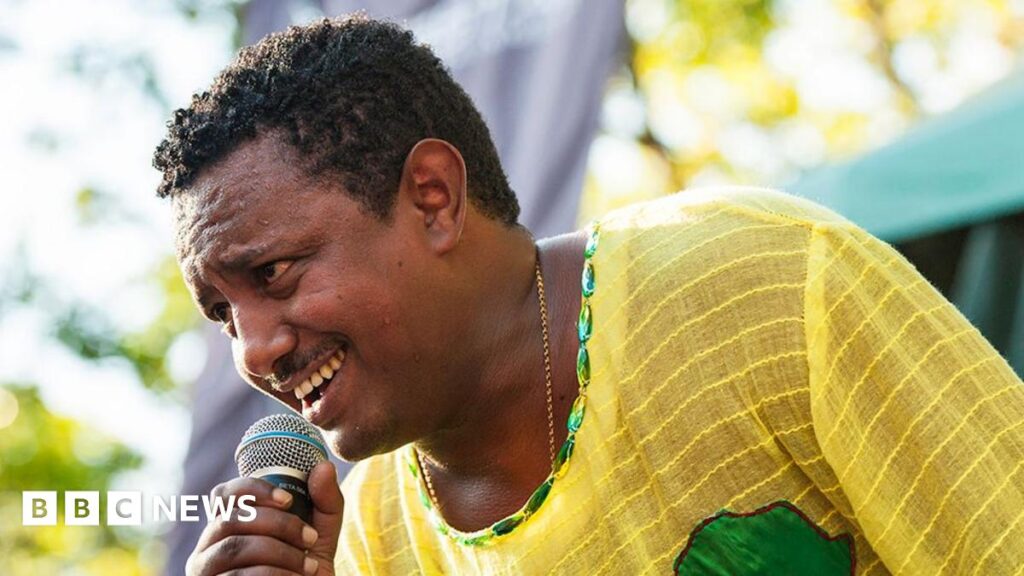
“The spirit of being Ethiopian is now pushed away,” the 49-year-old laments on Das Tal.
“Now I understand the sorrow and pain. Where can someone go to mourn, where do you cry? In the place that raised me, in the village where I grew up, I have become a stranger, like someone with no country.”
The star has been a thorn in the side of previous governments. Two decades ago he was imprisoned for 16 months for being involved in a hit-and-run, and said the charges were politically motivated.
His last album, 2017’s Ethiopia, enjoyed significant sales in the country and topped the Billboard World Albums chart for weeks. It dwelt on historical themes and called for unity among Ethiopians.
But its official release in the country was blocked by the authorities.
There were huge anti-government protests at the time over the marginalisation of the country’s largest ethnic group, the Oromo, which eventually saw the downfall of the then-prime minister.
“All of my music is based on love,” Teddy Afro told the BBC in 2017.
“Like Martin Luther King said: ‘Hate cannot drive out hate: only love can do that.’ And for us to come out of the situation we are in, I believe the only choice we have is love.”
Prime Minister Abiy Ahmed, who is Oromo himself, came to power in the wake of the protests and promised a new age of unity in the country, which comprises many ethnic groups.
Teddy Afro initially embraced that promise, but has since been disillusioned by widespread violence and the government’s actions – not least the two-year civil war in the north, which led to the deaths of hundreds of thousands of people.
He released a song in 2022 expressing his concern with increasing “tribalism”, on which his latest track builds.
Prime Minister Abiy frequently stresses that he is working for the country’s unity, saying that the only way to prosperity and security is for people to come together.
This message is only likely to get louder as June’s general election approaches.