
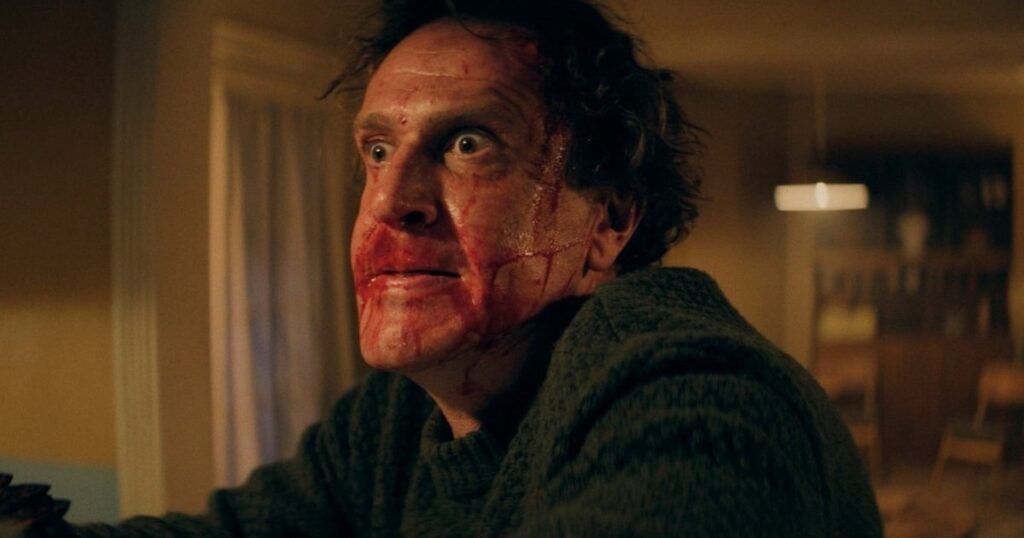
ComingSoon editor-in-chief Tyler Treese spoke with Over Your Dead Body director Jorma Taccone about his star-studded new movie featuring Jason Segel, Samara Weaving, Timothy Olyphant, and more. Taccone discussed his approach to making a remake, reflected on Popstar, and more. IFC will release the action comedy movie in theaters on April 24, 2026.
“When miserable couple Dan and Lisa retreat to a remote cabin for a romantic reset, each arrives with a secret plan to murder the other. Their carefully plotted traps and counterplots quickly unravel when a dangerous crew crashes the weekend with plans of their own. As the toxic getaway spirals into chaotic carnage, Dan and Lisa must survive the intruders, each other, and figure out if they want to save their marriage or survive it.”
Tyler Treese: Congrats on the film. I had such a blast watching it. I was curious what your approach is to a remake, because obviously, you want to carry over that core, which made the original special, but you also don’t want it to be a retread. I thought you really let your stars shine here. So how did you find that middle ground?
Jorma Taccone: Yeah, I think you put it very succinctly. It’s hard to even wanna make a remake, and I like the original so much. You gotta kind of think about like what you feel like you can either enhance… I don’t even wanna say enhance because I really felt like the original, like, does exactly what it wants to do. But for me, it was like a tonal shift that I wanted to bring to it.
Obviously, I wanted to push the comedy where I could, but again, as you said, honor what the original does so well. There are moments that you have to kind of look at your own ego and be like, “I don’t wanna change things that work. I don’t wanna just like put my stamp on something that is already there and doesn’t need your stamp sort of thing.”
It’s also then in those moments, allowing the actors to do the work because it is so different tonally just from having a different cast. I feel like what Samara and Jason bring to this tonally is so different than the original. The original is very dark. It’s very emotionally sort of dark and angry in a very much in a very purposeful way. I think for this version, I wanted the characters to be a bit more sympathetic. It has the same arc completely as the original movie.
I love the structure of the original movie because it’s so surprising, especially for people who are also well-versed in storytelling now, of just having watched so many things, that it’s really nice to see something that moves totally different from what you’re expecting it to. But it was really like letting those guys do the work of being different characters, being, I think, more sympathetic. It was like having us all create this different tone that I just was so happy to get to a point where I felt like I was really proud of what this movie was. Having Tommy [Wirkola], who did the original film, be really proud of it as well. Like, I didn’t f— it up is the short answer.
You definitely didn’t. There are some nasty scenes in it, but it always manages to be fun. How is it managing to have some real brutal disfiguration in the film, but also keeping the tone light? It seems like they would clash, but somehow it doesn’t.
No, that was very much by design, and I think that is like very much my tone with anything. Like, again, I’m always trying to push the comedy, but I think the comedy allows you to be as dark as it is. Like it’s sort of inarguably gross. It really goes there. It really goes to like pretty dark f—ed up places.
It is very violent, I think it always is in a really fun way. I’ve been telling people, watching my mom and my stepmom, who are not that kind of person, guffaw laughing at some of the most horrific stuff in the film. But I think that is the trick of it. The humor is the thing that stitches it all together.
Because there are so many different tones. It’s almost like three different movies in one, and the way it goes and the way it builds is going from one to the other, but it’s the humor to me. There’s the charm between like all like the couples, honestly, like Samara and Jason, and between our baddies of Juliette [Lewis] and Timothy Olyphant and then this other like wonderful lovable psychopath in Keith Jardine, like all of that working with like, there’s humor in all of those things, but it’s what stitches it together to me in like a really nice kind of cohesive way.
I feel like Popstar is one of the most underrated movies of the 2010s, a decade later. I still go back to it and watch it every year. What are you most proud of about that movie? Because I love it and it has a real place in a lot of people’s hearts.
Jorma Taccone: I mean, well, just jokes per minute. I think it has a pretty high jokes per minute quotient. But I think it was really hard for us to make. I don’t wanna say hard for us, but I think it’s in kind of the way that this movie does too. Like there is a heart, like that is the backbone of it. There’s some crazy jokes in it. The music… we had to make an entire album of, I think, pretty good songs before you even make the movie. So like, I’m proud of that, to have made both a movie and a decent album at the same time, as a feat in itself. Then like the edit honestly is the biggest thing.
I mean, it took us seven and a half months to edit that. There’s 400 hours of footage in that movie, which is basically how much an actual documentary would have. Normally, a regular feature film has about 120 hours. So it’s like just going through and getting all these things, the amount of times that we yelled, “that’s a wrap” on this movie was crazy because we just could keep adding onto it. Like with him doing Snapchats and changing the story and fine-tuning the story.
There was a moment I’ll leave you with. I remember Phil [Lord] and Chris [Miller], who did Project Hail Mary and Spider-Verse. Like unbelievable writers, filmmakers. But there was one point where Phil and Chris watched. We just showed them the first act and then, or that they showed them a movie, and Phil suggested like 10 different versions of the first act.
He was like, “What about this?” We were like, “Tried that, tried that, tried that, tried that.” We had tried like every single one of them. We did 108 versions of just the first act of that movie. We did it. We brought it to the nth degree of what it was supposed to be. So, I’m very proud of that because like we never let the bone out of our mouth, so to speak. I don’t know if that’s a phrase…
Thanks to Jorma Taccone for taking the time to talk about Over Your Dead Body.