
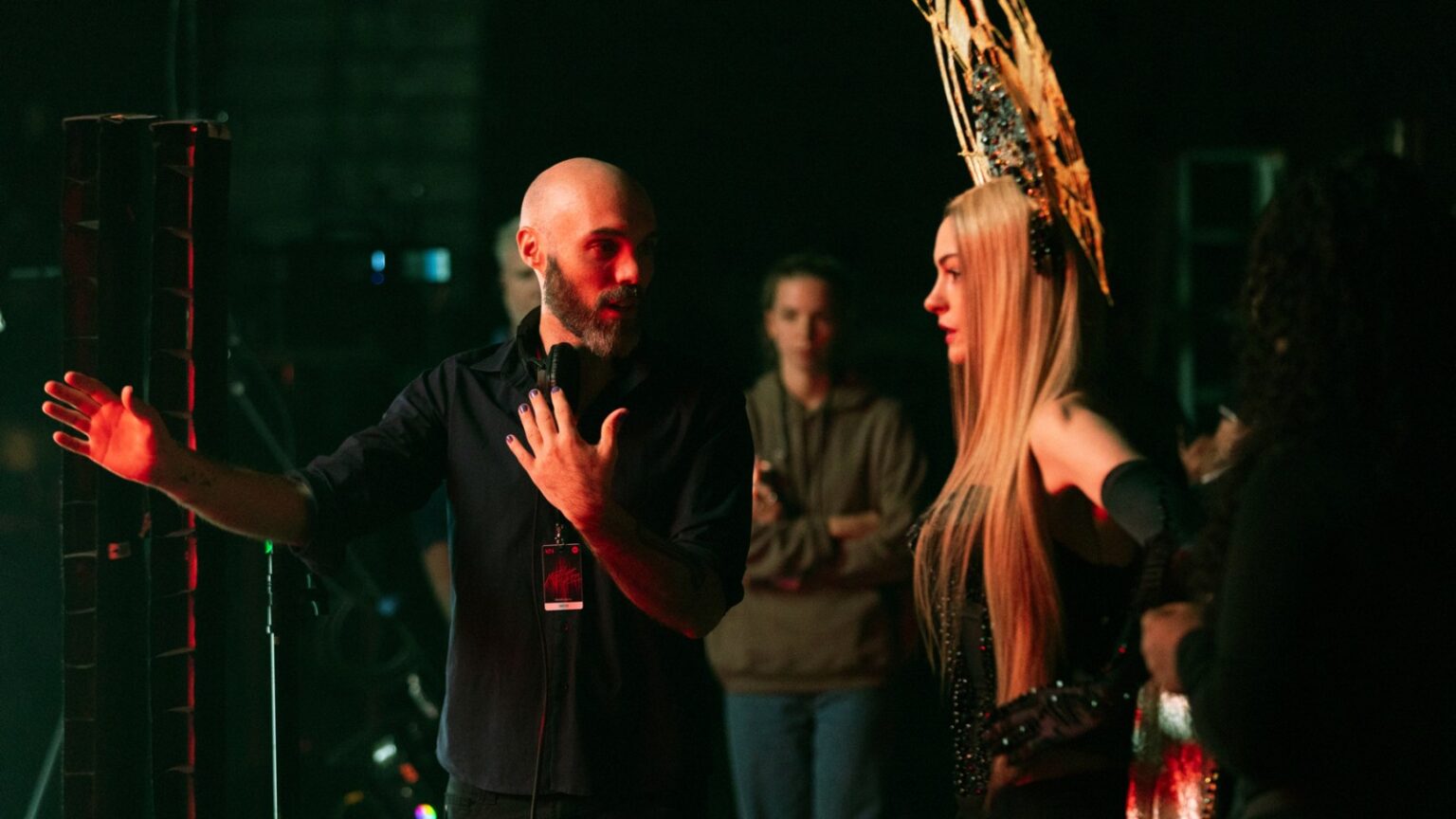
There are a number of things you’d guess about David Lowery simply by looking at him. Intelligence radiates off of him. Ditto curiosity. There’s an inherent gentleness about the 45-year-old, and you can tell he’s made films for and about kids; not for nothing is he responsible for Disney’s 2016 live-action version of Pete’s Dragon and one of the best takes on J.M. Barrie’s lost-boy fantasy, 2023’s Peter Pan and Wendy. But there’s also an intensity in his eyes when discussing topics he’s passionate about, and he’s likely to go from waxing poetic about Robert Redford — he directed the late star in one of last great movies, The Old Man and the Gun (2018) — to excitedly dropping facts about quantum physics. Talk to Lowery for five minutes, and you find yourself thinking: Well, of course he’s a filmmaker. You would not have pegged him, however, for a die-hard consumer of modern pop music.
“Oh, man, I’m a huge fan of pop music,” Lowery admits, citing a desire to do a deep dive into the Billboard Top 100 that started more than a decade ago and continues to this day. “Go back to Ain’t That Body Saints” — his 2013 breakthrough movie starring Casey Affleck and Rooney Mara as an outlaw couple on the run — “and you see a drama that’s infused with Americana. But the whole time I was making it, I was listening to Kesha.” (It’s why, he notes, the “TiK ToK” singer has a brief role in his surreal 2017 meditation on the afterlife, A Ghost Story: “It was a way of honoring the path I was on.”)
It was only a matter of time, Lowery notes, before he got around to telling a story about a pop star. And with his latest, he’s gone after the subject in a big, if extremely idiosyncratic way. Mother Mary centers around a massive, multi-platinum singer of the same name, played by Anne Hathaway and reminiscent of everyone from Madonna to Dua Lipa. She has arrived, unannounced and uninvited, on the doorstep of her old friend and collaborator, Sam Anselm (Michaela Coel). Sam is a fashion designer who helped craft Mary’s look and persona back in the day, until the musician decided she needed something new. Being exiled from the inner circle broke Sam’s heart.
Editor’s picks
Now, nearly 10 years later, Mary returns to ask — beg, really — for a favor. She needs an outfit for a major concert, set to happen in five days. Can Sam both forgive her and help her out? Mary also seems unnerved and more than a little on edge, partially because on an incident at a performance that went viral. But she’s also experienced a weird paranormal presence, dubbed “the Red Woman.” The strange thing: Sam has also encountered this exact same presence. And then things start to get really, really weird.
Shortly before the movie’s limited opening in New York — it goes wide on April 24 — Lowery sat down with us to explain why the origins of the project go back to a haunted hotel in Ireland; enlisting no less than Charli XCX, FKA Twigs and Jack Antonoff to help create Mary’s epic hyper-pop anthems; how each of the extraordinary outfits from the film’s costume designer tell their own story; and why a film involving fashion, music, art, ghosts, and making peace with your warring creative selves was extremely personal. Here’s the making of Mother Mary, in the writer-director’s own words (as told to David Fear).
In the Beginning
There’s this line in The Old Man and the Gun where Robert Redford talks about how he’s lived his life in such a way that the seven-year-old version of him would be proud of where he ended up. It’s something that I think about all the time. The seven year old version of me, the one who decided that he wanted to spend his life making movies: Would he be happy with where I am?
I was thinking about that one night in Dublin, while we were shooting The Green Knight. I had come home from set and had a call with Disney about Peter Pan and Wendy, which we were about to start working on. There was an overlap between these two vastly different projects, and I just had a moment of self-doubt where I didn’t know if I recognized myself. One night, when I couldn’t sleep and was fixating on this, I thought, “Why don’t you just try writing this down?” So I wrote it down this dialogue between two people, which almost instantly became an exchange between a pop star and a dressmaker. The idea of a pop star who needed a dress was about as far as I got that night. I don’t think Sam was even named Sam at that point. But Mother Mary was definitely named Mother Mary.
Related Content
I was still struggling to the get those two projects made and finished, but I kept going back to this in-progress script; it became kind of a sounding board form my conflicted feelings. Then, in August of 2012, my wife and I went to Colorado to visit my grandmother, and we’re like, Well, of course we’re gonna stay at the Stanley Hotel [where The Shining was filmed]. I finished my final draft there.

Eric Zachanowich/A24
Casting
When I was thinking about any single actor, I would imagine them in both roles. I would always send the script and say, “Who do you gravitate towards?” I had seen I May Destroy You while we were in quarantine in Newfoundland, making Peter Pan, and it eviscerated me. I just was, like, this is a work that transcends cinema. It transcends episodic storytelling. It was just a work from a generational genius.
I wasn’t thinking of Michaela for this originally when I was writing it, but she quickly rose to the top of my list. We sent her the script probably sometime in the summer of 2022, and she either read it or wasn’t available to meet, or didn’t have time to read it. When her agent let me know that, I took that as a pass — a very, very kind pass. And that was fine. I was just delighted that we got to send it to her.
Then I met with Anne, and that meeting led to a very quick decision that she should be Mother Mary. It was just clear that, Oh, you’re going to bring so much to this character that I cannot even comprehend. She was on board a few weeks after that.
Suddenly, a few months later, I hear from Michaela’s agent again. She read the script, absolutely loves it and just wants to meet and speak about it. It wasn’t about playing a part, or to ask me if Mother Mary was still available to play. She just wanted to know who had written the script. I just wanted to meet Michaela Coel. [Laughs.] So we had a Zoom, and we talked about the script and where it came from, our families, quantum physics; we’re both fascinated with quantum physics. I had just made two movies that were steeped in the British literary tradition, and I had written this script for two British actors. I was just hearing that accent as I was writing the screenplay. I cast that aside once I met Anne, but when I was speaking with Michaela, I could literally hear the rhythm of the script in my head when we were talking.
I certainly didn’t have the luxury of doing chemistry reads on this movie. But I printed out two photos of them and just put them side by side, and was like, this is there’s an electricity here already. All I have to do is not get in the way of it. When the three of us finally got together here in New York, we sat down in a room and just read through the entire screenplay, which was one of the most emotional readings of a screenplay I’d ever had. I suddenly realized they were going to bring all of their own biographies to it, all of their own experiences, all the things that I as the writer, with my own limitations, could never dream of. Seriously, we could have just filmed that first reading and released it, and it would have been amazing.
Frederic Batier
Pop Star 101
Anne understood — more than I did, to be honest — the undertaking that was required to become Mother Mary. I knew that she was an incredible singer. I’d seen her on Lip Sync Battle, performing “Wrecking Ball” with Emily Blunt, and thought she has so much swagger, she’s gonna crush it on stage. But she read the script and was very clear that she did not possess the physical abilities to do what the script screenplay describes. She did, however, feel that she was up to the challenge.
So she started vocal training and basically embarked upon a pop-star boot camp. She began in March of 2023; we filmed her dance scene [at one point, Mary does a violent, wordless interpretative dance of her new song] at the end of June. And every day in that span of time, Anne was spending sometimes up to eight hours a day training. She had to then break down all of those assumptions and relearn how to move, essentially. She to build up a vocabulary so that she could express herself through movement, and then begin to figure out what the choreography for this specific dance was going to be — to say nothing of the stadium show, which was an entirely different thing that required an entirely different training process.
You hear about Taylor Swift singing the entire Eras show every day while on a treadmill, and it’s like … I run marathons every six months, and it’s like she’s doing that every night. I couldn’t do that! I have a tendency to get sick at the end of a shoot, because you’re holding it all in, and then when it’s over, your body just goes [makes deflating sound]. There’s a lot of body horror that goes into the process of making movies. But from artists I’ve talked to about being a pop star on tour for upwards of 100 nights in a row, it gets downright Cronenbergian. And that was what Anne was signing up for. She wanted to make you believe she was in world-tour shape.
We had a healthy schedule for all of the scenes where it’s just Anne and Michaela talking; we wanted to give ourselves to explore things. It was still the most exhausting, most intense shoot I’d ever done — there were no release valves for any of us. You were in just in it every day, but we had time. The stadium-tour shoot was the exact opposite. We shot in a real stadium, around the Cologne region of Germany. That’s part of the reason we were there, because we could get a stadium for the amount of time that we needed it. There were no other concerts coming through, no hockey games or soccer matches. And we were trying to cram so much spectacle into so little time that we were barely scraping by the skin of our teeth. It was the only way to do it. [Pause] I mean, I’m sure there are other ways to do it. But the only way I knew how to do it was to basically stage an actual show and treat it as a five-night residency, in which the artist is going to play one song, and only that song on repeat, every day. And our job is to do our best to capture it.
Eric Zachanowich
The Music
When I was writing the movie, I was listening to FKA Twigs a lot. She’s one of my favorites. I knew I wanted her to be a part of the movie — she plays the medium in the movie — but I knew that I didn’t want Mother Mary to sound like her. I wanted the movie to feel like her to a certain degree, but I didn’t want Mother Mary’s songs to feel like FKA Twigs, at least at first.
I was meeting a lot of artists, meeting a lot of producers. And I met Jack [Antonoff] pretty early on, I was like, “You were writing or producing virtually every song that has broken through the culture in the past 10 years — you are a phenomenon. Like, it’d be foolish of us to not just collaborate with you.” He read the script and really got it, really liked it.
Then I met with Charlie XCX, who I have loved for a long time. I wasn’t listening to her while I was writing the script, but I thought: this is perfect. She’s going to be able to craft a voice for this artist that is separate from what I was thinking about when I was writing the film, so that Mother Mary can have a distinct voice of her own. Our relationship is entirely text-message based, but were immediately just firing influences and inspiration back and forth. Charlie sent me the demo for “Holy Spirit” probably within a week of meeting her. And much like the table read with Annie and Michaela, we could have just stopped there.
Then Jack got involved, he pushed it further, and they developed it for a while. And then the real key component for all of this was sharing this music with Anne, hearing what she thought of it, and then finding a way for her to feel as if it was personal to her. She has an incredible ear, and didn’t want to ever impose herself upon the songwriting process, which had begun prior to her being cast. But she did need to find a way to make these songs her own. And the best way I can describe it is she worked them through and through until they felt as if they had come from deep within her bones. You know, she would have lyrical suggestions. We did co-write a couple of them together, but the ingredients that they had were already there when she started entering the creative process.
She was finding her voice. She was trying to find the voice of this character and use these songs as the means by which she found that voice. And that process began before we started shooting the first time she went to the studio to record “Burial” and “Holy Spirit.” It continued after we wrapped the first leg of the production, we went back to the studio and kept working on those two songs, plus the other ones that had been written in the meantime.
And then after we’d shot the concerts, she could hear something that was missing that I was unaware of. I was very happy with the songs. They were incredible. They came out the gate blazing, and now they were on fire. But she knew that she could distill that fire to a degree that I was incapable of hearing, to use a weird metaphor — or maybe an appropriate one. [Laughs.] So last summer, she spent about three weeks in the studio, rerecording all of them over and over and over again, working with Jack, working with a few other producers. And I can’t quantify exactly what happened or how they changed, but they got really, really good, in a way that we all just were like, “Oh! We now hear what you’re hearing.” I’m so grateful that she chased that. Because the difference between the version of the movie that had the new songs … again, the pace, the rhythm, it’s all the same. But it really changed the feel, the vibe, everything.
Eric Zachanowich/A24
The Outfits
We knew there were going to be these pop concerts that had to have their own bespoke looks to them. And I wanted every song to be a different costume. I wanted them to represent the different stages of her career, and feel consistent to this persona that we were creating. The script mentioned that her signature look is involves a halo; whether that’s pulling from Beyonce or religious iconography, it fits with her name. That was always the centerpiece of every look.
But then beyond that, we looked at pop stars over the past 20 years, and just tried to tap into different trends, as well as our personal favorites regarding collaborations between designers and singers. We were looking at Gaultier and Madonna, or my personal favorite, Alexander McQueen with Lady Gaga — that relationship is so beautiful and profound. Even like Dua Lipa on her Future Nostalgia tour working with Casey Cadwallader and Mugler — we just liked coming up with this litany of looks.
In the screenplay, the movie originally began with a prologue where Mother Mary was giving a Vogue interview, doing one of those “Life in Looks” videos. Through that, we’d get to learn a little bit of backstory about her and Sam. That ultimately revealed itself to be unnecessary, and by the time we decided not to shoot it, Bina Daigeler, our incredible costume designer, had started making all of these different looks. She’s putting them up on mannequins and sending photos to me, and I was thinking, “We have to include these in a more substantial way than just taking photographs and cutting those still photos from, like, a red-carpet montage. These outfits are incredible. They need to be part of the movie.”
So that sort of gave birth to the idea that throughout the film, Sam would see Mother Mary from time to time in clothes that she had made for her over the course of their career together. We’d be shooting and just think, “Oh, is this a good opportunity to take a little pause and have a dress vision?” That’s what we call them: dress visions. We shot a lot of them. And the ones that worked are what’s in the final film.
But creating those looks was really … I give all the credit to Bina, who just took what I wrote in the script, which was very simple, and ran with it. I described one costume as looking like medieval armor — very Joan of Arc. There was another that I called the “broken-heart dress.” It was something that Mary described wearing when she had been dealing with a broken heart, and Sam turned that feeling into her dress. That’s the blue one with the red sacred heart that you see. Every look needed to tell a story, especially at the end we see all of them in sequence. In the original script, it was all very literal backstory, where characters were explaining them. And in the finished film, we just let the dresses tell the story.
And then the final piece was the dress that Sam was making for this big show at the end, and for that, I wanted it to feel different from everything else in the movie. We turned to Iris van Herpen, who’s one of my very favorite designers, and asked her if she would design that dress. We knew it needed to be a showstopper. You only see it for a second at the end of the movie, but needed to really tie the whole film together. And so she read the script and came up with an entire wall of designs. When we went to her atelier in Amsterdam, Bina and I just walked in and saw all these drawings, all these sketches, and we went straight to the one that was in the movie. It was immediately like, “This is the one. It’s perfect.”
Eric Zachanowich/A24
The Red Woman
The Red Woman was a combination of different things. So when you first see this apparition, it’s a rod puppet. I’m a big fan of Carlo Rimbaldi, who created E.T. and the sand worms from David Lynch’s Dune. I wanted this fear to initially manifest as a Carlo Rimbaldi puppet, like an homage. When you first see it on the floor, it’s this rod puppet with bellows and someone’s hiding under the bed, breathing into it. I wanted to have it be really a repulsive little entity — we always described it as feeling sort of like a red Jabba the Hut. Annell Brodeur, who did the ghost for my movie A Ghost Story, built all those puppets, but it’s essentially a ghost in a state of flux — it transitions from this mess of bloody tissue on the floor into something more effervescent and fluid. I didn’t know what it should be, I just knew I wanted it to be practical. We did do some CGI tests and it never felt right. It needed to be tangible.
Then I discovered this Brooklyn artist named Daniel Wurtzel, who does these incredible art installations with fabric blowing in the wind. It’s like custom wind tables that can keep a piece of fabric floating in the air permanently. It takes a piece of fabric and turns it into something that’s more akin to water or smoke. But because it is a piece of fabric, it has a sense of weight and gravity to it. You know what it would feel like to touch it, but it’s always changing and trying to find its own form. It was exactly what this ghost needed to be, partially because it’s coming from Sam, whose medium is fabric; it made sense that her ghost would take a form that is related to her means of expression.
Trending Stories
We spent five days on set just filming fabric in the breeze. It was incredible. With some of the shots we’d storyboarded, we were like, “The fabric to go out the door.” And we were all there with leaf blowers, blowing this fabric around. We were just seeing what we could get with it. It felt like we were doing chemical reactions, but just using air and cloth. We had to use digital technology to erase strings, and we’d mirror things to get this really great fractal imagery. But it’s basically a one-to-one ratio of what we did just dropped onto the screen.
So many of the great pop songs are about heartbreak. And the idea of taking that feeling and turning into something that people universally find to be beautiful is an incredible phenomenon. Just because a billion people find meaning in what, say, Taylor Swift or Lorde are singing about doesn’t make the emotion any less acute. And when an artist with that reach goes and sings a song about the worst day of their life, and a million people are dancing to it, that is an incredible transformation of feeling — and that was what I wanted this movie to be about. I mean, early in the movie, Sam talks about designing these outfits for Mary as being a “transubstantiation of feeling.” That’s also what the movie is doing. That’s what I was trying to do as well.