
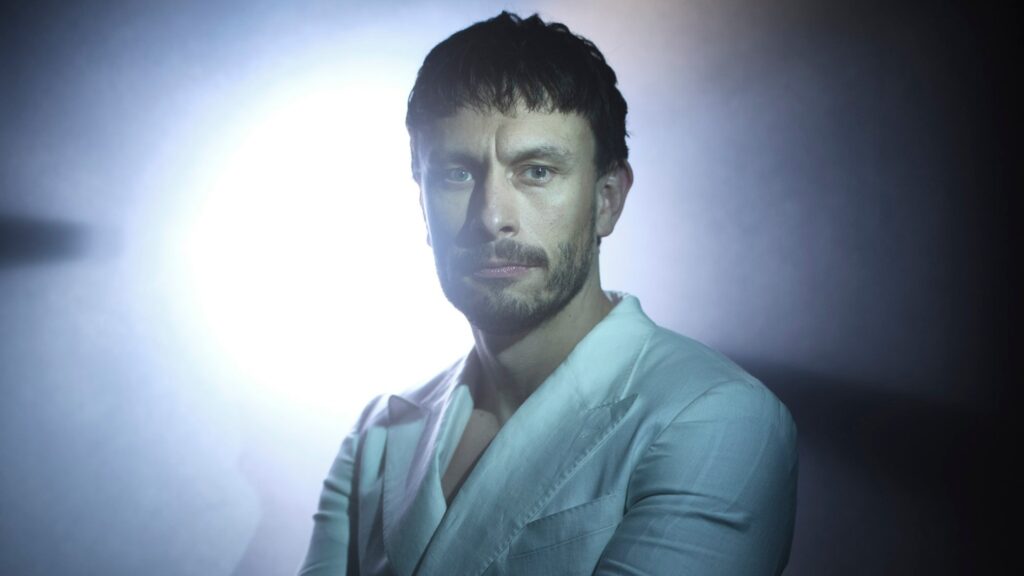
Richard Gadd hadn’t quite made peace with his newfound celebrity status when, at his local supermarket, he came face-to-face with a front-page headline in the Daily Record: “Baby Reindeer’s Richard Gadd is ‘struggling to cope with fame’ as fans ‘camp in his garden.‘ “I just looked at it and I was like, ‘I’m on the cover?’ What the fuck?” recalls the 36-year-old, reliving the moment. “Who said that and where have they got that from?” he wondered. He’s still in disbelief. “People were trying to hack my social media, trying to hack my emails. I really felt like, for a period in time, the whole world was talking about me.”
Maybe not the whole world. But for a few months in the spring of 2024, as Baby Reindeer smashed records and taboos, it certainly felt that way — to us, too.

Photographed by Frank Ockenfels 3
Gadd and I are midway through our evening together on an uncharacteristically hot, sticky evening at London’s Charlotte Street Hotel, where the Scotsman is nursing the particular anxiety of a man who already has changed television once and is about to find out whether he can do it again. His BBC and HBO six-parter, Half Man — a searing Glasgow-set exploration of male rage and repression, arriving right as culture’s so-called “manosphere” obsession begins to feel quite inescapable — drops April 23. It is, by any measure, the most anticipated follow-up in television. Critics so far have described it as “brutal,” “monstrous” and “uncomfortably erotic.” Yes, Gadd — who built a career on turning agony into art — is back to betting on his signature style of hard-watch telly. He plucks an oft-quoted expression from memory: “Art should comfort the disturbed and disturb the comfortable.” He’s smiling. It captures him pretty perfectly.
Still, the noticeably beefed-up Gadd is admittedly nervous. Settling into the cushioned armchair opposite me, shoulders slightly raised, he asks with a half-laugh: “Do you think it’ll go well?”
To offset that apprehension, I start with the U.K. Office. At a recent screening of Half Man, Gadd named it his favorite show of all time. It feels like a comfortable place to begin before the conversation inevitably descends into edgier territory. The Fife-born star, the son of a microbiologist and a university professor, was quite taken with the workplace sitcom.
And yet, even within that comedy, it’s the tragedy of Ricky Gervais’ cringe-inducing David Brent (the unpopular boss embodied a little more sympathetically by Steve Carell in the U.S. version) that captivated Gadd. “What I think people forget about Brent is he’s superbly drawn as a tragic character,” he says, eyes lighting up. “What he really wants is to be loved. There is such desperation to it, and there’s such humanity. I couldn’t believe I was watching a show that could make me laugh, cry and think all at once.”
Gadd’s bid to re-create that emotional trifecta began with a string of (mostly) one-man comedy shows from 2010 onward. He’d dipped his toe in the stand-up waters as a student at the University of Glasgow and began with a slew of Edinburgh Fringe Fest routines — all of them would draw on his chaotic personal life and cartoonish approach to making a spectacle out of his own misery. “Richard Gadd is clearly having a bad time,” a decade-old review of his 2013 show Cheese & Crack Whores begins. “So bad, in fact, that it’s debatable which would be better — to review him, or refer him to [British suicide prevention charity] the Samaritans.”
It was in his 2016 performance for Monkey See, Monkey Do — about his own experience of sexual abuse and the aftermath — that Gadd felt he was teetering on the precipice of full-blown darkness. “And it was funny,” he maintains. “I still stand by that. But it had real dark moments in it.” From that point on, the “pure storytelling” of drama called to him. No longer chasing laughs, he felt liberated. And while he was forced to surrender to the inscrutability of the audience — “With comedy, if it’s going well, people are laughing, but what constitutes good drama writing? How do you quantify someone’s reaction?” — what remained was a former comic with a flair for putting his torment up onstage.
In 2019, the product of that revelation was born: Baby Reindeer, released in April 2024 on Netflix, was a seven-part gut punch about stalking, sexual abuse and the labyrinthine mess of one man’s inner life. It became a cultural phenomenon, awards juggernaut and sparked a $170 million defamation suit that, if headed to trial, would deal a major blow to Hollywood’s streaming giant.
Not only does Gadd stand by everything, but he now finds himself at the hardest juncture of any breakout artist: the second act. He’s well aware of the question everyone in television is quietly asking: Can the kid from Fife do it again?
Says Gadd of his newfound fame following the worldwide success of Baby Reindeer: “It was an adjustment to suddenly be going down the street and everyone knows my name.” Paul Smith suit, shirt, tie; Lardini belt; Doucal’s shoes.
Photographed by Frank Ockenfels 3 (2)
***
It might be considered a tricky exercise, describing how Baby Reindeer was received around the world. Perhaps its creator-star is best placed to make sense of it. (Spoiler: He still can’t.)
“I would describe it as a hysteria,” begins Gadd. “I never want to be one of these people that say, ‘Oh, I just didn’t know it was going to be a success!’ Like people that play the humble game. I believed in Baby Reindeer so fundamentally. But in terms of one of the most watched Netflix shows of all time. … That doesn’t come into your head when you grow up in a small Scottish town and you write stuff like that.”
Within a week of its release, Baby Reindeer was the top series on Netflix globally, having garnered more than 52 million viewing hours. This number would only rise in the coming months as the show broke record after record, lauded by a range of A-listers from Stephen King (“BABY REINDEER. Holy shit,” the author tweeted) to John Cena (a wrestling hero of Gadd’s who sent him a video raving about the show). Chronicling the true story of a struggling comedian named Donny who is harassed, stalked and sent north of 40,000 emails from a woman he served at a pub, it became the year‘s must-watch series.
Even after two years, Gadd remains uneasy talking about his overnight fame. Some of it was euphoric: He relives his Emmy wins in September of that year, an event he attended with only an inkling that Jessica Gunning (in her breakout role of Martha, Donny’s stalker) would nab best supporting actress (she did). By the end of the night, Gadd had picked up Emmys for best limited series, best writing and best actor as well. The pinch-me moments peaked during his run-in with Steve Martin. “ ‘Oh my God,’ ” he remembers the legendary comedian-actor saying, “ ‘You’re Richard Gadd!’ ” Martin asked for a photo.
As a self-described “fame-allergic” person, there must have been elements he didn’t enjoy about that time. “It was an adjustment to suddenly be going down the street and everyone knows my name,” he says. Baby Reindeer wasn’t just the most watched show around the world, he reminds me: “It was also in the public conversation, in the news sphere. I felt like people could not believe that the guy on Netflix and in the news was suddenly there.” Some people would bound up to him and demand photos. Others would gasp. What he found most unnerving was when they’d simply stare. Paranoia set in: “What’s going to happen next? Is someone going to come up to me? Are they going to say something?”
His fretfulness only worsened when internet sleuths claimed to have unmasked the real-life stalker depicted in the series by Gunning. She later came out publicly, on Piers Morgan’s Uncensored, as Fiona Harvey, and declared war on Netflix with a $170 million lawsuit over defamation, negligence and privacy violations. The streamer, which curtly informed THR that there is no update on the suit, so far has failed to get the case thrown out. Harvey’s lawyer, Richard Roth, says there is a slew of Netflix appeals his team is waiting on. “We are extremely confident […] that Ms. Harvey will be fully vindicated as a result of Netflix’s alleged defamatory misconduct herein,” he says, “including, among other things, that Netflix published to the world that the series Baby Reindeer was ‘a true story’ when it indisputably was not.”
Gadd likely won’t comment on any of this, but I ask anyway: Would he do anything differently if he could? “I set out every day to just make it as good as possible,” he answers. “That’s all I did on Baby Reindeer: ‘How can I improve this? How can I make it better? Make it feel more rounded and whole, or emotional or funny?’ ”
He maintains that he put out an immediate statement when social media users unearthed years-old tweets from Harvey, who in turn says she was harassed over falsehoods portrayed in the show. Says Gadd: “In terms of the online detectives … I didn’t really know it was a thing because every time I’m in my work, I exist in a funnel. I just remember when that happened, I [said]: ‘Please stop. That’s not what the show is about.’ ”
Per a July 2024 declaration of support for Netflix filed to the U.S. District Court for the Central District of California, Gadd — who is not listed as a defendant in the case — describes the series as “emotionally true” and “not a beat-by-beat recounting of the events.” Today, he echoes that feeling-first sentiment: “I set out wanting to explore trauma, the need for human connection, loneliness, isolation, self-blame, self-hate. And that is what I wanted people to take from the show.”
Some viewers might misinterpret Baby Reindeer to be a coming-out story, he says. Gadd identifies as bisexual, though he refrains from speaking in absolutes about his sexuality: “Bisexual is the easiest way of explaining it to people, but even then, I feel like I have a restlessness around sexuality, almost a confusion or an ever-shifting attitude towards it.”
And though Donny fell in love with a trans woman, Teri (Nava Mau), and sought trans women out on dating apps, the series was only ever intended to broadcast his character’s inner turmoil. “I do get a lot of messages from trans people saying how much they appreciated the representation. I really wanted to get it right in Baby Reindeer,” notes Gadd about his relationship with the queer community. But he caveats that statement: He’s never felt part of those communities himself. “I always feel kind of alone or individual,” he says. “I want them to like my work, and I respect them as communities. … [But Baby Reindeer] was a guy going through a lot of struggle, going, ‘Hey, I’m struggling,’ and that’s enough at that point. That confusion is still in Half Man in a lot of ways.”
He finds some confidence here: “In any aspect of life, whether it’s sexuality or anything, realizing you’re in a box doesn’t necessarily bring you a sense of eternal peace. I represent as bisexual, because that helps people understand me. It doesn’t speak to me in a way where I feel any sense of settlement. I don’t write for specific communities. I write for the individual who struggles. And that means the most to me — the people who feel disconnected, left behind.”
Baby Reindeer dramatized some incredibly traumatic experiences for the Brit — we were witness to him masturbating over his stalker and interrogating his own sexuality after being raped. Gadd never wrote it to be healing, though he appreciates the impact it has had on others. “I think what really helps is when you get letters,” he says. “One time, I had a letter. … He said it allowed him to speak to his wife and family about what he’d been through. He said the whole show made him feel less alone. I think that’s what Baby Reindeer did for a lot of people.” Gadd quotes some buoying charity statistics: Calls to abuse charities in Britain went up 53 percent after the show’s release and to stalking charities 47 percent. “That is about as impactful as work can be.”
Having spoken recently about not experiencing same-sex attraction until after his sexual abuse experience, Gadd is quick to clarify exactly what he meant when asked about that statement: “I’m not saying that event made me that way. I’m just saying that I think I went through this identity crisis at the end of it all. I can never tell — and I think this is a line in Baby Reindeer — whether [those feelings] were always in me or not. It’s just that at that period of life, I went through a crisis, and I started to maybe dig up repressed feelings. I honestly don’t even know, but that ‘I don’t know’ is OK.”
“In any aspect of life, whether it’s sexuality or anything, realizing you’re in a box doesn’t necessarily bring you a sense of eternal peace,” says Gadd. “I represent as bisexual because that helps people understand me. It doesn’t speak to me in a way where I feel any sense of settlement. I don’t write for specific communities. I write for the individual who struggles. And that means the most to me — the people who feel disconnected, left behind.” Lardini suit, sweater.
Photographed by Frank Ockenfels 3
***
No juicy bidding wars or lawsuit-related pivots went on behind the scenes when it came to Gadd’s new project: He fell into the arms of the BBC for a pretty straightforward reason — they were there first.
He’d started on Half Man — though it wasn’t titled yet — before Baby Reindeer got picked up by Netflix. The Beeb already had signaled its interest to Gadd and was understanding when he had to park it all to work on Reindeer. “I wanted to stay loyal to the BBC,” he says. “They’d taken a chance on the project even before Baby Reindeer, when I was starting out. I wanted to repay the favor. I also wanted to do a show with one of the greatest [distributors] of dramatic and comedic television.” (Hello, David Brent.)
Unsurprisingly, the BBC snapped at Gadd’s finished script amid post-Reindeer bedlam. HBO came aboard early on. “We knew this series belonged nowhere else but on HBO,” the network’s drama chief, Francesca Orsi, tells THR about reading the scripts. The co-production on Half Man got underway in Scotland in February 2025. It wrapped five months later.
As taboo and unsettling as its predecessor, Half Man follows Ruben (Gadd) and Niall (Jamie Bell), two men who, while they aren’t blood-related, have grown up as close as brothers. Wildly different in nature, we track this relationship over the course of 30 years: Their younger versions, Stuart Campbell (as Ruben) and Mitchell Robertson (as Niall), kick off a toxicity between the men that lasts a lifetime. It’s underpinned by a fierce loyalty — Ruben beats Niall’s school bullies to a pulp, and Niall helps Ruben pass his school tests, though their teenage relationship culminates in a display of violence that’ll have you watching through your fingers. It’s a bond steeped in tragedy, violence and the profound fragility of male relationships; everything comes to a head when, in the present day, Ruben crashes Niall’s wedding.
I explain to Gadd that I’ve found putting into words what Half Man is about rather daunting. He’s pleased about this. He’s on intimate terms with complexity. How would he describe it? “People always said, ‘Oh, Baby Reindeer was a stalking show.’ But to me, it was a show about trauma and the need for human connection. With Half Man,” he says, “people say it’s a show about toxic masculinity when really it’s about struggling to love yourself and struggling to love someone else.”
Though a piece of fiction, it isn’t any less a personal project for him than Baby Reindeer. Half Man came with the same “relentless determination.” This almost certainly extends to Gadd’s physical transformation; he put on more than 50 pounds of muscle to play Ruben and has slimmed down only marginally since the shoot ended.
“I had a nutritionist, a personal trainer, I had some company make meals for me that were the right calories, the right protein, and they’d send them to Glasgow,” he says. He’d only eat at certain times of the day; it was an intense, regimented commitment. “I never deviated once,” he notes. “There were times when you’d pass a McDonald’s or something, and you’d be like, ‘Oh, God, the golden arches!’ ” To him, this was as vital as any other component of Half Man. “I never wanted it to be Hollywood six-pack, an unrealistic sense of what we think a strong body looks like,” he says. “I want you to see a man who carries his life in his body.”
What makes all of this more remarkable is that Gadd never intended to be in the show at all. It was Bell — whom Gadd wanted for Niall for his relative anonymity (“He lives a quiet life”) — that suggested Gadd star in Half Man, too. “Rather cynically, I suggested it because I thought more people would likely see the show if he was in it,” Bell confesses. “But more importantly, I knew most of the scenes Niall and Ruben share together were not going to be easy. We needed someone of Richard’s caliber to ground Ruben in all the underlying pain and avoid cliché.”
Bell’s scene partner, however, quite literally was losing sleep over the decision. “Jamie asked about it … and then HBO started to bring it up,” explains Gadd. “Of course, purely from just a marketing and sales point of view, it really helps the show if I’m in it. But I think the second it was mentioned, I got a sense of fear: ‘This is going to be a big thing to do.’ ”
The fear was exactly what spurred him on. “If something terrifies me, and the reason for it being terrifying is, ‘What if I fail or what if people don’t buy it?’ — [then] it’s not a good enough reason.” Bell, perhaps best known for Billy Elliot (2000), Rocketman (2019) and All of Us Strangers (2023), was delighted. “I knew we’d be cooking with gas,” he says. They hadn’t met before Half Man, so Gadd flew to L.A. to size up Bell in person. “I usually don’t like casting famous people,” says Gadd. “But I think Jamie brought a mystique and an art to [Niall].”
This is also a Richard Gadd creation, and with that mystique come some disturbing plot points. Adult Niall, whose sexual repression partly stems from his fear of how Ruben will react, becomes addicted to crack as a struggling writer. He’s also a frequent cottager — that’s British slang for gay men who have sex in public restrooms — and winds up blackmailed when the manager at his local library reveals he’s caught Niall’s toilet sexcapades on tape. Ruben, meanwhile, has a troubled relationship with his father. He navigates the world with a kind of rage that infects those around him with chronic dread; the occasions we’re witness to his bubbling over are — a warning — graphic and visceral.
“I never really set out to be provocative,” says Gadd. “If I set out to be provocative, it’s not going to go very well because my intentions aren’t pure. My life and my outlook on the world are innately, sort of …” He stops. “I don’t know. I’ve found life a struggle, and my observation of human beings is that they’re a mixture of good and bad. They do reckless things, and they also do good things, and somebody can be all those things all at once,” he says. “That’s what I represent on the screen.”
Is Niall’s struggle with his sexuality loosely inspired by Gadd’s? “It’s just something I can relate to, and I think I can write about and honor it,” he confirms. “It’s a tricky thing to go through. … But a lot of [my experience] was corrosive self-projections or anticipating reactions that weren’t there — the hurt or the pain in terms of how people would react. No one ever reacted that way,” he says with a small laugh. “And we can build a prison inside of ourselves overthinking about it. It’s something I wasn’t done exploring yet.”
We’re both attempting to keep it a spoiler-free interview. But there’s a creative decision Gadd takes — an element of Ruben and Niall’s relationship alluded to, from episode one, that is never actualized. It would have certainly raised some eyebrows. Says Gadd: “Well, I think some things are much more powerful left unsaid. I leave a lot unexplained because I think, in a lot of ways, art should be open to interpretation. But Niall’s struggle was never telling Ruben anything about himself. It was more about the fear of his judgment.”
This, clearly, is the part he’s been building to. “Making people uncomfortable is not necessarily a bad thing because I think when people are uncomfortable, they’re forced to think and challenge and discuss, and that’s what good art should do. [We should] be putting stuff out there into a world that is challenging and tough.”
When I put to him that some viewers might not find Gadd’s portrayal of where trauma and sexuality intersect a comfortable watch — something of a trademark for Gadd — he responds: “If you’re speaking to the damage and the violence and the challenging things, everything in Half Man is born out of character and circumstance and a need to drive the story forward. Ultimately, it’s a show about male violence, male rage, male repression. And Ruben is built up as this mystical character that carries these hugely terrifying qualities. If we spend six episodes and we don’t see the lengths to which he’s capable of, then the show’s not really going to work. It had to go to these extreme places,” he says.
With Half Man,” Gadd says, “people say it’s a show about toxic masculinity when really it’s about struggling to love yourself and struggling to love someone else.” Thom Sweeney jacket, polo, pants.
Photographed by Frank Ockenfels 3
***
Half Man was written far before the word “manosphere” entered our lexicon, but I tell him that people will be watching this show — a blistering analysis of what it means to be a man — in the context of Adolescence and Louis Theroux’s recent documentary Inside the Manosphere. Trawling through reviews from his early stage shows, maybe it’s even fair to say Gadd is something of a pioneer when it comes to interrogating toxic masculinity.
He mulls this over. “The first time I heard [manosphere] was about two months ago, and now it’s a word on everyone’s lips. But I don’t think this show has anything to do with the manosphere,” he says. “That feels like a social media thing. … This is a story about two men who are indoctrinated by and cannot escape the past, trying to make it in a world that’s progressing around them much, much faster than they’re able to progress within themselves.”
It’s also a deeply Scottish show, filmed in and around Glasgow — something that this Fifer is beaming about. What does success look like to him now, as someone still evidently keen on honoring his roots? More Emmys? More privacy? Could he live through a second wave of Baby Reindeer hysteria? “I would never put expectations on a piece of work,” is his diplomatic response. “It can be a bit of a fool’s errand insofar as you’re setting yourself up for [disappointment]. You can’t predict the future, and if you sit too long and put these possibilities in your future, you will end up never being happy with the work you do.”
And Gadd’s future? Almost certainly a trip to North America to catch his native Scotland in the World Cup: “I want to be there for all of it. It’s just so exciting. There’s a lot of work stuff going on, but it just feels like a very special moment for the country.”
And though we’ve established his spare time isn’t spare time at all — Gadd admits he worked 16-hour days on Half Man and hasn’t watched any TV show that has come out in the past two years — has this workaholic had time to date? “I guess I haven’t tried it properly,” he says with a laugh about finding a partner now that he’s famous. “I’m not in a rush. I feel like it was good for me to spend a bit of time figuring myself out — to the point where now I sometimes think there’s a freedom to it that I better not get too comfortable with. I would like to meet someone,” he says. “Maybe it’s something I should start thinking about.”
Putting yourself out there romantically is no small feat when hundreds of millions of people bore witness to such extensive inner discord. As material, it’s the lifeblood of Gadd’s work. As a real person’s mental health, it requires a lot more sensitivity. Thankfully, Richard Gadd is doing a little better. “I still have my days, you know? I think I’ve done a lot of work on myself [over the] past few years, and it’s been very useful. But I’m not the finished article. I’ve still got a long way to go.”
Says Jamie Bell about his Half Man co-star Gadd, “I knew we’d be cooking with gas.” Dolce & Gabbana suit.
Photographed by Frank Ockenfels 3