
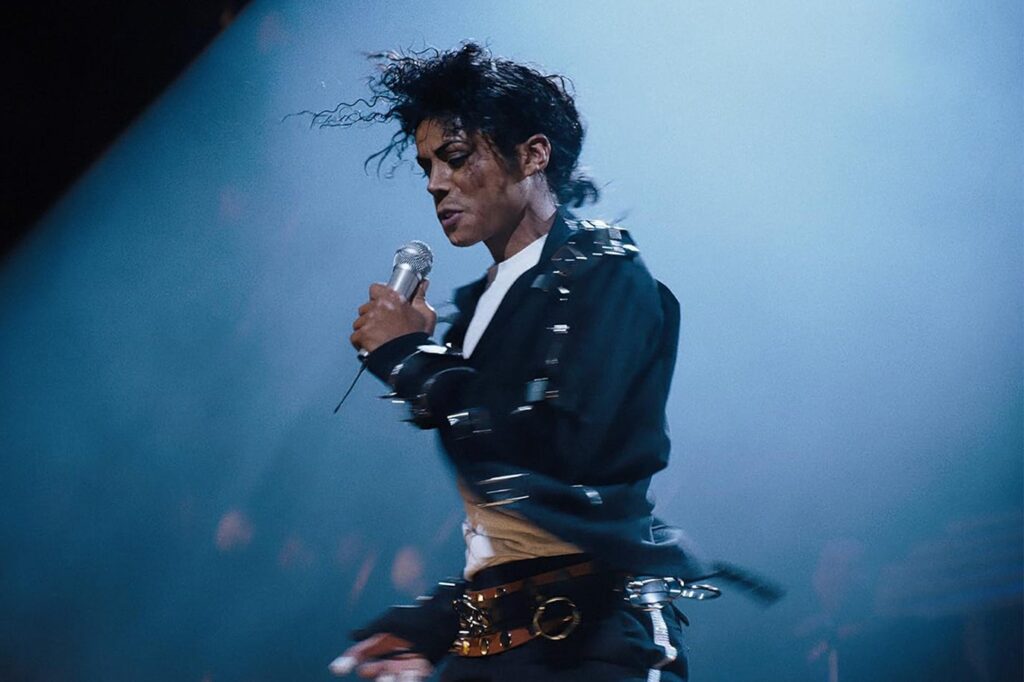
Earlier this month, Leaving Neverland director Dan Reed was asked what he learned while making the four-hour documentary about Wade Robson and James Safechuck, who allege that Michael Jackson sexually assaulted them when they were children.
“I learned Michael Jackson fucked little boys,” Reed responded. “That’s what I learned.”
In the midst of a flood of discourse about how to weigh Jackson’s musical legacy against the crimes of which he was accused—and whether Michael, the gauzy new biopic about him, has any obligation to acknowledge or even allude to them—Reed’s directness hit with an almost physical force. The movie cuts off, somewhat abruptly, in 1988, and the last time we see Michael offstage is four years before that, well before any charges were filed, and even before Jackson’s habit of spending time with preadolescent boys had become well-established enough to be the subject of frequent jokes on late-night comedy shows. But it was originally intended to open with the 1993 police raid on Jackson’s Neverland Ranch, during which, as director Antoine Fuqua told the New Yorker, “I shot him being stripped naked, treated like an animal, a monster.”
The plan, it seems, was not to ignore the allegations but to lean into them—and almost certainly, given the uniformly hagiographic tone of Michael, to portray the singer as a wealthy but naive spirit targeted by unscrupulous grifters. Fuqua doesn’t outright tell the New Yorker he thinks Jackson’s accusers were coaxed to lie, but he does observe that “sometimes people do nasty things for some money.” Ironically, it’s also money that forced Fuqua to remove the Neverland Ranch sequence, since a $23 million settlement with Jackson accuser Jordan Chandler, who alleged that Jackson touched his genitals when he was 13 years old, also forbade any future depiction of him in a movie. (Leaving Neverland has itself been disappeared: Jackson’s estate found a nondisparagement clause in a decades-old contract and forced HBO to remove it entirely.)
Jackson was tried and acquitted in 2005, and he always denied the allegations, as his estate continues to. So you could, like some members of Michael’s cast, make a case that there’s no need for Michael to address them, especially since they fall outside the period in which the film is set. But that period was chosen for a reason, even if that choice wasn’t entirely in the filmmakers’ hands. The story, as it remains after legal issues forced the deletion of a chunk of John Logan’s original screenplay, effectively cuts off in 1984, with Jackson emancipating himself from his family—not just his abusive father, Joseph (Colman Domingo), but also his brothers in the Jackson 5, whom he publicly announces he will never tour with again. (Some of Jackson’s family members, including Janet and Randy, distanced themselves from Michael in advance; the movie never so much as acknowledges that they exist.) A stage performance of the title track from Bad serves the dual function of standing in for the entire rest of Jackson’s career and sending the audience out singing a familiar hit.
But though Michael ends in 1988, we live in 2026, a fact the movie occasionally draws on to gesture at the story outside its frame. When Michael, who is played by Jackson’s real-life nephew, Jaafar, starts surrounding himself with zoo animals and gazing at a map of Neverland from an old edition of Peter Pan, we’re meant to know what he’s dreaming of, if not to think about what night have happened there. No biography can tell a person’s whole story—even The Power Broker had to be cut by a third—but Michael is full of so many elisions and oversimplifications that at times watching it feels like being gaslighted. Did the movie really not just skip over any mention of Jackson’s first four solo albums but imply that 1979’s Off the Wall was the beginning of his solo career? Does it really reduce legendary producer Quincy Jones’ input to turning up the volume whenever Michael steps up to a microphone?
There’s a hole at the center of the movie where Michael Jackson ought to be.
It’s not difficult to guess why Michael, which was produced under the aegis of Jackson’s estate, is bent on portraying him as a singular genius—not just a visionary, but a man who essentially did everything alone. He has no friends, no collaborators, no confidantes, nor even any rivals. The one exception to the latter makes for one of the film’s best moments, when Michael, who’s floating in the middle of the family pool, tells his brothers he needs to keep his mind clear so that he can receive musical ideas from God, “Because otherwise, he might give ’em to Prince.” In the movie’s early scenes, we see the young Michael being literally whipped into shape by Joe, who beats him with a belt when he protests his father’s insistence that he and his brothers keep practicing until every note and dance move are honed to his satisfaction. But if Michael keeps up that discipline as an adult, we never get a glimpse of it. The first time he rehearses the choreography for “Beat It,” it’s already perfect—and whatever Jaafar Jackson lacks in screen presence, which is just about everything, he is an astonishing dancer. We don’t get a sense that, past his childhood, Michael ever had to work for anything, except convincing others to recognize his undeniable genius.
The purpose of a biopic is to show us aspects of a public figure that the public never had access to. But Michael utterly fails at giving us any sense of who Jackson was behind closed doors. Given that the movie’s executive producers include five of his siblings and his eldest son, it’s baffling how little insight it has into its subject’s private self. Either the people who made this movie didn’t know who Michael Jackson was when he was out of the spotlight, or they don’t want us to, because their interest is only in the brand, not the man.
Dealing with the private Jackson would, of course, require admitting that even at the height of his global adulation, he always seemed a little off. Public relationships with Tatum O’Neal and Brooke Shields, both teenagers (and several years younger) when he met them, did little to convince the public of his interest in heterosexual courtship, and though he sometimes took on the persona of a ladies’ man or a tough guy in song, one of the stranger aspects of his success is how little it required audiences to buy into that performance. You didn’t watch him sing “Billie Jean” because you believed him as a player who got played; you watched because he did the moonwalk.
Nadira Goffe
Why So Many Older Black Fans Will Never Give Michael Jackson Up
Read More
I Was Wrong About Lena Dunham
There’s a compelling tragedy here, if Michael were interested in telling it, of a boy taught through pain to perform only joy, and a man who couldn’t outgrow that habit; of a victim of abuse who was, at the very least, accused of perpetrating even worse abuse; and of a cultural icon too valued, and too valuable, to risk looking at too closely. His gifts were too astonishing, his music too deeply woven into the fabric of our lives to risk endangering its magic by opening our eyes. Everyone knew that Jackson had friendships with young Hollywood stars like Macaulay Culkin and Corey Feldman, and even when other children, less famous and powerful, started accusing him of sexual assault, it didn’t put a dent in his popularity, because his music was too precious to give up. As Chris Rock joked in 2004, “We love Michael so much, we let the first kid slide.”
Michael is already a hit and, given the way social media has been filling up with videos of audiences losing their minds at early screenings, quite probably an enormous one. I don’t begrudge people who still find joy in his music, which even when he was alive felt almost entirely disconnected from the man who made it. And even though I believe Wade Robson and James Safechuck, whom I’ve seen talk about their traumatic experiences both on screen and in person, it hasn’t stopped me from listening to Michael Jackson, although I also can’t remember the last time I hit play on one of his songs. But there’s a hole at the center of the movie where Michael Jackson ought to be. I’ve seen plenty of biopics that didn’t increase my understanding of their subjects. Michael might be the first to make me understand him less.
Get the best of movies, TV, books, music, and more.