
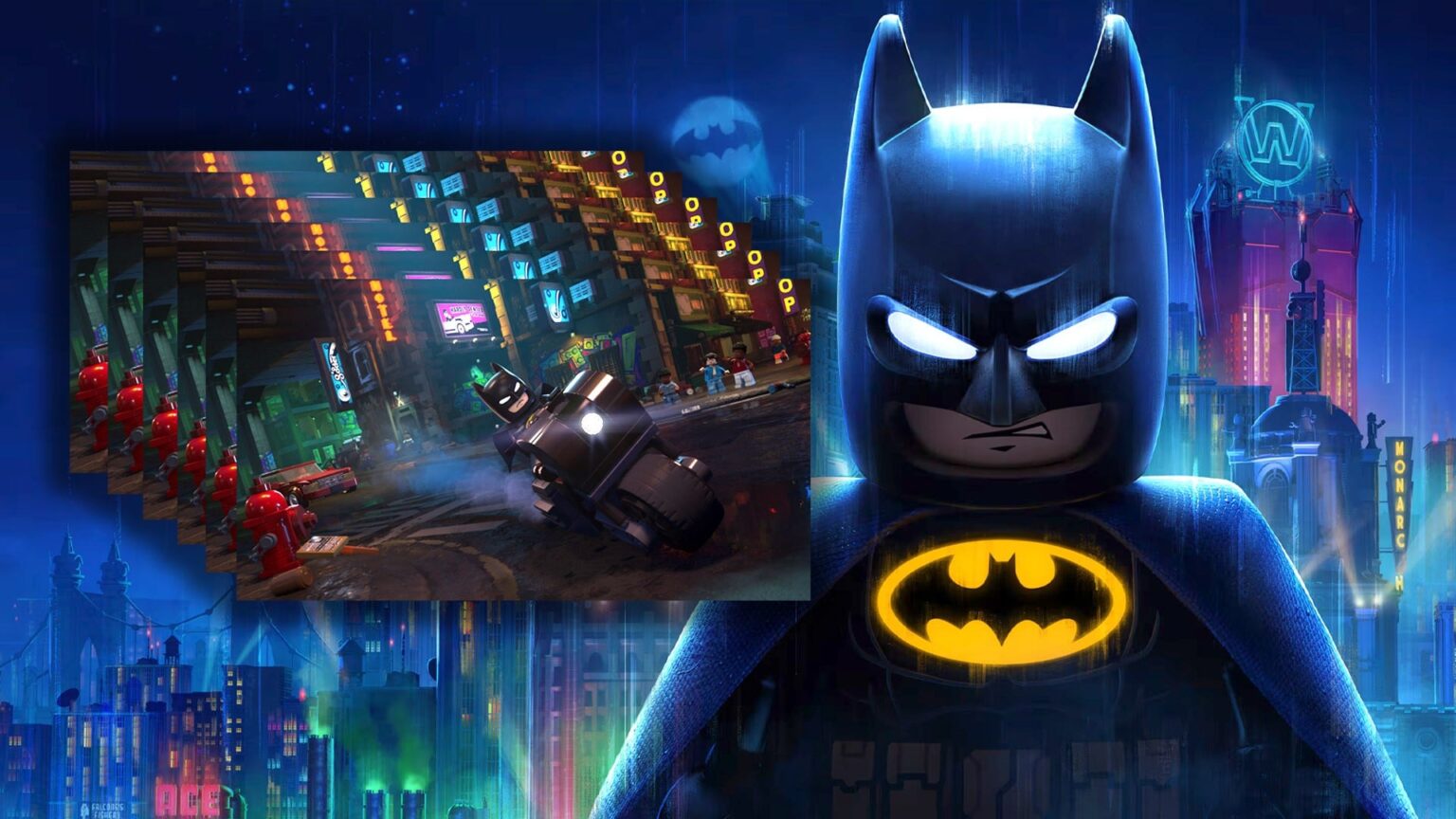
Here’s the full clip from DF Direct Q&A.
Lego Batman: Legacy of the Dark Knight isn’t the sort of game that ought to cause controversy, but the release of a recommended specs sheet this week caused widespread confusion amongst DF staffers and PC gamers alike. The minimum spec listed here aims for a 1080p 30fps experience with frame-generation, meaning that the base frame-rate in that case would be a nigh-unplayable 15fps.
The 1080p figure is also the result of FSR balanced upscaling, putting the actual number of raw pixels at a heretofore unseen 1506x847x15 – just over 19 million pixels per second, when a standard 1080p 60fps presentation would be 124 million pixels per second. It’s extremely unusual to see such a low base pixel count for a game running on low settings, even on relatively modest hardware like the Ryzen 5 1600 and Radeon RX 6400 listed.
However, the big issue here is that frame generation adds additional latency on top of what is already quite an unresponsive experience thanks to that low 15fps base frame-rate. Most Lego games are some distance away from twitchy first-person-shooters and other genres that require extremely rapid inputs, but using frame-gen on a 15fps base ought to result in noticeably dull controls even in the slowest-paced game imaginable.
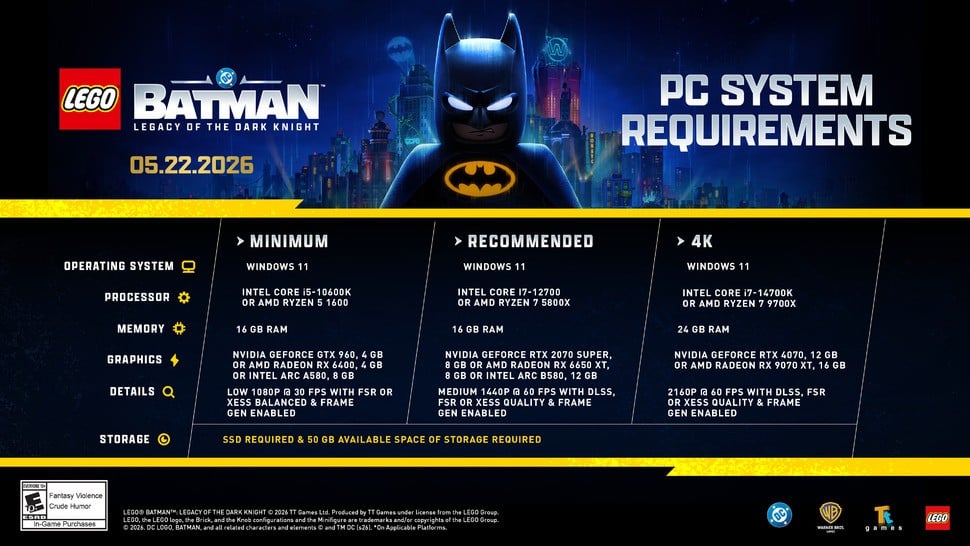 Here’s the full PC system requirements sheet.
The same technique is used for the recommended and 4K specs higher up the totem pole, with both of these tiers providing a 60fps experience with frame-gen enabled – so the base frame-rate in these cases ought to be around 30fps. This is more tolerable than a 15fps base frame-rate, but even the likes of Nvidia and AMD have mentioned a 45-60fps base frame-rate to me as a reasonable starting point when demonstrating their frame generation tech.
Based on the spec sheet, either the spec sheet writers have been extremely conservative in their performance predictions, or Lego Batman is going to be a surprisingly challenging game to run – even for an Unreal Engine 5 title. The easiest alternative here would have been naming more modern hardware which should be able to achieve playable frame-rates without frame generation, rather than shoehorning in ancient CPUs and GPUs to make it seem like the game will run on anything.
Either way, opting for a native 30fps presentation ought to be the bare minimum worth listing in a spec sheet like this, and even people on mainstream hardware ought to expect features to scale down enough to allow a near-60fps readout, especially if FSR, XeSS or DLSS are in play. Don’t get me wrong, it’s nice to know that frame generation is supported for targeting 120 or 240fps to max out an HFR monitor, but 60fps without frame-gen really ought to be the default expectation when it comes to assigning minimum and recommended specs.
The Lego Batman game comes out on May 22nd, so hopefully we’ll have a chance to take a look at how it actually runs on low-end hardware.

Will is website editor for Digital Foundry, specialising in PC hardware, sim racing and display technology.