
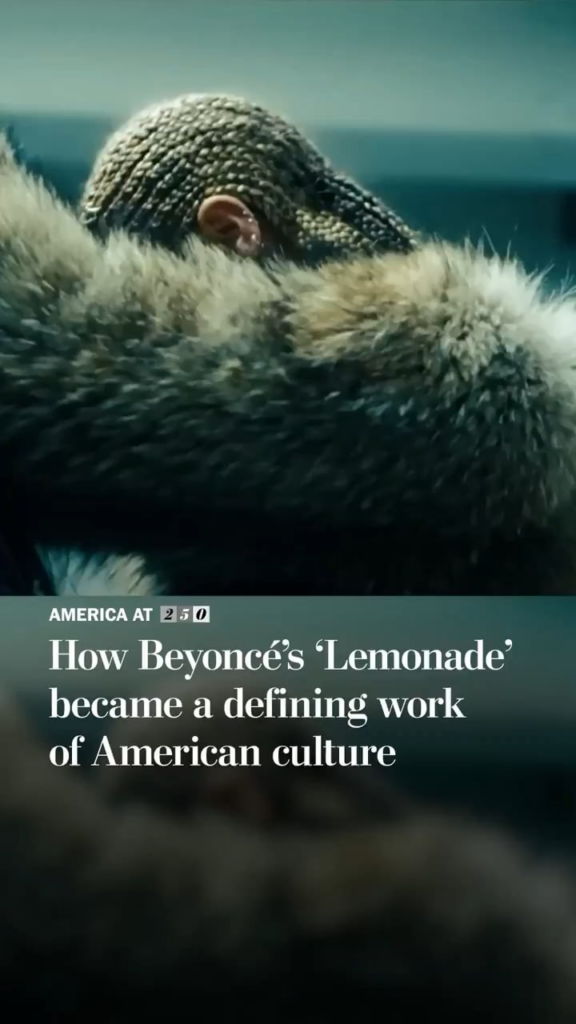
It was clear from the surprise first single, “Formation,” that whatever Beyoncé’s next project was, it would take her in a new and starkly political direction: The Melina Matsoukas-directed video found the superstar in the parlor of a plantation house and atop a police car sinking into floodwaters evoking Hurricane Katrina.
Two months later, Beyoncé would drop the genre-transcending “Lemonade” without prior announcement and with a corresponding 65-minute visual album full of A-lister cameos, arresting gestures toward African and African American history, and haunting spoken-word interludes that traced the Kübler-Ross model of human response to trauma. And somehow, the album was still more audacious and ambitious than that description implies.
Matsoukas later explained that Beyoncé’s thesis statement for “Lemonade”* *was that slavery was still affecting Black men and women, and the Black family: “how we’re almost socialized not to be together.” Classes on “Lemonade” promptly sprang up at universities such as Harvard, Penn and the University of Texas (among others).
“Lemonade” repopularized both the visual album and the secret album release. And in the years since, cuts from “Lemonade” have continued to soundtrack dialogues about the unfinished work of racial equality in America. The Kendrick Lamar collaboration “Freedom” became an anthem for Black Lives Matter activists after the murder of George Floyd in 2020, and it featured prominently in Kamala Harris’s historic presidential campaign in 2024. — Ashley Fetters Maloy
Constance Bailey, who teaches African American literature and folklore at Georgia State University, led a Beyoncé course at the University of Arkansas. The magic of “Lemonade” was that “it made the concept of intersectionality accessible to everyday women,” Bailey says. “Lemonade” moves between multiple gender and racial identities seamlessly. “It’s not just ‘I’m Black,’ but ‘I’m a Black woman, and I’m a married woman.’”
Other notable works
“Atlanta,” Donald Glover, 2016-22
“Whole Lotta Red,” Playboi Carti, 2020
“Reservation Dogs,” Sterlin Harjo and Taika Waititi, 2021-23
The Eras Tour, Taylor Swift, 2023-2024
“Debí Tirar Más Fotos,” Bad Bunny, 2025
Posted by Financial-Painter689
29 Comments
Michael Jackson’s Thriller was the only other musical artist to make the list.
If anyone wants the full list behind the paywall:
[https://archive.is/20260715151320/https://www.washingtonpost.com/style/interactive/2026/07/15/25-most-influential-works-american-culture/](https://archive.is/20260715151320/https://www.washingtonpost.com/style/interactive/2026/07/15/25-most-influential-works-american-culture/)
[removed]

It gave us Titus lemonading, for which I am grateful

Its was not even the best album of 2016
that’s right
Okay, musical album maybe, but including other art forms?!
I will never forget watching it when it aired for the first time on HBO. Jaw-dropping. I remember feeling just incredibly moved and that I had watched like history being made
Welp, I fully expect a calm, non-racist reaction from a certain fandom… /s
No complaints from me with that choice.

The Eras Tour making the list… sorry but how was that influential art and not just a vehicle for her to make buckets of money? All the videos I’ve seen from the tour don’t show it being a groundbreaking stage show either? I’m just a hater though 😵💫 so I could be looking at it with extreme bias.
>”lemonade” repopularised both the visual album and the secret album
Did it? I’d strongly argue that Self-titled did that.
It’s the only American album released so far this century that will still be listed to in 100 years.
That is correct. It was astonishing.
For the decade before that, they picked Keeping up with the Kardashians lol
Correct. Beyonce’s Lemonade was not only easily the most impressive mainstream artistic feat to come out of the United States in the past decade, it is also beautifully captures the history and culture of Black Americans and set the stage for the racial and political tensions that happened over the following 9 years as Obama was replaced by Trump in the White House, the BLM movement exploded, and everything else that came after.
https://reddit.com/link/oxw5k9c/video/pjpkv79goldh1/player
🐝
I think the first half of the album was amazing. Absolutely beautiful music and the accompanying film was equally as good. But it fell off in the second half a lot. Still good but not as strong. I think because the second half is more of the “forgiveness” part of the album, it made me roll my eyes. There wasn’t a good enough transition from her hurt to forgiveness. I don’t think sandcastles was enough of a standout to make that transition. The first half you can really hear her anger and sadness.
I think the album was monumental but tbh there are a lot of albums from that era that would deserve this spot as well. TPAB and DAMN by Kendrick Lamar come to mind. He even won a Pulitzer.
I guess? Kind of a stupid exercise trying to determine this because it’s going to be wrong no matter what
Invasion of Privacy >>>
I mean… yeah. No lies. Beyoncé has remained culturally significant for decades, reinvents her sound but still manages to stay true to herself. She’s created and led trend after trend. Pretending she didn’t released some of the best and most influential music of the decade would be crazy. (And ppl hate to say it on the pretense of being “not being mean” but pretending she’s not a league above others has always been dumb af)
Possibly the first time in my life that I agree with The Washington Post
She was robbed for aoty:(
I’m not the biggest Beyonce fan, but I actually fully agree. The fact that this didn’t win Grammy AOTY was a fucking disgrace.
I took a Lemonade syllabus class in college and it was amazing I really learned so much about the history of feminism and critiques of Beyoncé
Blonde clears imo
Coincidentally, those were also the years WaPo was last relevant
I still love this album. Except for track 11. I skip it and go straight into Formation.
