
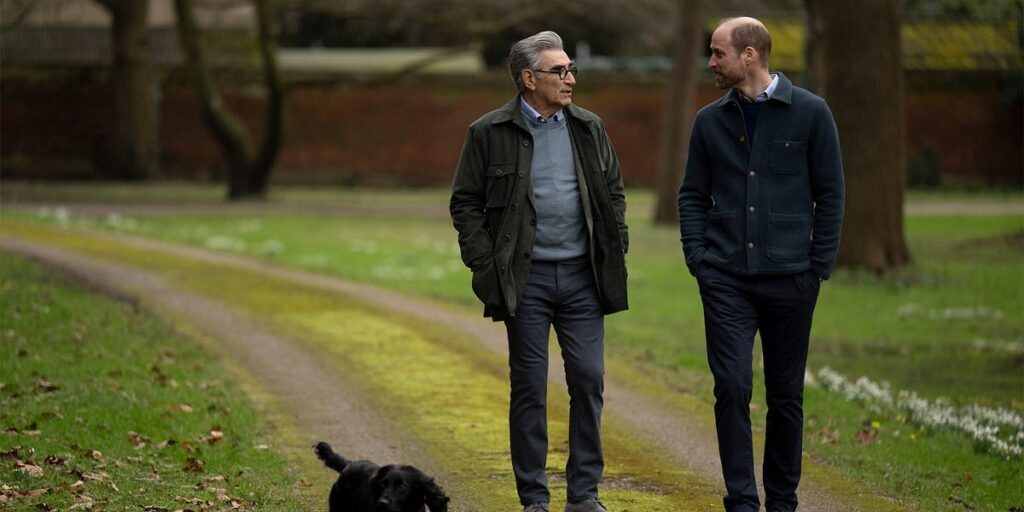

Note: My previous post on Prince William’s revealing chat with Eugene Levy is here.
“I think it’s safe to say that change is on my agenda. Change for good. I embrace that and I enjoy that change – I don’t fear it. That’s the bit that excites me, is the idea of being able to bring some change. Not overly radical change, but changes that I think that need to happen.” (bolding added)
“There are points when you look at tradition and go, is that still fit for purpose today? Is that still the right thing to do? Are we still doing and having the most impact we could be having? So I like to question things, is what I’m really getting at.”
As I heard Prince William talk to Eugene Levy in The Reluctant Traveler (Apple TV+) about how he would rethink the way the monarchy operated when he was sovereign, I kept thinking that I’d heard those sentiments before. They are very similar to what advisors of the previous Prince of Wales (Charles) said in the decades before he came to the throne in 2022. They didn’t do it as publicly as William, but the intent was there.
After the death of the Queen Mother in 2002, the notion of Charles as the “shadow king” stalked the monarchy, wrote biographer Sally Bedell Smith. There was no overt talk by Charles as to how he’d reign – that would be deemed crass and unbecoming for a prince damaged by years of speculation as to what sort of king he’d be.
Instead, it was a gradual transition: “The elephant in the room, the Queen’s aging and how everybody is going to cope with that,” a source told Bedell Smith.
Charles moved into Clarence House, a stones throw away from Buckingham Palace, as he conducted more and more official business on his mother’s behalf. “A carefully managed progression” was how some referred to the slow retirement of Elizabeth II and rise of Charles. After she ended leaving Britain on trips and tours, it was Charles who stepped up to take her spot on the world stage (always carefully emphasizing that he was representing his mother). Perhaps the most important of such events was when he attended the Commonwealth Heads of Government Meeting in Rwanda in 2022. In addition to his regular duties as heir, he often met with world leaders passing through London.
“He had so carefully thought through positions. You cannot be with HRH for very long without realising that he has thought immensely about really big vision-type issues. He thinks on a very broad canvas and he has an integrated world view,” said Jonathan Sacks, the former chief rabbi, to biographer Catherine Mayer.
The monarchy survives by evolving with careful intent, often a step or two behind popular culture so as to reflect those changes that are permanent, while ignoring those that are fickle, soon-dated trends.
The Marmite theory of royal evolution is named by Robin Janvrin, one of the Queen’s former private secretaries. As I explained in 2020, “while the red, yellow and green label on the jar of quintessentially British food spread looks like it has never changed, its design has been incrementally tweaked over the decades. In the same way, the monarchy of today looks nothing like it did a half-century ago because of many, almost imperceptible change. … The monarchy, like that Marmite label, is destined to adapt.”
For instance, the first decades of the late Queen’s reign were an era of extreme deference to authority, especially the monarchy. The last decades marked the rise of social media, when agenda-setting sources of information such as mainstream media outlets were supplanted by an avalanche of online sources, many of dubious quality and background. The monarchy reacted to those changes by beefing up its public relations and communications skills – video is now dominant to the point that the palace posts polished videos an hour or two after an engagement is finished.
“Informal formality” is how King Charles II’s private secretary described the style of the new monarch, a contrast to the old-fashioned conservative tone of Elizabeth’s reign, after a woman hugged the new monarch when Charles plunged into the crowds at Buckingham Palace on the day after his mother died.
For Hannah Furness, royal editor of the Telegraph, his style could best be seen on September 18:
The King had hosted President Trump at Windsor Castle, for a high-stakes, gold-plated state visit in which pomp and ceremony were switched to maximum. Then, less than an hour after waving farewell to the American motorcade, Charles was driven quietly to a Surrey care home to sit with 116-year-old Ethel Caterham to celebrate her birthday and listen to her reminisce.
It was a “giant crunch of gears” for the King to go from one event to the next, an aide concedes. But “both made him equally happy”.
It is a vignette which illustrates the breadth of the King’s reign neatly: a bridge between old and new, formality and informality, as head of state and a human being. It is, they hope, a new style of monarchy.
A common analogy is that of the long-running Doctor Who series. Biographer Robert Hardman wrote about how one regal advisor used the term “Doctor Who syndrome” to explain how the monarchy reinvents itself “in a similar way but not an identical way,” just as long-running TV character stays the same though being portrayed by multiple actors.
That same analogy was raised by royal staff with Furness:
“It’s a bit like Doctor Who,” a senior aide said recently. “The next one that comes along has to be completely different but a bit the same. The institution regenerates itself.”
“That’s how it survives,” another palace insider told me. “Being both the same and different. The mistake some people made was to think that he [King Charles] could be, or would want to be, the same as his mother.
“It’s a bit like the Doctor Who regeneration. At the start, everyone says the new one isn’t like the old one so we don’t like it. And then when the next one comes around, it’s the same thing all over again.
“It’s essential that the Royal family continues to evolve and it will do so again into the next reign.”
Charles’s more transitional reign has already seen some significant moments: his diplomatic skills have been evident as he addressed national assemblies in Germany, France, and Italy in their own languages, and made a crucial quick jaunt to Canada to reinforce its sovereignty.
He’s also notably inclusive of religious and ethnic groups, including commissioning 10 leading artists to paint portraits of 10 pioneering members of the Windrush generation for the Royal Collection, being the first monarch to attend a Catholic funeral in Britain in modern times, and the first sovereign to visit the Auschwitz concentration camp.
Other changes include being far more comfortable chatting, joking, and hugging with crowds at royal engagements compared to his more reticent formal mother. He’s also opened more and more parts of royal residences, including the historic East Wing of Buckingham Palace, as he and officials mull about how to make them even more accessible.
At the same time, he loves using the treasures tucked away in cupboards and closets, as can be seen at the lavish state banquets held at Windsor Castle. “If you chuck away too many things,” Charles told Mayer in 2013, “you end up discovering there was value in them.”
When Prince William was taking Eugene Levy on a tour of Windsor Castle and its grounds, viewers could tell that he loved the place. He’s not alone. Though Charles rarely stayed at Windsor during his adult years – it was very much his parents’ home – he now spends considerable time at the oldest and largest of royal residences.
“The King often talks about the need for a living tradition, that this is a proper house. Windsor is not Versailles. It needs to be lived in and the living tradition informs everything,” a senior official told Hardman. The King’s impact can be seen in the rare official images taken in the private wing. The dog bowls have vanished, as have some of the clutter that was so present during Elizabeth’s reign.

 Elizabeth II with the Trumps in 2018; Charles with President Zelensky in 2025
The monarch’s to-do list is long, including the future of the Commonwealth and the issue of slavery reparations. He may not get through it before his reign ends, but that’s the thing about a monarchy – there’s always an heir to take up the cause. And like Charles, his son is already thinking of what changes he’d consider making. They may not be as dramatic as some think, just like those of Charles are equally incremental. Not overly radical change, but changes that I think that need to happen,” Prince William told Eugene Levy.
Perhaps the best vote of confidence goes to the quiet Canadian comedian whose gentle queries resulted in one of the best royal interviews in years.
“Having met Prince William, I would say, ‘Yes, I’m quite proud this man will be head of state for the country [of Canada],’” said Eugene Levy to royal correspondent Chris Ship.
The Morning Show interview with Eugene Levy, who talks about his surprise at meeting Prince William: