
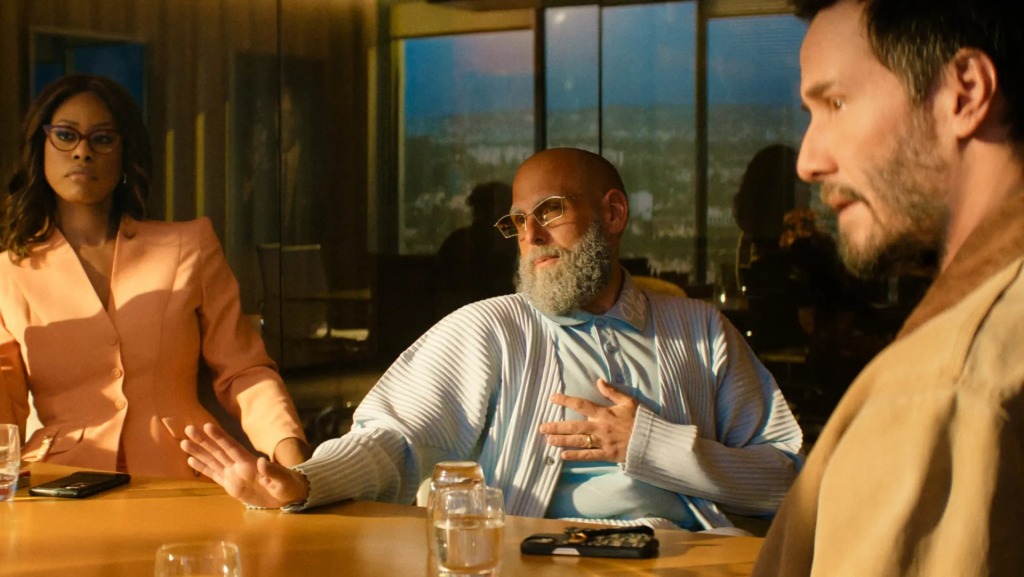
Spoiler Space offers thoughts on, and a place to discuss, the plot points we can’t disclose in our official review. Fair warning: This article features plot details of Outcome.
At last, someone has the courage to call out the real problem bringing down Hollywood. No, it’s not AI, labor issues, or even the collapse of production in Los Angeles. According to Jonah Hill’s latest film, Outcome, the real existential threat facing Hollywood today—as if it’s 2018—is cancel culture. It’s a bitter take on showbiz, one perhaps a bit personal for the writer and director with a history of accusations. The film’s shallow grasp of the purpose of cancel culture makes it out to be a boogeyman chasing after a good person, when really it’s more of a strawman in a world where “cancellation” feels less like consequences for bad behavior and more like a suggestion.
It all starts when lovable actor Reef Hawk (Keanu Reeves) launches a comeback to the spotlight after five years away to kick a heroin addiction. After a successful first interview, Hawk gets a phone call from his crisis lawyer, Ira (Hill, in Bohemian Rhapsody-esque veneers) telling him someone is blackmailing him over a scandalous video. Ira comes up with a scheme for Reef to apologize to as many people that might hate him as possible, until the real blackmailer announces himself, at which point Reef and Ira’s team of lawyers will spin and settle the matter as quickly and quietly as possible.
According to Outcome, cancel culture can be summed up as vultures looking for an opportunity to prey on good people when they’re at their most vulnerable. The end of the movie reveals that the wrongdoing in question was an illegal recording of Reef masturbating to a woman who showed him her breasts over a video call. In fact, he’s quite sad in the scene, sharing with the woman that he has no one else to turn to for companionship. Hill makes Reef an almost perfect victim, unworthy of the angry online pitchforked mobs––also, he’s played by Keanu Reeves, who might as well be likability personified. Reef’s only shortcoming is that he was a bit of a diva back in the day and burned bridges with almost everyone in his life, but the movie seems to argue that if you apologize enough, karmic balance can be restored.
When Ira first approaches Reef about the controversy, he asks if his client has killed anyone multiple times. That’s the extent of the lawyer’s concern––is the incident something that legally can’t be forgiven. Otherwise, these accusations are treated like a shakedown. Outcome may be in the running for one of the bleakest outlooks of showbiz in recent memory. Almost all of the relationships in the film are transactional. Red (Martin Scorsese), the first agent who discovered Reef as a child actor, laments that while he knows his place in the entertainment pecking order is to be left behind; none of his former clients ever make time for him after they outgrow him. When Reef goes to apologize to his mother (Susan Lucci), she’s a member of the Real Housewives Of Beverly Hills, forcing her son to share this personal moment for the camera for the sake of good TV. Once the real blackmailer, his neighbor, and an accomplice reveal themselves and settle the extortion with Ira and Reef in the lawyer’s conference room, Reef takes the moment to ask the accomplice if he hates him as they exit. The man sheepishly answers, no, that he loves the actor, but “I’m just broke.” Even fandom can be a form of extortion.
Considering Hill’s past with accusations from another actress and a former partner, attacking cancel culture like this reads as a vindictive move, especially since some of Reef’s background looks similar to Hill’s real life. Both were child stars who grew up in a difficult industry, and both took time away from the spotlight for personal reasons. Hill also has some unique insight to the warped experience of growing up famous, the isolation that goes into adulthood, and the nonstop invasion of privacy by everyone from strangers to neighbors. But to play up his main character as a man who’s doing all the right things and his accusers as nothing more than opportunists feels especially pointed.
There’s much personal ado about the nature of cancel culture in Outcome, but it ironically comes at a time when cancellation is at a highly visible ebb. In light of Louis C.K.’s reemergence to headline the Netflix Is A Joke Festival and Ye’s sold out shows in Los Angeles, it’s not like Outcome is even raging against the cancel culture of yesteryear that tried to make the entertainment industry a less terrible place to work. The court of public opinion has a statute of limitations, and its rulings don’t always stick for all audiences.