
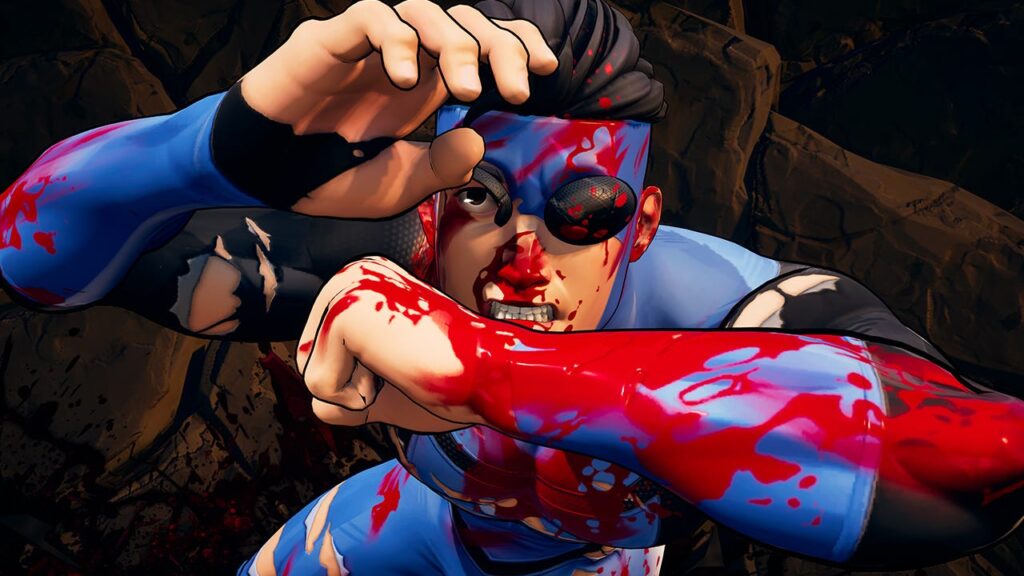
It certainly seems like we’ve entered the era of the Tag Fighter. We’ve got 2XKO repping 2v2 tag action, Marvel Tokon: Fighting Souls planning to introduce the world to a 4v4 fighter later this year, and now Invincible VS representing a more familiar 3v3 structure. Developed by Quarter Up, a team comprised of much of the core group that developed 2013’s fantastic Killer Instinct reboot, Invincible VS is a fast paced, hard hitting, extremely mechanics-driven successor of sorts to Killer Instinct’s unique style of 2D fighting. That style may be polarizing for many, and its ancillary modes are a bit underwhelming outside of an impressive, but very brief story mode. All of this makes it another tough tag fighting contender, but one that’s far from [Invincible Title Card]
While not immediately apparent just from looking at it, Invincible VS’s fighting system is actually quite unique, with the closest approximation being the aforementioned Killer Instinct. Like KI, combos are a two-way street – a mind game between the attacker and the defender in almost every interaction. The attacker needs to focus on building their combo while keeping an eye on a meter to make sure that it doesn’t fill up all the way, otherwise that combo will drop. The person getting combo’d wants to keep an eye on that meter too, because as it fills up, the other player is going to want to look to reduce it, and the main way to do that is by tagging their teammate in. However, if the defender is able to react to that tag right before they get hit, they can execute a Counter Tag, which will halt the combo and reset the situation back to a neutral state.
Mitchell’s Favorite Fighting Games
See All
But here’s where the mind game comes in. Let’s say I’m comboing my opponent and I think they might use a Counter Tag. I can either delay my tag to try and throw off their timing, or I can do a hard call out by feinting the tag all together, which will leave my opponent wide open if they fell for the bait. On the flipside of that though, if they don’t actually go for the Counter Tag, then I’m the one that gets left completely vulnerable and the tables turn.
When this all works as intended in a match between two players that both know about the existence of this little minigame (meaning, they played the tutorial), it’s awesome. Successfully baiting out that counter tag with a feint is incredibly satisfying, and it’s also nice to feel like you still have a chance to escape a long combo if you’re able to make the right reads.
When both sides understand this little Counter Tag minigame, it’s awesome.“
Counter Tags aren’t the only way to break combos, either. If you’re desperate, or the opponent simply isn’t tagging to even give you the opportunity, you could use an Assist Breaker – but that does come at the steep cost of two bars of meter, a lengthy cool down on your assists, and 50% of one of your assist character’s max health (which will refill as long as they’re not tagged in). To be blunt, I hate this mechanic in its current state. In most fighting games, this kind of get-out-of-jail-free card is only usable once a round, or maybe even once every two rounds, because being able to break out of an opponent’s combo at will is incredibly strong. But here, not only is it uncapped, each character has three bars of meter that are full right from the start.
What that often means is I’ll start a combo, they’ll Assist Break, we’ll fight for a bit while their assists are on cooldown, and maybe I’ll manage to land a snapback to forcibly tag their partner in and permanently remove that life. So far so good. But then, the second that cooldown is up and I start a new combo, they just do another Assist Break because their other characters have been waiting patientily with three full bars of their own. Granted, this likely won’t happen against opponents who understand that they are literally killing their own characters every time they break a combo this way – but whenever I was matched up against someone who didn’t realize this, which was very common throughout both the open beta and the limited pre-launch time I got online with the full game, it just dragged out the match.
Dragging out the match is additionally frustrating because, when the timer runs out, the person with the most combined health among their characters doesn’t just win the match. Instead there’s a sudden death between the two active characters where their health bars are restored based on the life of the remaining inactive fighters and both players are afflicted by constant damage over time. It just feels kind of bad to have the lead when the time runs out and then potentially lose the whole thing based on one interaction.
It took me quite a while to warm up to how characters in Invincible VS get around.“
As far as how that action actually feels, it’s pretty stiff. It’s very much in the same vein as Mortal Kombat and Killer Instinct, so you’ll probably feel right at home here if you’re already used to those games. But as someone who prefers the smoother movement and animations of games like Guilty Gear Strive, 2XKO, Granblue Fantasy Versus, and Street Fighter 6, it did take me quite a while to warm up to how characters in Invincible VS get around.
On the plus side, Quarter Up did a really great job making the 18 fighters that are available at launch feel like their TV show counterparts. The ones that are supposed to be fast feel lightning fast, and the ones that are supposed to hit hard hit extremely hard. Then you’ve got wild cards like Cecil, who’s able to teleport around the screen like a mad man and hit from just about every angle thanks to his arsenal of weaponry and army of zombie cyborgs. The sheer amount of armored moves on characters like Monster Girl and Titan can be pretty obnoxious, and getting in on Rex can feel like a nightmare if he’s in the hands of a good player – but, in general, there’s a great spread of distinct and interesting playstyles
Rexposition
If you’re an Invincible fan first and foremost, you’ll be happy to know that there’s a full-on story mode here that features an original story co-written by Quarter Up’s narrative director Mike Rogers and Helen Leigh, who’s a writer and producer on the Amazon Prime show, along with involvement from series creator Robert Kirkman. That authenticity goes a long way in making this compact campaign feel a bit like a filler episode of the actual show that was never aired.
A quick warning that I’ll avoid spoilers for this story, but there will be some unavoidable ones from the show for those who haven’t seen at least the first few seasons – but you really need that context to appreciate what’s going on here in general.
Invincible VS Story Mode Screenshots

It begins with a strange scene: Invincible in the middle of a fight with Omni-Man, only this isn’t a flashback to their season one showdown or anything. Omni-Man is in a traditional Viltrumite uniform, he’s teamed up with Lucan and Thula, and it’s hard to shake the feeling that things are just a bit off throughout the entire first third of the story. I won’t say more than that, but it was fun to piece things together on my own as Mark tries to do so himself.
The story mode is only an hour long, and while that is short by any measure, even for a fighting game campaign, it’s at least well paced and the fights between various characters never feel forced. Every fight is well contextualized, makes sense narratively (and isn’t just two friends fighting to the near death under the guise of a “sparring match”), and never drags down the pace of the plot. The cutscenes themselves are excellent as well, utilizing the same “animation on twos” style that the Spiderverse movies employ to great effect. Most of the voice cast from the show is accounted for and do an excellent job, and even the people brought in to cover for the actors who didn’t reprise their roles are fantastic as well.
The story mode shines as a quick and authentic filler episode, but ends without a real conclusion.“
The biggest issue with the story mode isn’t its length, it’s the fact that it ends without a real conclusion. Again, without going into spoilers, it all wraps on a pretty unsatisfying cliffhanger. Hopefully there is a free DLC continuation in the works, because otherwise this is just an hour long episode of build up with no actual pay off.
The rest of Invincible VS meets the standards of a modern fighting game, but never exceeds them. There’s a traditional arcade mode with short, occasionally amusing character endings, but fighting against the CPU feels uniquely bad in a game that is so built around conditioning and baiting your opponent. There’s a fairly basic training mode, but no combo trials, and no character guides. There’s a replay viewer to watch your own recent and saved matches, but no way to search for replays from other players (nor is there replay takeover to try and lab out a solution to a problem you encountered in a match). At least there are some cool rewards for leveling up each character – there are more than 300 customizable elements for your profile tag, covering badges, titles, backgrounds, and frames, all pulled directly from both the show and the graphic novel.
The rollback netcode is also stellar, and that comes without any caveats. Every match I’ve played so far has been buttery smooth, both in the open beta from a few weeks ago and during the limited amount of pre-release matches that I’ve played against other people during this review period.