
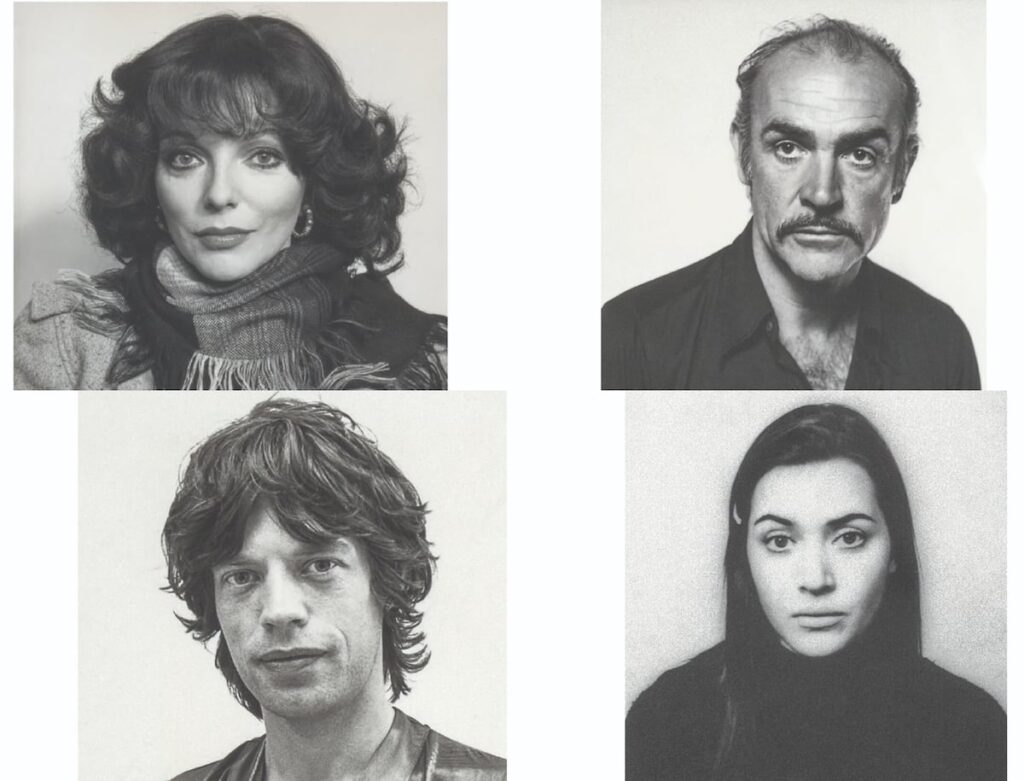
There is a type of photograph that can disarm even the most photogenic subject: the passport photo. That small, no‑frills portrait levels everyone — anonymous and well‑known, rich and poor, beautiful and not so much. Everyone needs one at some point and submits to the same ritual: sitting up straight before the flash with an expression as neutral as the backdrop behind them. Some people come out unscathed; others feel the image doesn’t represent them.
But with public figures, something strange happens. Accustomed as we are to seeing them dazzling and meticulously produced, gaining access to this tiny slice of their private selves feels like meeting them in their purest, most honest, most real form.
“We had like 800 celebrities [come by the studio]. Nobody had any makeup or PR people saying ‘do this, do that.’ They were simply themselves,” says Philip Sharkey, 60, on a video call with EL PAÍS. He was the last owner of Passport Photo Service, the London photo studio most frequented by the stars.
This modest family business — started by his father, former boxer David Sharkey — opened its doors on busy Oxford Street back in 1953. Philip was born a minute’s walk from the studio and started working there in 1973, at the age of 16. His memories of the shop are memories from an entire lifetime.
“When my brother and I were little, they would take us to the studio during school holidays. One day, Jean Paul Getty was there having his picture taken. My father said to me, ‘This is the richest man in the world.’ I was about eight years old. And I said, ‘Why isn’t he smiling? He looks very serious.’ When he finished taking the pictures, my father encouraged me to wait on him in case he would give me a tip, but Paul Getty asked for the minimum of three photos and already had the exact amount of money ready to pay me. I guess that’s how you become the richest man in the world,” he quips, laughing.
Sharkey has compiled this and many other anecdotes related to the celebrities who visited the studio in Passport Photo Service: An Unexpected Archive of Celebrity Portraits (2026), which was published this past April. It serves as an archive of the hundreds of famous faces immortalized by his family between 1953 and 2019, when the business finally closed its doors. From a young Iggy Pop, Kate Winslet, Muhammad Ali, Daniel Day-Lewis, and Mick Jagger — to a not-so-young Tom Jones, Ava Gardner, Sting and Valentino — the faces of more than 300 actors, singers, directors, fashion designers, and athletes make up this unprecedented visual journey.
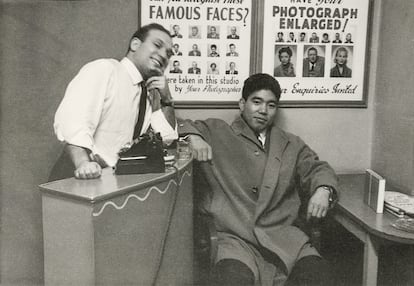 David Sharkey, Philip’s father (left), with a client in the photo studio, in 1962.cortesía de Philip Sharkey
“One of the keys to having so many famous celebrities is that we were very close to the American Embassy and the Canadian Embassy and the Japanese Embassy,” Sharkey explains.
Another important factor, as he recounts in his book, is that the studio boasted it could produce photos in 10 minutes, back when instant film development was still a pipe dream: “That’s how we found our niche.”
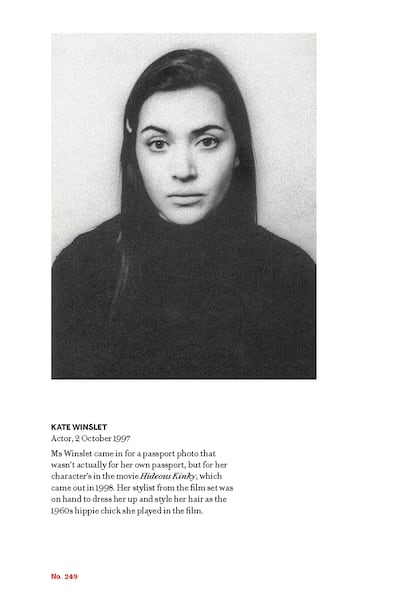 Kate Winslet, photographed in the studio in October of 1997, at the age of 21.Phaidon Press
The photographer says actor Donald Sutherland was particularly impatient: “He was in a big hurry because the embassy closed at like 12 p.m. and it was half past 11 a.m. He needed to get straight back. I said, ‘Do you want to take your coat off?’ He said, ‘No, I haven’t got time.’ He turned his collar up, and it’s a fantastic photo.”
The proof is on page 116, where the piercing gaze of the Klute and Hunger Games actor — captured on May 2, 1977, at age 41 — cuts straight through the reader.
“Some were in a hurry. Others were a bit more haughty, and you knew you shouldn’t talk to them too much, because they’d just walked down Oxford Street to come to us, so they were probably hassled all the way there. But, in general, they were lovely,” says Sharkey.
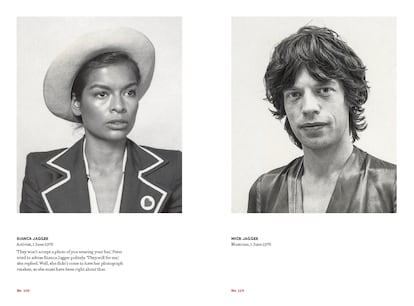 Singer Mick Jagger (right) and his wife, Bianca (left), photographed at Passport Photo Service in June 1976, when they were 32 and 31 years old, respectively. Phaidon Press
The photographer has all sorts of stories. There’s the one about Christopher Reeve walking into the studio at the height of his fame, after Superman (1978), to have his two sons’ ID photos taken. “His children were looking at all the photos we had on the wall. I said, ‘Well, look at that, there’s Arnold Schwarzenegger, and there’s Donald Sutherland: you should be up there.’ He said, ‘Alright then.’ And he sat down, and I took a lovely photo of him,” he recounts. The result is a smiling Reeve, dimpled, on June 25, 1988, seven years before the equestrian accident in which he severely damaged his spinal cord.
Rod Stewart’s reaction was completely different when he accompanied a woman to the studio. “Rod Stewart came in with one of his… I don’t know if it was a wife or a girlfriend… and I photographed her. And I asked, ‘Shall I photograph you?’ He said, ‘No, I don’t need one today,’” the author of the collection recalls.
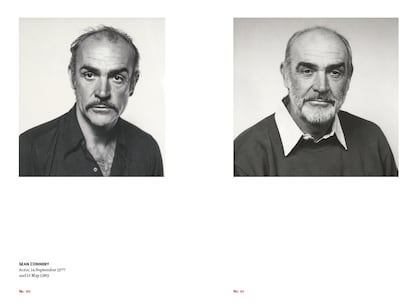 Sean Connery photographed at Passport Photo Service in September 1977 (left) and in May 1989 (right).Phaidon Press
Passport photos accounted for between 70% and 80% of the business, he says. Some celebrities trusted the family so much that they visited the studio repeatedly, allowing the passage of time to be seen in their portraits. This is the case with Sean Connery, who appears in the book: he was photographed in 1977 — the year he starred in A Bridge Too Far, at age 47, with a mustache and an attentive gaze — and in 1989, at age 59, when he appeared in Indiana Jones and the Last Crusade, with a gray beard and a much more relaxed expression.
Joan Collins, meanwhile, appears at three different stages of her life: first in 1971 (at age 38), with long, straight hair; the second in 1979 (at age 46), with curly hair above her shoulders; and the third in 1988 (at age 55), with a bouffant hairstyle that was characteristic of the era. “It’s interesting to see the fashion trends,” Sharkey points out. “You’ll see that, in the 1950s and 1960s, all the men have got a tie and suit on. And then, everything gets a lot more casual. And you’ll see [how] Pattie Boyd — who was married to George Harrison and then Eric Clapton — is dressed like a real hippie. Looks fantastic.”
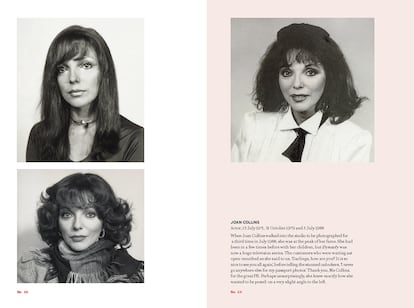 On the left, Joan Collins is photographed in the studio in July 1971 (above) and in October 1979 (below). On the right, the actress is photographed in July 1988. Phaidon Press
Working at the photography studio allowed Sharkey to meet all sorts of celebrities, though he still wishes that he had met a few others, like Frank Sinatra or Elvis. With some — like the comedian and actor Stephen Fry, who wrote the book’s foreword — he’s even developed a friendship.
“He’s been a client for many years, since he was young. And he always comes in, says hello, introduces me to his husband [Elliott Spencer], who is lovely,” the photographer says.
He also remembers a particularly special encounter with George Michael, back in 2006: “I had a lovely time with George Michael, because we grew up very close to each other in the same little village. And I used to do a paper route, delivering the morning papers and evening papers. And when I met George, I said, ‘I’ve got to tell you George, your father was such a lovely man, he was so generous.’ Because he gave very good tips. I remember, one Christmas, I went to deliver the newspaper to him, and he gave me a five-pound note, which was a lot of money in the 1970s,” he reminisces.
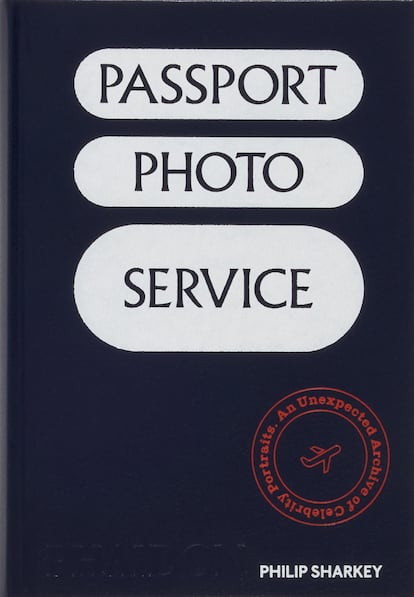 Cover of the book ‘Passport Photo Service: An Unexpected Archive of Celebrity Portraits’ (2026), by Philip Sharkey.Phaidon
When Philip Sharkey’s family started the business in 1953 — his father, David, and uncle, Peter, were the photographers, while his mother, Ann, was the receptionist — it wasn’t common to have a camera at home. However, over the years, digitization and the selfie culture made the need for the studio — which had been indispensable for decades — disappear. “The U.S. embassy — which was our main source of clients — moved miles away from us. Besides, by then, the digital age had arrived: people could take photos with their phones, so I knew the end was near. When people could take their own passport photos, they didn’t need me anymore,” the photographer laments.
The studio closed in 2019, but Sharkey continues taking photos. He has an agency and specializes in photographing boxing matches, a hobby he inherited from his father. He distributes images through Shutterstock. “You never stop taking photos. As long as I can see, I’ll be alright,” he says.
What’s not guaranteed is the generational handover that he maintained: “When my son and daughter were little, they used to come on Saturdays to lend me a hand. But these days, they’re not into photography. They want other kinds of work. I’m afraid it’s a skill that’s disappeared,” he sighs.
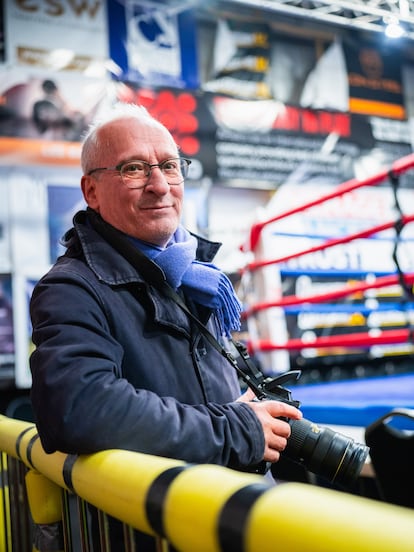 Photographer Philip Sharkey with his camera, pictured outside a boxing ring.Lewis Moore
The video call shows Sharkey — always smiling — against a white, studio-like background, demonstrating the naturalness and skill of someone who has spent a lifetime perfecting portraits. He says he doesn’t particularly like his own passport photo, but he’s happy to share some simple tips for looking your best in these situations.
“You have to stand up straight, and you need good lighting,” he explains, demonstrating this through the computer camera. “You could always hold a little reflector under your chin. Maybe just get some silver foil: that’ll throw a little light under there. And relax, it’s not that difficult. Think about your lips: you can’t smile, but a slight upward curve makes you look happier. Just think of something cheerful.” These are tips that he’s been repeating to his clients for decades, to both the camera‑shy and the camera‑savvy.
Sign up for our weekly newsletter to get more English-language news coverage from EL PAÍS USA Edition