
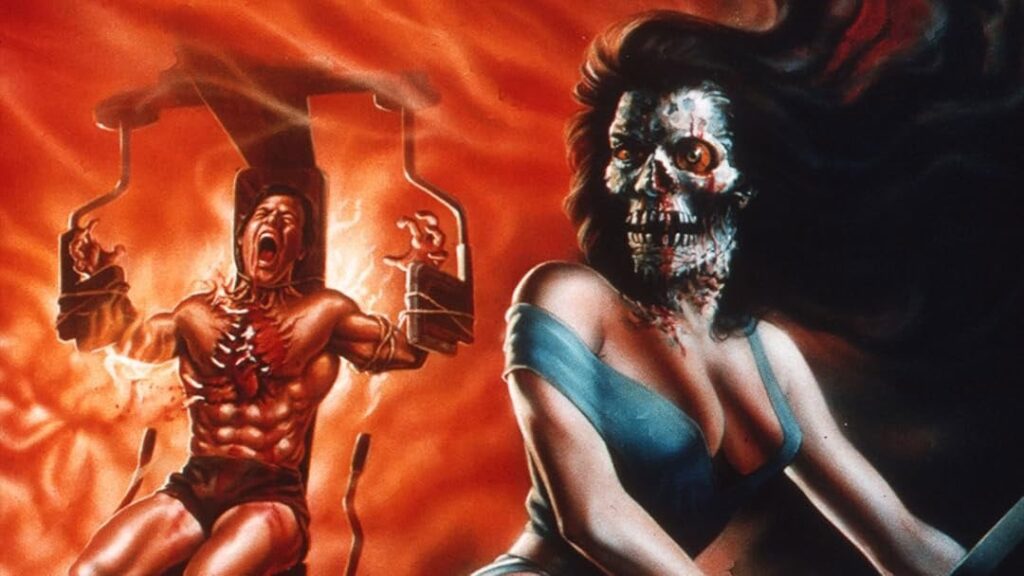
Jack Gayer revisits 1988’s cult oddity Death Spa…
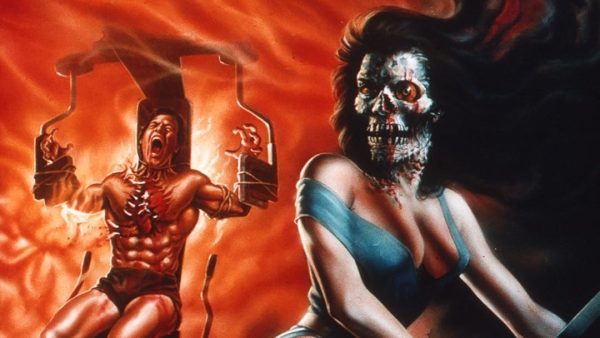
You can make a lot of things erotic. A limp piece of asparagus can never be erotic. A concept the creators of Death Spa (1989) clearly didn’t agree with, as the movie features a “romantic” scene where a woman is fed a flaccid stalk of asparagus by her boyfriend. Is this part of some larger impotency fetish? It doesn’t appear so. What the hell is this movie? It’s a genre-confused erotic-horror film. Full of wackadoodle scenes and characters, gnarly horror bits—ridiculous horror bits—nudity, and horniness galore. And a completely incoherent story. The best thing we can say about the main character, Michael, is that he’s easy on the eyes.
A great movie to watch with your buddies or your girlfriend’s parents if you’re trying to get her to break up with you, Death Spa loves seesawing between the authentically macabre and campishly absurd. For every shot of a wheelchair-bound woman engulfed in flames, we have someone having a diving board come apart on them before they can jump. What is the risk here, really, that someone’s form will be off? They’re falling into water, not cement. And they’re not that high up. But the movie has a strangeness that, to paraphrase Harry Dunne, totally redeems it.
Some filmmakers will swear till the end of time they were making a good film (Birdemic: Shock and Terror’s James Nguyen comes to mind). Other filmmakers are a bit more self-aware. In the article, How Did This Get Made: Death Spa (An Oral History), we get a quote from Death Spa producer, Jamie Beardsley, that is rather telling: “I mean, we knew it wasn’t going to be the greatest film in the world, but we just wanted to make something different and something cool.”
She is correct. They didn’t make the greatest film in the world. But they definitely made something different. Did they make something “cool”? Art and taste are subjective, but it is fair to say no, they didn’t make something “cool.” What they did make is a pure delight, zipping by at less than an hour and a half. Does the movie make sense? As much sense as a story told by someone severely inebriated. In the oral history, the actor David Shaughnessy, who plays “Freddie,” admits he only took the role to get his SAG card, confessing he could never “follow the story,” going as far as saying, “I’m not even sure if there was one.”
Forget the story; the central conceit of the movie is already painfully dumb: A gym is haunted/possessed and is trying to kill its members. Why the gym is trying to kill its members is never clear. And if a gym is killing people, the two obvious solutions are: 1. Shut down the gym. Or 2. Stop going to the gym. Neither the owner nor the members seem interested in either route. It doesn’t make much more sense from there. Who conceived this masterpiece? Two credited writers with a handful of credits between them: Mitch Paradise and James Bartruff. Besides Death Spa, none of these other credits are for horror movies.
In the oral history, Paradise takes time to shit on the other writer, stating that the original script was “something else” and that “it was not very good.” Brave words, when you consider the final product. By his own admission, Paradise’s script was a complete rewrite, so all credit, or blame, falls on him. At least in his mind. Pretty much the only thing he kept was the idea of a haunted health spa. The lack of character development? All him. Confusing plot twist of the dead wife being able to shapeshift? All him. However, according to the producer Beardsley, another writer, Kirk Honeycutt, gave the film a polish. And if Death Spa is the work of a “polished” script, we’d hate to see the unpolished one. Honeycutt only has one official screenwriting credit to his name, Final Judgement (1992), and it sounds like a doozy.
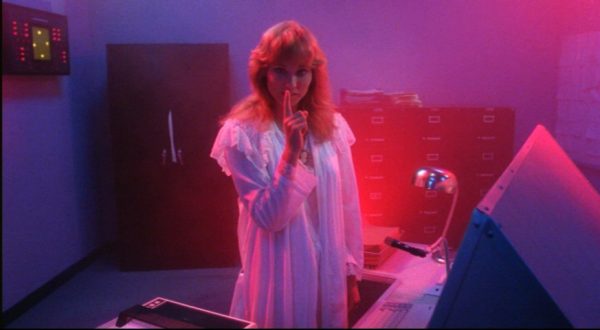
Death Spa wastes no time getting to the steamy bits. In the opening, after we see Laura Danvers (Brenda Bakke) do a spicy little dance in a gym, alone, at night, she undresses, and the camera lingers on her nude form. Why do we need a drooling shot of her naked body? Because this was the eighties, goddammit, and when you (likely) create a film with the help of cocaine, anything is possible—anything makes sense, and you can’t get women naked often enough. You certainly can’t have enough eroticism, no matter how strange it is for the characters to be so sexually charged in their given situations.
Moreover, there’s no reason to be coy; this is an erotic horror movie, and these characters are here to do two things: work out and fuck. Although we will see far more of the characters working out than we see them bumping uglies. Plenty of sizzle and no steak? Perhaps. But you don’t want to give the audience too much of the good stuff. Did we mention a woman is tantalizingly fed a limp piece of asparagus? Exactly. When you have cinematic eroticism that strong, you don’t want to spoil the audience.
Besides the ludicrous plot, it’s the characters that make this film such an unexpected pleasure. Who is our main character? He’s a handsome, wife-mourning, one-dimensional sweetheart boyfriend and an unabashed fuckboy. And a straight-up exposition machine. His introduction in the hospital scene has him declaring who he is and how he owns the gym where that woman just got hurt. Somewhere, at some time, M. Night Shyamalan must have watched this and thought, “Yes! That’s how you do dialogue!”
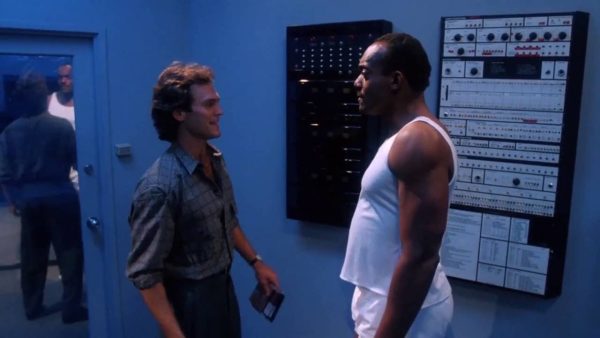
For someone who seems to be tortured by his wife’s suicide, Michael has no problem teasing a pair of women about a threesome and playing hard to get with Marvin (Ken Foree), a gym instructor. This makes it hard to take his pain remotely seriously. To all appearances, Michael is having the time of his life. Why wouldn’t he? He’s Patrick Swayze without the gravitas. A beefcake with the complexity of a Pop-Tart. And he’s only too happy to put his form on display. We’re not sure whose idea it was for him to do some investigating in a leather jacket and no shirt, but hats off to you. It’s so unnecessary and so fucking goofy you can’t help but laugh.
On the topic of goofy, the cutest little bromance between Michael and Marvin is far more intimate than any time a camera is pointed at a female character. Does it seem like Michael is banging everyone at his gym? Yeah, kinda. Maybe it’s just Michael’s undeniable sexual charisma and nearly flat affectation. If the novel American Psycho taught us anything, it’s two things: One, a hot guy who is completely vacant can still be enormously appealing to both sexes. And two, don’t trust a guy who owns a Habitrail and has no interest in animals.
If Miami Connection’s (1987) homoeroticism got you going, you’ll love Death Spa. As mentioned, Marvin and Michael have a bromance that’s more of a “will they, won’t they?” dynamic. They have a playful swimming competition in the pool, where Marvin good-naturedly dunks Michael underwater; they toss a football around like it’s a hot-potato metaphor for their repressed sexuality. They even have a special handshake that stops just short of them grinding against each other. Did the director see the handshake in Predator (1987) and think, “That’s good, but what if the two characters were barely clothed and looked at each other like they wanted to tear into one another?” Because it certainly appears that way in the scene.
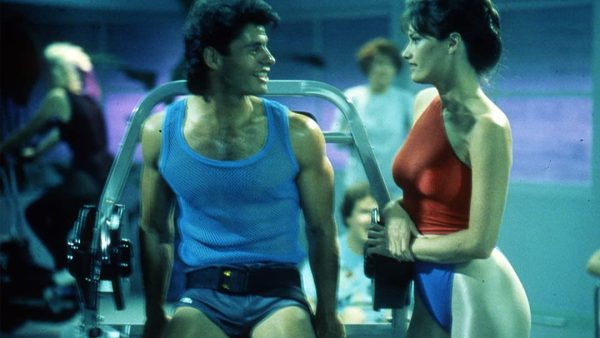
The football-tossing scene, by the way, takes place almost immediately after Laura has been disfigured. While she was Michael’s girlfriend, Marvin also kissed her on the lips in the opening, so they were reasonably close. There is also another staff member present. Yet no one in this scene seems remotely rattled that a fellow gym member and friend/girlfriend has been mutilated at their place of work. This will be a recurring theme throughout this movie: people having cavalier attitudes toward someone getting maimed.
Merritt Butrick plays David Avery, the former brother-in-law who chews the scenery like he hasn’t eaten in days. Butrick hasn’t met a word he couldn’t theatrically pronounce. Through his arch, flamboyant, and campy performance, he delivers withering put-downs that leave you in no doubt that he thinks he’s the smartest guy in any room. You’d swear he’s doing an impression of Glen Shadix in Beetlejuice (1989), except the movies came out in the same year. He’s also far more interesting than Michael.
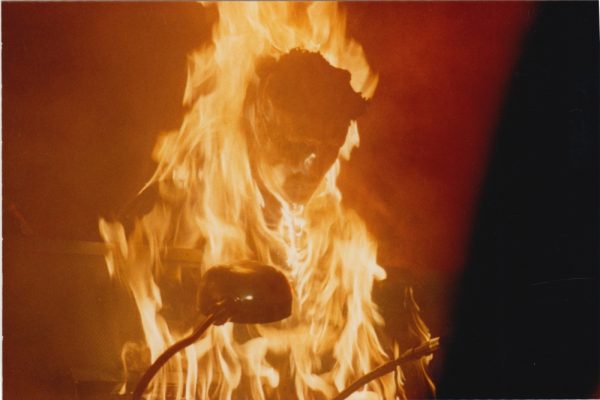
In a movie already teeming with unintentional comedic relief, we also get treated to a pair of detectives who function as intentional comedic relief. When they’re not being the world’s worst detectives or giving us exposition, they banter. The male detective, Fletcher, makes a joke early on where the punchline is essentially, “I hope my wife burns to death.” Ha…ha? Cops may be known for their gallows humor to compartmentalize, but we also see Fletcher overtly hitting on a woman at the gym later, so an argument could be made for how much irony there was even meant in this joke. Some of their exposition includes telling us, the audience, how Michael’s wife set herself on fire, reducing herself to “unrecognizable ashes.” As a side note, one of the screenwriters seems fond of the phrase “unrecognizable ashes,” as two different characters utter it. A phrase that’s inherently non-brilliant. Unrecognizable ashes? Compared to what, recognizable ones?
The only other notable character is Dr. Lido Moray (Joseph Whipp), a shady parapsychologist who seems to have been transported from a better movie. He’s eccentric and sleazy, but he’s also highly watchable in his brief screentime. Then again, a cardboard cutout would seem like a complex character next to Michael.
At so many points, characters react with, at most, indifference to the horrors around them. Before quickly transitioning to horniness. Or, for the more dramatic turns, characters get mildly alarmed. Then transition to horny. Throughout the Mardi Gras party, gym members dance on as two different people get thrown through glass. A type of commitment to dancing that can only be described as “narcotically motivated.”
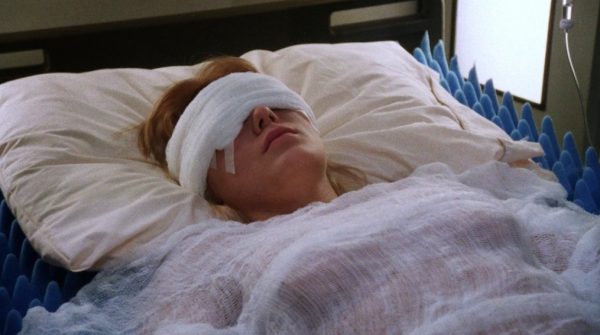
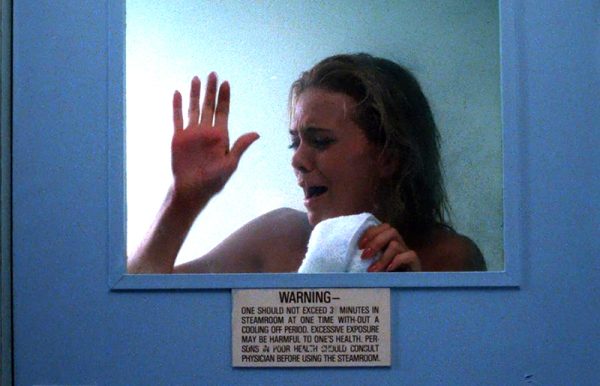
No one’s ever truly that freaked out that their gym is trying to kill people. After the shower scene, Michael comforts two women, and if they’re perturbed that the shower just came alive and tried to kill them, they hide their trauma well, as they respond to nearly dying by trying to get Michael to have a threesome with them. Michael, whose girlfriend has recently been blinded by the gym (“It’s not as bad as it looks,” said her doctor), flirts right back with the women. One interpretation of this behavior—and one that’s the biggest stretch—would be that Michael is just trying to spare himself a lawsuit.
This movie is a genuine oddity. Unlike top-tier “garbage-or-gold movies?,” e.g., Birdemic, this film can surprise us with surprisingly effective horror scenes. The special effects are actually disturbing and often appalling to look at. Take the flashbacks of the wife burning in a wheelchair—jarring shots, they are. When Dr. Moray finds a woman’s body fried to a crisp in the basement, it’s absolutely horrifying. It’s like something out of The Fly (1986). However, his subsequent death is completely ridiculous. He’s comically yanked into the air. Then his arm explodes like something out of Scanners (1981). Time and time again, we have flashes of genuine horror offset by the film’s “have-its-erotic-cake-and-eat-it-too mentality.” An odd juxtaposition that does a complete disservice to its strength as a graphic horror movie.
Contributing to this incongruous pairing of tones is the film’s soundtrack. Our introduction to the gym includes some of the tackiest scores ever heard on film. It’s not quite the Seinfeld (1989-1998) theme, but it’s not too far from it either.
As you probably guessed, levity is another off-kilter, hit-or-miss (mostly miss) aspect of this film’s oddness. It’s not often you’ll see a movie where a gorgeous woman strongly comes on to a man only to have the man call her an uggo piece of shit to her face. Or, in his words: “I’m Beta. You’re VHS.” Take that, loser.
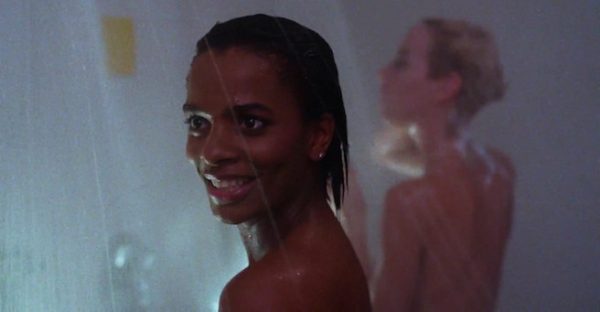
Does this movie hate women? It does spend most of the runtime objectifying them, so it’s not exactly empowering them. Why do we need a scene of women showering? It’s called “Death Spa,” not “Death Library,” you silly prude. One of the women even jokes about how they need to get some men in the shower with them. Some very convincing dialogue for women. Did Carrie Fisher write this? There’s no evidence this celebrated screenwriter had a hand in Death Spa, but there’s also no proof she didn’t. You make your own conclusions.
According to IMDb, extras in this shower scene were “obtained from a porn casting agency.” As per the oral history, the director, Michael Fischa, didn’t have the worst time filming this scene. The director of photography for Death Spa, Arledge Armenaki, says the shower scene was simple enough that it might have taken an hour to shoot. Not for the director of Death Spa. Armenaki goes on to say: “Michael was having the time of his life shooting this scene. He had 12 or so naked women that were beautiful models taking a shower in front of him, so we were shooting take after take after take. I think we were in there for about 3 hours and then finally Jamie Beardsley came in and said “that’s enough! Time to wrap this thing up!”
When it’s not being sexually charged, or even when it is, it’s a spectacularly weird film. Why would you throw a Mardi Gras party at a gym where people are getting maimed by the gym itself? And a better question: Why would you attend the party? But it’s this weirdness that acts as its saving grace. When the lawyer tries on his costume, modeling it for himself in front of a mirror, he does a little gesture like, “Ta-da!” The best part is he doesn’t appear to be doing it ironically or maniacally. He seems genuinely pleased with how he looks. Adorable. In another scene, the lawyer, messing with the electrical system at the gym, gets a nasty shock that he seems to shrug off.
The film just glides from wacko scene to wacko scene. And its quality of entertainment owes a lot to this. As mentioned, you’re not invested in this film for its groundbreaking plot. Having said that, while most of the film is fairly straightforward, the last 10% decides to get convoluted as all hell. Wait, the haunted gym can also manifest into human form? And it can shapeshift? What the fuck is going on? Was the writer coming down at this point and just wanted to finish writing so he could go to bed? Did they run out of money? All likely scenarios.
Are the creators satisfied with the end result? Or their work on the film? Not so much. As Beardsley puts it in the oral history: “By the end of making a film like this…you’re just dead. You’re done, you’re cooked, you’re over, it’s finished. You’re like: oh my god, I never want to see this film or any of these people again in my whole life. You know? And yeah, it was [sic] a rough. So I don’t know that I fought for it as much as I should have. You know? I mean, I wasn’t the only person, but I don’t think I did very well in that part of the movie. And I kind of, I don’t know, I kind of feel sad and kind of blame myself a bit now that you mention it. Thanks! Now I’m all depressed.”
Armenaki was at least fairly impressed with the making of documentary by Elijah Drenner: An Exercise in Terror: The Making of Death Spa. In the doc, the producer, Beardsley—which would also be a good name for Michael’s girlfriend—admits to being shocked by the film’s release. Although it is a bit unclear if she’s talking about the documentary or the film itself. At the premiere, Beardsley was taken aback to see a “line wrapped around the street,” which Beardsley assumed “must just be a bunch of homeless people.” Drenner states, “Jamie [Beardsley] just about shit her pants.” Elsewhere in the documentary, production coordinator David Reskin says about Death Spa, “It was a wonderful and horrible experience.”
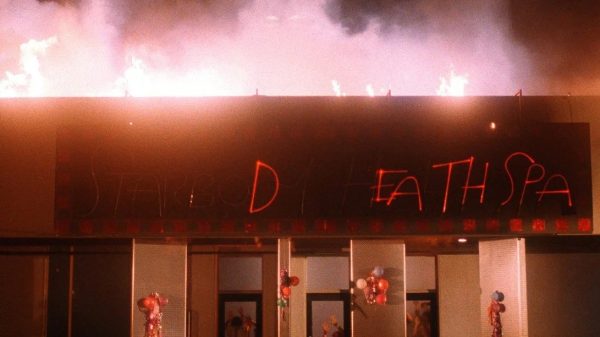
You can love this type of film for its idiosyncrasies. How many movies have you seen with characters shrugging off multiple people getting thrown through windows? Characters move past people crashing through a notoriously noisy material like someone hearing a car honking in the city. Death Spa is a film with disparate parts. One that intersperses weirdness with horniness and horrific special effects—a woman gets her hand stuck in a blender like something out of A Nightmare on Elm Street (1984); following this scene, the male detective gets killed by a reanimated fish. Even Peter Jackson couldn’t have sold this death scene.
If you smashed together Cronenberg’s horror aesthetics and American Horror Story’s (2011-) camp and hypersexuality, you might get something like Death Spa. It’s one of those comically nonsensical movies that makes itself so well-suited for one of Ryan George’s Pitch Meetings. It’s a movie that ends abruptly, at which point you’re not sure what the hell you just watched. But you’re glad that you did.
Jack Gayer
Originally published May 8, 2026. Updated May 9, 2026.