
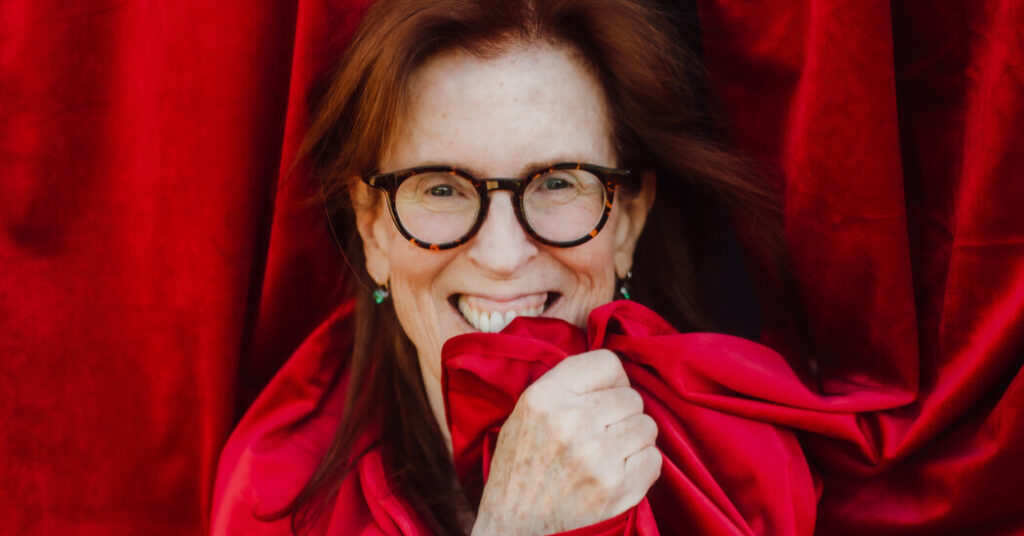
The title of the writer Pamela Redmond’s new one-woman show, “Old Woman Naked,” isn’t entirely metaphorical.
Redmond, 73, bares her soul in the 75-minute piece, which she will perform for the fourth time publicly on May 17 at the Broadwater Second Stage in Hollywood. She also appears fully nude at the end.
Redmond, the author of the novel “Younger,” which became a hit TV show, said she wasn’t thinking that “sex sells” when she wrote the play last year at her home in Los Angeles. “I’ve had three 10-pound babies, two surgeries, gained and lost the same 35 pounds at least 10 times,” she wrote recently in her Substack newsletter, the Jubilarian. “I haven’t had anything lifted or tucked, no fat sucked out of or injected into me.”
Nevertheless, she was motivated to stage what she called an act of “stealth feminism” by baring it all at an advanced age. The show, which she hopes will eventually be performed by a professional actor (her wish list includes Jessica Lange and Whoopi Goldberg), is also, she said, a rebuke of artificial intelligence.
Redmond, twice divorced and now single, had witnessed the popular baby-naming website she co-founded decades ago, Nameberry, reduced to near rubble after A.I. scraped its contents. The technology was also threatening to render pointless a “painful” three-year rewrite of a novel. “I thought, By the time I finish, A.I. is going to do the same thing, only better,” she said. “A.I. was eating my lunch.”
It didn’t have a body, though. She did.
“Figuring that out was my lightbulb moment,” she said. “The whole idea came to me in 15 minutes.”
“Old Woman Naked” tells the story of the permutations of Redmond’s body from puberty onward.
This interview has been lightly edited and condensed.
Your two sons and daughter, all adults, are not planning to see “Old Woman Naked.” Are they horrified?
They’re supportive of my creativity and my success, they just don’t want to see me naked. They don’t want to hear about my sex life. They don’t want to hear about my puberty experience. I respect that. But my two sons-in-law, my daughter’s husband and my son’s husband, have both been so encouraging. It’s not the same thing for them. I’m sure with their own mothers, they would be like, Ugh.
What about friends and colleagues? Did you worry what they would think?
No, my friends were always incredibly supportive. It’s strangers I think about. I have never written anything anywhere close to this personal. These are stories that I’ve never told anyone in my whole life. It’s like, do they think I’m weird? Are they feeling sorry for me?
A few of my friends have brought their husbands. I’m like, What are they thinking? People have told me they get so caught up in the story that by the time I’m naked, that’s not really what they’re thinking about. And they might be just being nice, but that’s kind of how I feel. By the time I’m naked, it’s like, this is the least of it, baby.
You describe yourself in a stage direction as “like Mister Rogers shrugging off his cardigan.” Do you feel as sexless as Mister Rogers in this role?
That’s a great question. The director said to me last night (before an L.A. performance), “Try to make the whole thing more of a striptease and have fun with it.” I don’t know if I succeeded in that, at least until I took off my red bra and threw it at my friend in the audience. But I start out wearing, like, five layers on top because I want to have the maximum number of things to take off. So I’m feeling very sexless until that bra comes off.
The show might bring to mind “The Vagina Monologues” for some. How do you think it compares?
“The Vagina Monologues” is a compendium of a lot of women’s experiences. And it’s very focused on this one body part. My show is about my experience over a lifetime in a female body, and some of those experiences are about sex, about my vagina, and a lot of them aren’t.
The recent Broadway show “Liberation” had nude women of all ages onstage. Are older women’s bodies having a moment?
Yeah, it’s definitely a cultural phenomenon right now. It’s like, Oh yeah, we’re going to take menopause seriously now.
You say at one point in the play that you and many of your friends don’t remember much about the consensual sex you had as younger women, only the date rapes. Then you answer your own question about why some of them didn’t speak up. “Ultimately,” you say, “I’d rather do something I didn’t want to do than say something I didn’t want to say.” Why is it so hard to say things we don’t want to say?
I think a lot of women feel that if they speak up, they’re told, don’t say that, don’t feel that. I remember as a kid my mother used to call me Sarah Bernhardt, meaning, “you’re so sensitive, why are you making a big deal about this?” It just feels safer and easier to have the sex than to confront a guy with, “Oh, I don’t like you anymore and I want to leave.” Which has historically been a very dangerous thing for women to do.
You talk about your use of GLP-1 drugs and your recent weight loss. How much weight did you lose?
Fifty-five pounds.
Would you have performed the show if you hadn’t lost the weight?
You know, probably not. I have this whole passage where I talk about this endless yo-yo diet of gaining and losing the same 30 or 40 pounds. When I lost the weight, it was the first time that it felt easy. When I got down below 150, which I hadn’t been since I was in my 20s, I asked the doctor, “Well, how much more should I lose?” And he said, “What do you want to weigh?”
That was the first time I had even asked myself that because I thought that what I wanted to weigh and what it was possible to weigh were two different things. At first, I said, “I don’t know.” And then I thought, No, I do know what I want to weigh. I want to weigh 137 pounds because that’s what I weighed when I was young. I feel like my young, beautiful self at that weight, I guess, and not a compromise self.
What are your thoughts about the body-positivity movement?
I think for women in their 20s, it doesn’t matter how much the fashion industry or magazines or ads or movies talk about body positivity. Celebrities are thinner than ever. At that age, you can’t help but compare yourself. You’re in this world that’s telling you, “Oh, it’s not cool to want to be thin. You’ve got to be body positive.” And at the same time, everything you’re seeing is contradicting that. That’s hard.
Women in their 30s and 40s are dealing with this whole “better body after baby,” Kylie Jenner stuff, and I’m like, Thank God this wasn’t a thing when I was having kids. We all felt like it was OK to stop worrying about what size your jeans were or whatever. I live in L.A. I see women pushing their strollers in spandex and walking really fast. And I’m like, Give it up, babe.
There is a line in your description about sexuality enduring. Often, the cultural narrative is that sexuality fades and is replaced by wisdom. Are you rejecting wisdom in favor of desire?
You know, I think that’s just another version of the smart vs. pretty dichotomy that I hope we don’t accept anymore. Why do I have to pick? I refuse to pick.
You say female bodies are often hilarious. Is the comedy in the show a way of making the nudity more palatable for an audience that might otherwise be too uncomfortable to look?
Yeah, it’s definitely a deliberate deflection of the experience of getting completely naked. A real thing happened at the gym as I was writing — in the locker room, I was taking off my clothes and feeling all proud of representing naked, old women for the world, and a little kid saying to her mom, “Why does that lady have wrinkles on her butt?” That, I increasingly believe, was a gift from the goddess. It’s hilarious and totally brought me down to earth. And it gives the audience permission to laugh.
What do you think is the funniest part of a body, or the funniest thing about nudity?
The funniest thing about nudity? Well, I have to say, penises are a lot funnier than anything on a woman’s body.

Tammy LaGorce
Styles contributor
I asked Pam if the show is a reaction to how A.I. is backing us into a corner — if we basically have to get naked to be real with each other now. She told me that while the play takes it to an extreme, we, as a culture, need to get better at talking openly about our bodies. This seems like a good step in that direction.
Read all comments