
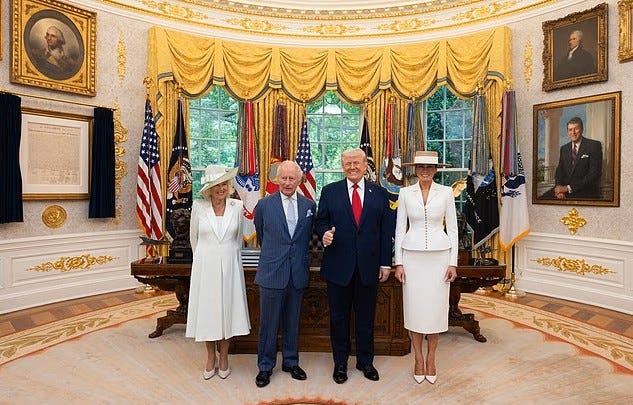
 King Charles and Queen Camilla with President Donald J. Trump and First Lady Melania Trump in the President’s newly gilded Oval Office, April 27, 2026
It was, Queen Camilla said, a “whirlwind”— four days in Washington, New York City, and the countryside of Virginia. The first two days of the King and Queen’s visit in the nation’s capital—intended by the British government to temper a fraught relationship between President Donald Trump and British Prime Minister Sir Keir Starmer—surpassed expectations and avoided political tripwires. Charles and Camilla charmed their way across the political spectrum (although no Democrats were invited to the State Dinner in the White House East Room).
I have watched Charles speak in large formal settings, such as meetings of Commonwealth leaders, and in small private gatherings for his charities. He has invariably been eloquent, alternately serious and witty, often speaking without notes. But I had never seen him speak when the stakes were as high as they were before a joint session of Congress—only the second British monarch to do so after his mother, Queen Elizabeth II, addressed American legislators in 1991.
 Charles and Camilla leaving the House Chamber in the U.S. Capitol following his address to a joint session of Congress, April 28, 2026
“The harmony and essential diversity of Nature”
It turned out to be his best and most consequential speech, earning a dozen bipartisan standing ovations as well as bursts of laughter. He handled divisive issues with finesse, delicately emphasizing the importance of institutions and policies questioned by Trump, among them the value of NATO and support for defending Ukraine against Russia. He effectively highlighted the historic bond between Britain and the United States for more than four centuries that has been underpinned by democratic values. Although written in collaboration with the Labour government, the speech touched on some of Charles’s personal priorities— interfaith dialogue, “the disastrously melting icecaps of the Arctic,” and “the harmony and essential diversity of Nature.” King Charles proved himself a masterful diplomat, winning plaudits from both sides of the aisle.
Beyond Trump’s effusive praise for Charles (“the greatest King in my book” … “an elegant man” with a “beautiful accent” whose speech “got the Democrats to stand. I’ve never been able to do that.”), there was no guarantee that the good feelings would extend to the British government. The biggest winner was the monarchy itself, with a boost in respect and admiration for the King and Queen. It could not have come at a better time, shifting the world’s attention from the behavior of Andrew Mountbatten-Windsor and Prince Harry and his wife Meghan Markle.
“Back slapping, hand clutching”
King Charles probably knows the United States better than most Americans. He has numerous America friends and has found inspiration for his charities and initiatives from American ideas. In his address to Congress, he remarked that this was his 20th visit to the United States, although it was actually his 24th, beginning with a brief stop in Los Angeles in March 1970 that prompted him to complain in a letter to a friend about “back slapping, hand clutching and endless speechifying” by California politicians. Four years later he returned to the West Coast and began a romance with an American admiral’s daughter that I described in a Royals Extra titled When Charles Met Laura Jo on July 26, 2024.
As Prince of Wales, he made five visits in the 1970s, nine in the 1980s, four in the 1990s, three in the aughts, and two more in 2015 and 2018. He honored the memories of President Reagan and President George H.W. Bush by attending their funerals in 2004 and 2018. By contrast, over his lifetime Charles has made fewer trips to the two largest Commonwealth realms where he serves as head of state—Canada 20 times and Australia 17 times.
Her cicerone for that trip
America has also been a welcoming haven for Camilla. A November 19, 2023 Royals Extra titled An Important Moment for Charles and Camilla That the Crown May Overlook, recounted that in 1999 New York City was the first place she traveled to in an effort to build public acceptance when she was emerging from the shadow of Princess Diana’s death. Her cicerone for that trip was none other than Scott Bessent, who a quarter century later would become Donald Trump’s Secretary of the Treasury.
In studying the events of this past week, I found additional personal connections that I’ll describe below, starting with the special American friends who greeted the King and Queen affectionately at the garden party given by British Ambassador Sir Christian Turner only hours after their arrival in Washington on Monday April 27.