
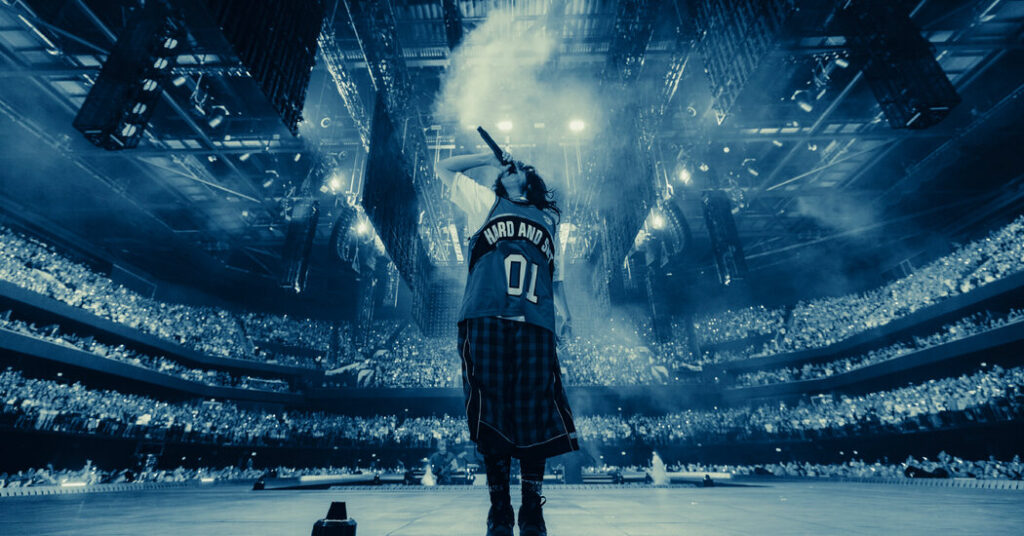
When Billie Eilish’s mother told her that the “Titanic” and “Avatar” director James Cameron wanted to direct a 3-D concert movie starring the pop star, the singer’s first reaction was incredulous: “What the hell are you talking about?” she recalled saying. “He emailed you himself? Like, James Cameron at Gmail?”
Then she considered the filmmaker’s pitch. “It was also, ‘Wow, what an incredible idea,’” Eilish, 24, said in a recent video interview alongside the Oscar winner. “Something no one had ever thought of before that — not my team, not anybody I had ever heard of.”
Cameron, 71, came up with the idea while “playing hooky” from finishing “Avatar: Fire and Ash,” released last year; he had been following Eilish’s concerts supporting her 2024 LP “Hit Me Hard and Soft,” and admiring the “Birds of a Feather” hitmaker’s emotional connection with her fans. “I didn’t even tell the studio I was gone. I just snuck out,” he said. “I went and made another movie before anybody noticed.”
The two agreed to collaborate on “Billie Eilish — Hit Me Hard and Soft: The Tour (Live in 3D),” in theaters including IMAX screens on Friday, which captures Eilish’s July 2025 shows in Manchester, England, supplementing footage of the singer whooshing around the stage with star and fan interviews. It’s one of many concert-focused docs in theaters and on streaming services in recent years, including Taylor Swift’s “The Eras Tour — The Final Show,” “Harry Styles. One Night in Manchester” and “Carole King & James Taylor: Just Call Out My Name.”
“It’s a new beginning for those kinds of films,” said Frank Marshall, who directed “Just Call Out My Name” as well as earlier, more traditional music documentaries about the Bee Gees and the Beach Boys. “It’s a fantastic experience to be in a big movie theater with great sound and a big picture and experiencing a concert again. It’s different than a regular narrative feature documentary.”
To make “Hit Me Hard and Soft,” Cameron set up 17 moving cameras in different positions throughout the stage Eilish designed with her team that placed her in the middle of the arena floor. She was reluctant at first to distract her audience with a filmmaker following her with a hand-held 3-D camera, but she and Cameron agreed one of her existing camerapeople could do the job.
They shot over four concerts — Eilish has joked about repeatedly wearing the same outfit, a personalized basketball jersey, knee-length shorts, high-top sneakers, racing gloves and a baseball cap — and the movie depicts both Eilish’s galloping energy over 29 songs and the sharpness of her light-blue eyes.
Eilish’s Hit Me Hard and Soft: The Tour was a grand spectacle featuring complex lighting cues and a massive cube festooned with LED lights. The film captures the elaborate staging, alongside intimate moments, like Eilish directing her fans to be silent while she overlaid her own vocals in the spare ballad “When the Party’s Over.”
An initial challenge was getting two “very opinionated, strong-willed perfectionists,” as Eilish called herself and Cameron, to relinquish control and collaborate. The pair quickly figured out how to listen to each other.
“We both allowed someone else to be sharing the driver’s seat,” Eilish said. “We started to see each other’s point of view, which was really eye-opening.”
Early on, Cameron showed Eilish a cut of the opening song, the 2024 ballad “Chihiro,” which he’d spent seven hours putting together. “You were like, ‘This is never going to work.’ We’ve got 29 songs. Literally, the math didn’t pencil out,” Cameron said, addressing Eilish. “And I said, ‘It’s OK. The important thing is for me to start to see it through your eyes.’”
The film contains behind-the-scenes and making-of details, including Eilish being secretly delivered onto the stage inside a road case rolled through the audience, and addressing fans from a window in the venue with a makeshift cardboard “I love you” sign. Cameron conducted interviews with Eilish and her fans, and as he immersed himself in her perspective, he came to understand the film’s central themes.
One is Eilish as bespoke pop star, relying on her songwriting and performance talents rather than “showing more of my body,” as she says in the film. Another is fans’ appreciation of this approach. One interviewee tells Cameron he was “going through a tough time” and Eilish “made me feel like I had a safe space.” During one of her interviews with Cameron, Eilish displays her hands, scarred from fans reaching out.
To prep for the film, Cameron attended two Eilish shows in Melbourne, Australia, observing how the singer — onstage with two backup singers, a small band and a special guest, her brother and musical partner, Finneas — seemed to speak to everybody. “It’s this enormous venue, and they all feel so closely connected to you,” he said. “How do we capture that feeling?”
Concert documentaries — films focusing on an artist’s live show, as opposed to biography and history with expert interviews — first appeared in theaters as classical-music performances in the ’40s, then took off during the rock era. Martin Scorsese documented the Band’s “The Last Waltz” finale in 1978 and Jonathan Demme memorably captured Talking Heads onstage in 1984’s hit “Stop Making Sense.” As VHS tapes took off in the ’80s and ’90s, bands including Metallica and Depeche Mode sold concert videos to fans, which continued into the DVD and streaming eras.
“The thing that’s shifting is these shows need to feel more like a moment,” said Guy Carrington, a partner with Done+Dusted, which produced “BTS: The Comeback Live,” the K-pop stars’ recent Netflix livestream. “A simple concert film isn’t enough.” These films often supplement live footage with past and present interviews. “It feels like you’re at a show, but there are so many more stories going around it,” added Tom Mackay, president of Sony Music Vision, one of the production companies that worked on Baz Luhrmann’s film “EPiC: Elvis Presley in Concert,” shown in theaters throughout 2026. “It takes that definition of a concert film and enhances it.”
Cameron’s goal was simple. “We were just going to basically be surveillance cameras,” he explained. “It’s not like one of those conceits where, ‘OK, I’m Martin Scorsese, and I’m going to start at the beginning of the Stones tour, and hit all these amazing behind-the-scenes moments.’ That wasn’t the gig,” he said. His film with Eilish “is not the story of the whole tour. It’s the story of the day-of.”
“Shoot the show,” Eilish interjected.
“Shoot the show,” Cameron agreed. “Then we started getting creative around the fan relationship. You work so hard to create the intimate connection with everybody in that room. Once we started to realize that’s what it’s about, what emerged was something that has a little more emotional and psychological depth to it.”
The film sums up this adjusted mission statement with an interview in its final moments. Cameron asks an attendee, “So, how did you like the show?” The fan responds by sobbing uncontrollably.